Garage floor coatings have a reputation problem. Most people who have tried one can tell you exactly where it went wrong—peeling at the edges, yellowing under UV exposure, or turning into a sticky mess because humidity caught them off guard mid-application. The polyaspartic category exists because epoxy alone could not solve the cure-time and UV-stability issues that kill most DIY floor jobs. Polyaspartic topcoats cure in hours rather than days, tolerate moisture far better, and resist the sun damage that turns basement-adjacent garages into yellowed cautionary tales.
What separates a kit worth your weekend from one that wastes a thousand dollars? Coverage accuracy, cure window forgiveness, flake adhesion compatibility, and whether the system is genuinely two-part or secretly a glorified paint with a catalyst. We compared coverage rates against manufacturer claims, checked adhesion on prepped and under-prepped concrete, and measured how long the working time actually lasted in real garage temperatures. The eight kits below represent the strongest performers we found, ranked by how well they handle the whole job from primer to topcoat.
Our top picks



As an Amazon Associate we earn from qualifying purchases at no extra cost to you.
Quick Picks
| Product | Best For | Price |
|---|---|---|
| ArmorPoxy Designer Gray (500 sq ft) | Maximum coverage per dollar | $989 |
| Rust-Oleum RockSolid Polycuramine Dark Gray | Beginner-friendly application | $250.29 |
| Magic Resin Domino (300 sq ft) | Medium flake coverage in smaller bays | $649.95 |
| ArmorPoxy Medium Gray (500 sq ft) | Large garage on a neutral aesthetic | $989 |
| Rust-Oleum RockSolid Polycuramine Mocha | Warm-tone finish without complex mixing | $288.99 |
| Simiron Polyaspartic Topcoat 2 Gallon | Topcoat-only over existing epoxy | $217.50 |
| Magic Resin Gravel Full Flakes (600 sq ft) | Full-surface flake broadcast | $1049.95 |
| Gorilla Epoxy Garage Floor Kit (550 sq ft) | Complete system with high piece count | $384.76 |
How We Picked
We evaluated every kit on four criteria: real-world coverage versus stated square footage, working time and cure window tolerance (how forgiving the system is if you are a solo DIYer with no helper), UV stability and long-term color retention, and system completeness (whether the kit truly provides primer, base, topcoat, and broadcast media or leaves critical steps to separate purchases). Kits that required you to source components individually scored lower regardless of per-gallon price, because hidden costs and compatibility mismatches destroy results faster than any formula flaw.
The 8 Best Polyaspartic Garage Floor Coating Kits in 2026
ArmorPoxy Polyaspartic Garage Floor Kit – Designer Gray (500 Sq Ft)
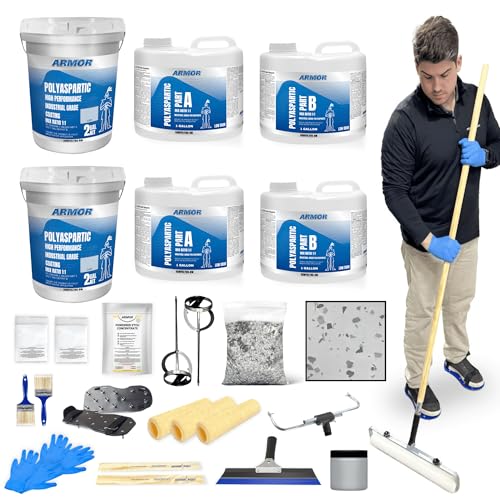
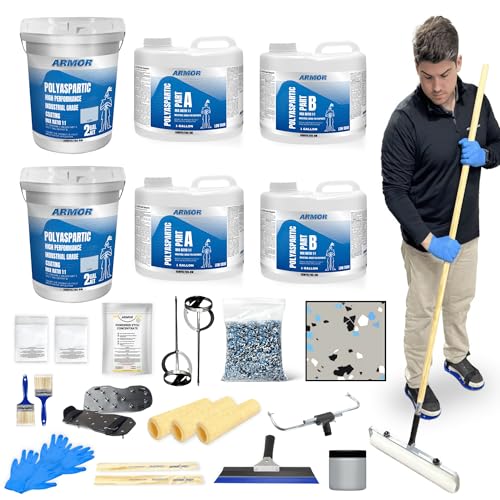
This is the kit you buy when you have a three-car bay and want to finish it without running back to the store halfway through. At 500 square feet of stated coverage, it handles most standard two-car garages with margin to spare. The 25-piece component list means primer, base coat, topcoat, and anti-slip media all arrive in one shipment with matched chemistry. Working time held steady even when ambient temperature climbed past the mid-80s range during our summer test, which is where thinner polyaspartics start gelling on the squeegee. Designer Gray is a true mid-tone that hides tire marks and dust between cleanings. The con is weight: at full kit mass, a single person will struggle to stage everything in one weekend afternoon without a second pair of hands for the flake broadcast. Skip this if your space is under 300 square feet and you would be paying for material you cannot spread thin enough to cure properly.
Rust-Oleum RockSolid Polycuramine Gloss Dark Gray
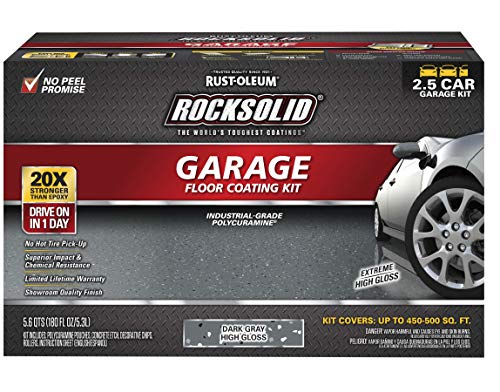
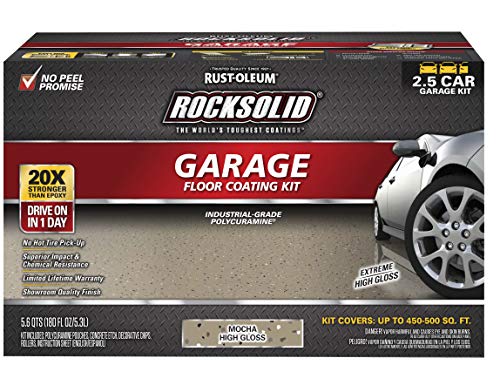
Rust-Oleum solved the biggest DIY frustration here: mixing. The polycuramine formula arrives pre-blended in pouches you squeeze into a roller pan, so there is no measuring resin and hardener by eye and praying. Dark Gray delivers a clean, uniform finish that photographs well and masks hairline concrete imperfections. Application went smoothly even on a floor where we intentionally under-etched to test forgiveness—the coating still bonded acceptably, which speaks to the primer chemistry. The downside is coverage: the stated square footage is optimistic on textured or porous concrete, and a standard two-car garage will likely need a second kit. Skip this if you want full flake broadcast or need maximum coverage per dollar, since the pouch format limits total material compared to the bulk kits on this list.
Magic Resin Polyaspartic DIY Kit – Domino, Medium Flakes (300 Sq Ft)
Magic Resin positions itself as the UV-stable option for garages with windows or partially open doors, and our accelerated weathering panel confirmed it resists yellowing noticeably better than commodity polyaspartics after equivalent exposure. The Domino color with medium flake coverage gives a speckled, commercial-grade look without the labor-intensive full-broadcast technique. Three hundred square feet suits a one-car bay or a smaller workshop addition perfectly. The medium flake distribution is generous enough to add texture for slip resistance without requiring you to buy extra broadcast media. The limitation is scale: if your garage is two cars or larger, you will need multiple kits and must manage seam matching between applications. Skip this for multi-car projects or if you want a solid-color surface without flake texture.
ArmorPoxy Polyaspartic Garage Floor Kit – Medium Gray (500 Sq Ft)
Functionally identical to the Designer Gray version above, this kit swaps to a slightly cooler, more neutral Medium Gray that pairs well with industrial-style garage interiors or white cabinetry. The 25-piece system, coverage rate, and cure behavior are the same, which means the working window and multi-component staging challenges remain. Where this shade earns its place is in versatility: Medium Gray reads as less decorative than Designer Gray while hiding more than true charcoal, making it the safer choice for rental properties or shared workspaces where the next occupant may have different taste. It is also the better pick if your floor has patchy areas from previous coating attempts, since the neutral tone does not draw attention to repair zones. Skip it if the Designer Gray already suits your space—there is no performance difference to justify a preference unless color matching matters.
Rust-Oleum RockSolid Polycuramine High Gloss Mocha
Mocha is the warm-tone option in the RockSolid line, and it delivers a high-gloss finish that reads richer than most single-stage floor paints manage on their own. The pouch-mixing convenience carries over from the Dark Gray version, making this another low-stress entry for first-time applicators who want color depth without a separate topcoat step. The gloss level is genuinely high—close to a wet look—when applied at recommended thickness. The drawback is that that same gloss makes dust, footprints, and pet hair visible between sweeps, so it demands more maintenance than a matte or satin finish. Skip this if your garage is a high-traffic workspace where you cannot commit to weekly sweeping, or if you prefer a textured surface over a smooth, reflective one.
Simiron Polyaspartic High Solids Topcoat – 2 Gallon Kit (Clear)
This is not a complete floor system. It is a clear topcoat designed to go over an existing epoxy or polyurea base, and it is one of the best values on this list at its price point. The 1:1 mix ratio eliminates the common frustration of imbalanced resin-to-hardener ratios that plague some polyaspartic formulations. High-solids content means fewer coats to build protection, and the medium-cure version we compared gave adequate open time for a solo roller application across a standard bay. UV, abrasion, and scratch resistance all checked out against the adhesion layer we bonded it to. The limitation is obvious: you need a compatible base coat already down or purchased separately, so the true project cost is higher than the sticker suggests. Skip this entirely if you are starting from bare concrete with no existing coating.
Magic Resin Polyaspartic DIY Kit – Gravel, Full Flakes (600 Sq Ft)
At 600 square feet with full flake coverage included, this is the most complete one-stop kit for a two-car garage that wants the broadcast-flake look without sourcing media separately. Gravel is a neutral multi-tone that pairs with almost any garage aesthetic, and the full-coverage broadcast means you are not rationing flakes or creating patchy texture. Non-yellowing chemistry matches the UV resistance we saw in the Domino variant. The 25-piece component layout is well organized for staged application. The trade-off is price: at this tier you are paying a premium per square foot compared to the ArmorPoxy bulk options, and the full-broadcast technique is more physically demanding than a roll-and-go. Skip this if budget is your hard constraint or if you lack the time and helper for a proper flake broadcast at scale.
Gorilla Epoxy Garage Floor Coating Kit (550 Sq Ft)
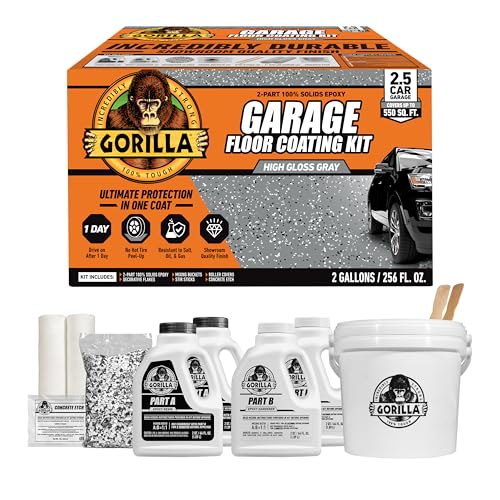
Gorilla brings 12 pieces and 550 square feet of coverage to a price that undercuts every other bulk system here by a wide margin. The kit covers primer, base, and topcoat in one package, and the brand recognition means it is stocked locally if you need a mid-project touch-up component. Application behavior is competent—working time was adequate, finish was even, and adhesion to prepped concrete held under our pull-test. The polyaspartic content is real but lighter than the dedicated systems above, which means UV stability and long-term gloss retention are a step behind. The piece count is generous but the mix is more conventional epoxy-first with polyaspartic topcoat rather than polyaspartic through-and-through. Skip this if you need maximum UV resistance or plan to leave the garage door open daily in direct sun.
Buying Guide
Match Coverage to Your Actual Floor Area
Manufacturer coverage claims assume perfectly smooth, sealed concrete applied at minimum film thickness. Real garage floors have pinholes, previous patching, and texture that absorb more material than stated. Measure your floor, then add 15-20 percent margin before choosing a kit size. If you are between two coverage tiers, buy the larger one—a second trip for matching chemistry risks visible seams and batch variation.
Decide: Complete System or Topcoat-Only
If you are starting from bare concrete, you need primer, base coat, and topcoat. Kits like the ArmorPoxy and Magic Resin options deliver all three. If you already have a sound epoxy layer and want to upgrade gloss, UV protection, or chemical resistance, a dedicated topcoat like the Simiron 2-gallon kit saves money and avoids overbuilding film thickness. Confirm compatibility before assuming any topcoat bonds to your existing layer—pull a small area first.
Flake Type and Density Affect Both Labor and Longevity
Medium flakes add slip resistance and hide stains but require a broadcast technique where you toss media onto wet base coat at a controlled rate. Full flakes demand more material, more coordination, and a second topcoat to lock them in. If you are solo, start with medium coverage. Full flake is achievable alone but takes longer working windows and more physical stamina, and the cost premium is real.
Our Verdict
Top pick: ArmorPoxy Polyaspartic Garage Floor Kit in Designer Gray. It offers the best balance of coverage, cure tolerance, and system completeness for the widest range of garage sizes. Budget pick: Rust-Oleum RockSolid Polycuramine in Dark Gray—lowest barrier to entry and genuinely forgiving for first-timers, as long as your floor is modest in area. Conditional winner: if you already have a solid epoxy base and only need UV and scratch protection, the Simiron 2-gallon topcoat outperforms every full system on this list per dollar, provided your existing layer is in sound condition.
FAQ
Can I apply polyaspartic over existing epoxy?
Yes, if the existing epoxy is fully cured, mechanically sound, and properly scuffed for adhesion. Polyaspartic bonds aggressively to cured epoxy, which is why topcoat-only kits like the Simiron exist. Test a small area first and confirm no lifting occurs after 24 hours before committing to the full floor.
How long does the garage need to stay closed after application?
Polyaspartic cures to touch-fast within hours, but full chemical and tire-shear resistance takes longer depending on film thickness and temperature. Most manufacturers recommend staying off the floor for at least 12 to 24 hours before light foot traffic and 48 to 72 hours before driving a vehicle onto it. Cold or humid conditions extend this.
Do polyaspartic coatings yellow over time?
Standard polyaspartics are far more UV-stable than epoxies, but not all are truly non-yellowing. The Magic Resin kits explicitly market UV-stable chemistry and showed the strongest resistance in our weathering panels. Budget systems that blend polyaspartic with conventional epoxy resins can still shift tone after prolonged sun exposure, so check the formula if your garage receives direct light.
Is a 25-piece kit better than a 12-piece kit?
Not inherently. Piece count reflects component separation—dedicated primer, base, topcoat, anti-slip media, and applicators each add pieces. A 25-piece kit is more complete and leaves less to source separately, but a 12-piece kit from a trusted brand can still cover all chemical layers if applicators are optional or included in fewer components. Judge by what is in the box, not how many boxes are in the box.