Key takeaways
- Pro: Zero software setup on your phone after insertion.
- Pro: Hotspot lets you protect a laptop simultaneously without a second VPN subscription.
- Con: Requires a SIM-unlocked phone; no option for eSIM-only devices.
Travellers heading to mainland China face a specific connectivity problem: the Great Firewall blocks Google, WhatsApp, Facebook, Instagram, and most Western services by default. A reliable VPN solves this, but the category is crowded with services that look identical in marketing copy while behaving very differently once you land in Shanghai or Shenzhen.
This roundup covers eight products that address that problem from different angles. Two are traditional VPN subscriptions; three are prepaid data SIM cards or eSIMs that route traffic outside China entirely, eliminating the need for a VPN; two are eSIM plans with unrestricted access baked into the network path; and one is a Spanish-language travel guide that walks through VPN selection, mobile payment setup, and app provisioning before you board. We compared published specs, listed prices, and aggregate owner feedback to separate genuinely functional options from those that collect subscriptions and deliver dead tunnels.
As an Amazon Associate we earn from qualifying purchases at no extra cost to you. Product prices and availability are accurate as of the date shown and are subject to change.




Quick Picks
| Product | Best for | Price |
|---|---|---|
| Prepaid SIM 10GB 15-Day | Short trips, no VPN hassle | $17.09 |
| Prepaid SIM 10GB 30-Day | Extended stays on a budget | $17.13 |
| China Unicom 5G 20GB | Local number with voice and text | $32.88 |
| ExpressVPN | Full-time VPN coverage | n/a |
| Prepaid eSIM 10GB 12-Day | Lowest-cost data-only entry | $12.19 |
| Asia-Pacific eSIM 20GB | Multi-country itineraries | $28.18 |
| Prepaid eSIM 15-Day Unlimited | Heavy data users on medium trips | $28.49 |
| Viajar a China sin miedo | Spanish-speaking first-time travellers | $13.99 |
How We Picked
We evaluated each product against four criteria: reliability of unrestricted access while physically in mainland China, total cost of ownership for a typical trip length, setup friction for non-technical travellers, and whether the solution works on both phones and laptops. Products that require you to install and maintain a separate VPN on every device scored lower than those with routing handled at the network layer.
The 8 Best VPN For China in 2026
Prepaid SIM Card 10GB 15 Days
A physical SIM delivering 10GB over fifteen days across mainland China, Hong Kong, Macau, and Taiwan on 5G or 4G LTE with hotspot sharing. No VPN installation is needed because traffic routes through an unrestricted gateway.
- Pro: Zero software setup on your phone after insertion.
- Pro: Hotspot lets you protect a laptop simultaneously without a second VPN subscription.
- Con: Requires a SIM-unlocked phone; no option for eSIM-only devices.
Skip it if your trip exceeds fifteen days or if your carrier locks the phone.
Prepaid SIM Card 10GB 30 Days
The same hardware and routing model as the fifteen-day variant, extended to a full month. At $17.13 it costs four cents more for double the window, making it the default pick for anyone staying over two weeks.
- Pro: Same no-VPN-required architecture as its sibling.
- Pro: One SIM covers Greater China, useful for multi-city trips crossing borders.
- Con: 10GB may run short for heavy video streaming or large file transfers.
Not ideal if you need voice minutes or a local number for ride-hailing apps.
China Unicom SIM Card 5G 20GB
A genuine local carrier product bundling 20GB of data with 300 minutes of talk and 300 texts. Unlike the prepay options above, this gives you a domestic number, which matters for WeChat verification and hotel bookings.
- Pro: Voice and text included, enabling full local app functionality.
- Pro: Access to China Unicom’s native 5G network, typically faster than roaming paths.
- Con: Does not bypass the firewall; you still need a separate VPN on top.
Best suited for business travellers who need a working local number more than unrestricted browsing.
ExpressVPN
A subscription-based VPN with dedicated obfuscation servers designed to function behind the Great Firewall. Unlike the data-SIM options, it protects every application on every device that has the client installed.
- Pro: Encrypts traffic on desktop, tablet, and phone without carrier cooperation.
- Pro: No data cap; useful for long stays or high-volume use.
- Con: Must be installed and active before arrival; connecting from inside China for the first time is unreliable.
Pass if you want a set-and-forget solution and prefer not to juggle SIM logistics.
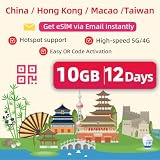
Prepaid eSIM 10GB 12-Day
The cheapest entry point in this list at $12.19. A QR code delivers a 10GB eSIM valid for twelve days across Greater China on 4G LTE, with hotspot permitted and no contract.
- Pro: Lowest price of any product here; instant digital delivery.
- Pro: No physical SIM swap, so your primary number stays active.
- Con: Twelve-day window is tight for longer itineraries; requires an eSIM-compatible phone.
Skip if your device lacks eSIM hardware or your trip runs past twelve days.
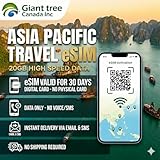
Asia-Pacific eSIM 20GB
An eighteen-country eSIM with 20GB that explicitly advertises unrestricted access to Google, Facebook, and WhatsApp inside China without a separate VPN. The multi-country coverage makes it the strongest single-product choice for a regional tour.
- Pro: Covers China, Japan, Korea, Singapore, Thailand and twelve more under one plan.
- Pro: Larger 20GB allowance than most single-country competitors.
- Con: Higher price than single-country options; not worth it if you stay only in China.
Best value when your itinerary spans three or more Asia-Pacific destinations.
Prepaid eSIM 15-Day Unlimited
Unlimited 4G LTE data for fifteen days across mainland China, Hong Kong, Macau, and Taiwan, delivered by QR code with hotspot support. The “unlimited” allowance removes the anxiety of mid-trip data exhaustion.
- Pro: No data cap to monitor, ideal for navigation, translation, and streaming.
- Pro: Hotspot allowed, so a laptop gets unrestricted access too.
- Con: “Unlimited” plans may throttle after a fair-use threshold during congestion.
Choose this when you cannot risk running out of data in a city with no convenient top-up path.
Viajar a China sin miedo
A Spanish-language practical guide for travellers from Spain and Latin America covering mobile payments, VPN selection, app provisioning, and itinerary tips for independent travel in China in 2026.
- Pro: Fills the knowledge gap that causes most first-time traveller problems: Alipay setup, WeChat registration, and pre-trip VPN installation order.
- Pro: Explains when an eSIM replaces a VPN and when you still need both.
- Con: Not a connectivity product itself; you still need one of the options above.
Pair it with any data-SIM or eSIM from this list for the most complete preparation.
Buying Guide
Network Path vs. Software Tunnel
The critical distinction in this category is whether your unrestricted access comes from the carrier network (SIM and eSIM products) or from an encrypted tunnel running on your device (ExpressVPN). Carrier-routed solutions require zero software maintenance but only work on the device holding the SIM. Software tunnels cover every device but demand correct installation before you cross into the firewall zone. If you travel with a laptop, a phone-tethered hotspot from an unrestricted SIM is simpler than running a VPN client on the laptop.
Data Volume and Trip Length
Ten gigabytes covers roughly a week of moderate use: maps, messaging, occasional video. Fifteen to twenty gigabytes handles a full two-week trip with streaming. Unlimited plans remove the guesswork but often throttle above undisclosed thresholds during peak congestion. Match your purchase to your actual usage pattern rather than defaulting to “unlimited” out of anxiety.
Device Compatibility and eSIM Support
Physical SIM products require an unlocked phone with a free SIM slot. eSIM products need a device that supports dual SIM or eSIM provisioning, which includes most phones released in the last several years but excludes some budget and carrier-locked models. Verify your device supports eSIM before purchasing a digital plan; you cannot return a QR code once it is activated.
Our Verdict
The top overall pick is the Asia-Pacific eSIM 20GB at $28.18, because it eliminates the VPN layer entirely while covering a wide itinerary. The budget pick is the Prepaid eSIM 10GB 12-Day at $12.19, the lowest cost of unrestricted access available. However, if you need a local phone number for WeChat verification or hotel reservations, the China Unicom 5G SIM at $32.88 wins on that single dimension, provided you run ExpressVPN alongside it for web access.
FAQ
Do I still need a VPN if I use one of these SIM or eSIM cards?
No. The SIM and eSIM products in this list route your traffic through a gateway outside mainland China, so blocked apps open normally without any VPN software installed.
Can I set up a VPN after I arrive in China?
Almost never reliably. Most VPN websites and app stores are blocked once you are inside the firewall, so you must install and verify the connection before departure. Carrier-routed SIMs and eSIMs avoid this chicken-and-egg problem.
Is the prepaid eSIM hard to activate?
Activation is a matter of scanning a QR code in your phone’s cellular settings. The process takes under two minutes, but you need Wi-Fi access on arrival to complete it unless you already have a working data connection.
Which option works if my phone is carrier-locked?
None of the physical or eSIM products will function on a locked device. Your only viable route is ExpressVPN, installed before you leave, assuming the client is already present on your phone and laptop.