Key takeaways
- Check dishwasher and cabinet handle collisions in a corner kitchen with a measurement worksheet, movement checks and an installer handoff.
A dishwasher can fit its cabinet opening and still collide with a neighboring drawer handle. In a corner kitchen, check the dishwasher door, its handle, adjacent fronts, and the space used while unloading. The opening width alone does not describe those moving parts.
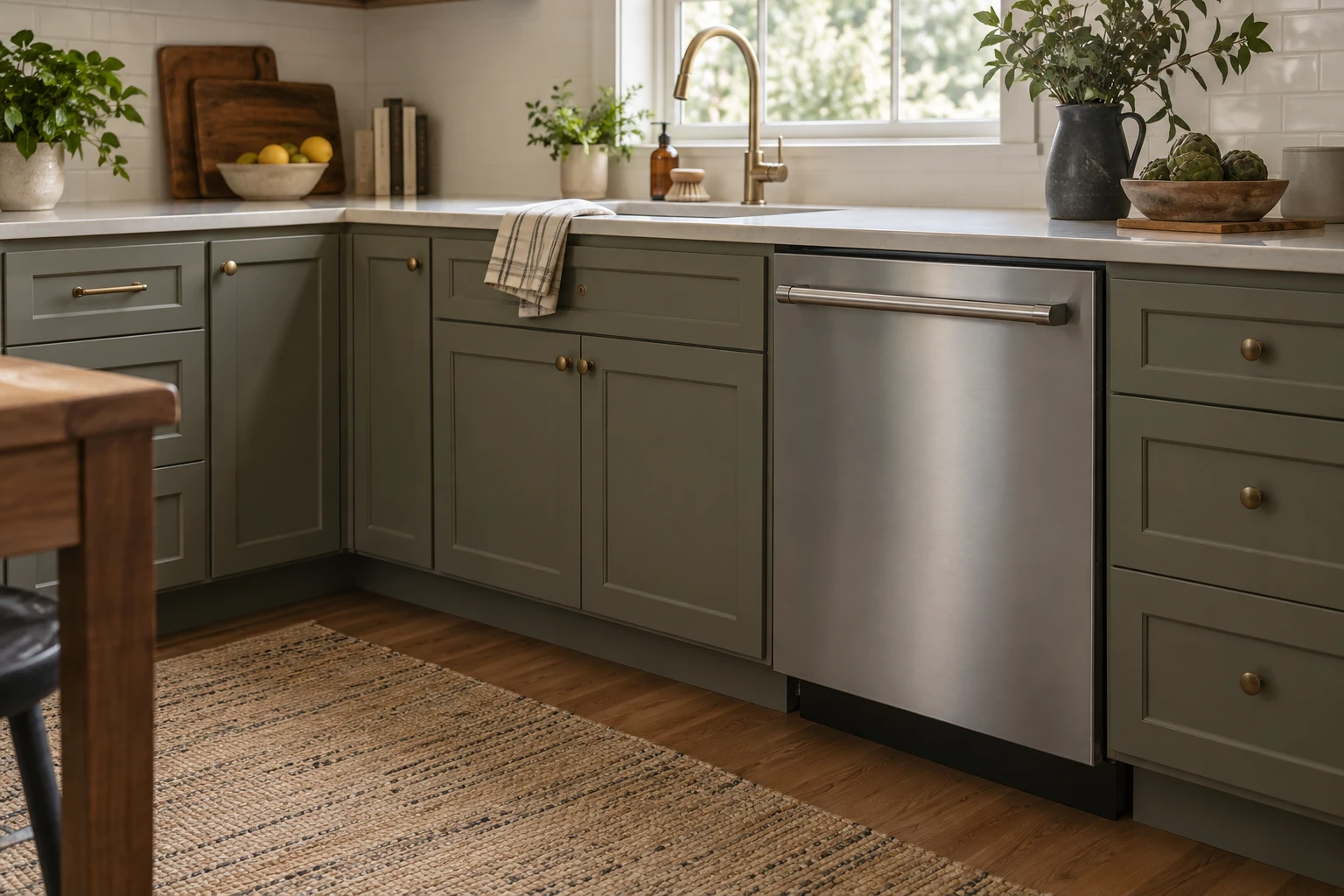
Keep installation clearance separate from handle clearance
The installation manual sets the required opening and minimum clearances. Your cabinet layout adds another question: can the appliance and neighboring storage operate without hitting each other? Both checks must pass. A large filler strip is not automatically sufficient, and a recessed dishwasher handle does not remove every possible collision.
For example, the Whirlpool W11532445 Rev C manual, under Location Requirements, specifies a two-inch minimum between the side of the dishwasher door and the wall or cabinet for corner locations. That is a requirement within that manual’s scope, not a universal dimension for every dishwasher or a guarantee that an adjacent handle clears.
Use the installation instructions for the exact model and market you will buy. If you are replacing an appliance, keep the old model’s measurements separate. A new door thickness, handle shape, or installation position can change how the same kitchen functions.
Draw the corner from above and from the side
On squared paper, draw the dishwasher opening and the perpendicular cabinet run. Mark the finished cabinet faces, filler, end panel, and the nearest drawer or door. Add each handle at its actual position. Write measurements beside the drawing rather than expecting a rough sketch to represent scale accurately.
Then make a simple side view. Record handle heights, the dishwasher’s open-door position from its dimension drawing, and nearby drawer heights. Two handles can appear to cross in a top view while occupying different heights; conversely, a clear view from above can hide a collision between a drawer front and the lowered dishwasher door.
| Item | Record | Where to verify |
|---|---|---|
| Appliance identity | Full model and door style | Order and installation manual |
| Required side clearance | Value and measurement points | Exact manual |
| Dishwasher handle | Projection, width, height | Dimension drawing or measured sample |
| Neighboring handle | Projection and position on front | Installed cabinet or selected hardware |
| Drawer movement | Full extension and front envelope | Cabinet specification |
| Open dishwasher | Door reach and rack access | Appliance drawing and demonstration |
| Unresolved dimension | Name of person confirming it | Installer or kitchen designer |
Check four everyday positions
- Everything closed: check that projections do not touch and the neighboring drawer can start opening.
- Dishwasher closed, storage open: trace the drawer front or cabinet door past the appliance handle.
- Dishwasher open, storage closed: check the lowered door, your standing position, and the rack’s unloading space.
- Both in use: consider the storage you normally open while putting dishes away, without forcing either component past contact.
You may decide that a particular drawer will stay closed during unloading. Treat that as a deliberate workflow compromise, not as proof of unrestricted clearance. A collision while opening the appliance itself is different and needs to be resolved before purchase.
Worked example: a closed gap can be misleading
Consider a hypothetical layout where the nearest edge of a drawer front passes 2.5 inches from the dishwasher’s closed front plane. A proposed dishwasher handle projects 2.75 inches into that path at the same height. In this simplified parallel-path check, the projection exceeds the available gap by 0.25 inch: 2.75 minus 2.5. The combination fails even though the appliance body fits its opening.
This arithmetic is only an illustrative collision screen. A real corner may involve angled travel, rounded hardware, a different door plane, or height offsets. Give the actual drawing to the installer rather than using the example as a filler-size formula. Do not order a narrow replacement handle until the appliance manufacturer confirms compatibility.
Use a harmless mock-up before the final order
For a proposed kitchen, cardboard strips can represent handle projections on a full-size paper plan. Label which edge represents the finished cabinet face. Move the paper drawer footprint through its intended path. Use the exercise to identify missing dimensions; it cannot reproduce hinge geometry or approve an installation.
In an existing kitchen, measure accessible surfaces without pulling the dishwasher out or disturbing water and electrical connections. If checking an installed door, stop at resistance and keep fingers away from pinch points. Ask the installer to assess anything hidden or tight rather than trimming cabinetry or altering the appliance yourself.
What to send the installer
Send the model number, current manual, two drawings, hardware dimensions, and photographs of the corner. Ask for separate confirmation of installation compliance and everyday opening clearance. If a dimension remains unavailable, keep the order conditional until it is resolved.
The final record should say which configuration was checked, including handle style and filler width. That makes it easier to catch a late substitution before installation day, when a small change can undo an otherwise workable corner layout.