Key takeaways
- Internal organization: Separate sleeves or labeled compartments prevent poles from damaging the net and make setup faster.
- Bag construction: Reinforced handles and a full-length zipper are more useful than a thin drawstring sack.
- Frame protection: Padded pole sections reduce rattling and chipped edges during transport.
- Replacement parts: Confirm that net clips, feet, guy lines, and shuttlecocks can be replaced or purchased separately.
- Outdoor storage: Bring the net indoors after play. Ultraviolet light, dew, and lawn sprinklers wear mesh and metal connectors quickly.
The best badminton sets depend on where you will play: choose a compact 10-foot net for a small indoor room, a stable 17-foot regulation-style set for a backyard, or a lightweight height-adjustable set when children, renters, and frequent storage matter most.
Best badminton sets by playing situation
| Situation | Best set type | What to prioritize | Typical setup time | Usual price range |
|---|---|---|---|---|
| Small apartment or rec room | 10–12 ft indoor pop-up net | Short frame, foam feet, soft shuttlecocks | 2–5 minutes | $35–$90 |
| Family backyard | 17 ft portable net set | Wide base, guy lines, weather-resistant frame | 10–20 minutes | $80–$180 |
| Serious recreational play | Regulation-height 20 ft net system | Rigid poles, tensioning hardware, stronger rackets | 15–30 minutes | $150–$350 |
| Children and mixed ages | Height-adjustable 10–17 ft set | Light rackets, low net option, rounded connectors | 5–15 minutes | $50–$140 |
| Frequent transport | Collapsible set with wheeled or reinforced carry bag | Low packed weight, labeled parts, durable zipper | 5–15 minutes | $70–$200 |
What separates the best badminton sets
Racket durability
Entry-level sets usually include aluminum rackets with steel shafts. They are inexpensive and tolerate occasional family play, but their heads can bend when rackets collide. A better recreational set uses a stronger aluminum frame, a steel or graphite-composite shaft, and a securely attached grip. Look for reinforced T-joints rather than a visibly loose plastic throat.

ENOVI EasyGo Badminton Set with Net, 4 Rackets, 4 Shuttlecocks, Portable Storage Box, for Backyards, Outdoor Games, Yard Games
Included for 'Best Badminton Sets for Backyard and Indoor Play' because the listing specifies 4 Rackets and 4 Shuttlecocks, details this guide uses to compare options.
View on Amazon
Vbneto Badminton Set, Easy Set Up Net with 4 Rackets for Backyards
Included for 'Best Badminton Sets for Backyard and Indoor Play' because the listing specifies Easy Set Up Net with 4 Rackets for Backyards, details this guide uses to compare options.
View on Amazon
EastPoint Easy Setup Badminton Set - 15 ft Net, 4 Rackets, 2 Shuttlecocks
Included for 'Best Badminton Sets for Backyard and Indoor Play' because the listing specifies 15 ft Net and 4 Rackets, details this guide uses to compare options.
View on Amazon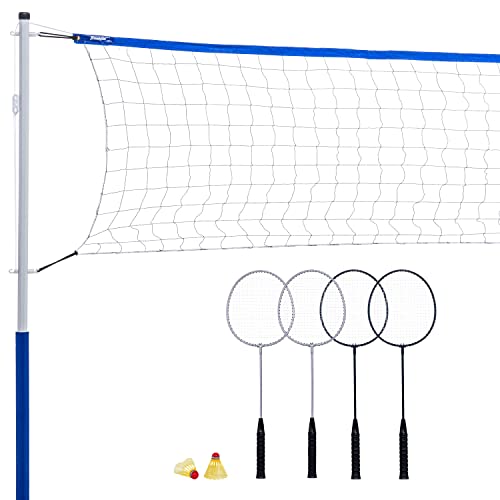
Franklin Sports Complete Badminton Net Set for 4 Players - Recreational
Included for 'Best Badminton Sets for Backyard and Indoor Play' because the listing specifies Recreational, details this guide uses to compare options.
View on AmazonFor children, lighter rackets are more useful than tournament-style rackets. A racket weighing roughly 80–100 grams is easier to control, while adults who play regularly may prefer approximately 90–110 grams with tighter, more even stringing. Avoid using outdoor rackets in rain; moisture degrades grips, strings, and metal joints faster than most buyers expect.
Net height and width
A full badminton net is about 20 feet wide and 5 feet high at the posts, with the center slightly lower. Many backyard sets are 17 feet wide because that dimension fits more patios and is quicker to tension. That is a practical compromise, not a defect.
For indoor use, a 10-foot net is much easier to fit. A 10-by-12-foot room can accommodate a short net for casual rallies if furniture is moved aside, but it is not large enough for full-court badminton. Allow at least 3 feet of clear space behind each player and 2 feet on each side of the net. In a typical living room, remove coffee tables and protect lamps, televisions, and glass doors before playing.
Frame stability
Frame design often matters more than the number of included rackets. A narrow, lightweight base is convenient but can tip when the net is pulled tight or a player brushes against it. Wide feet, crossbars, and sandbag-compatible legs provide better stability.
| Frame construction | Advantages | Limitations | Best use |
|---|---|---|---|
| Fiberglass or flexible plastic poles | Light, inexpensive, quick to assemble | Can bow or loosen under high tension | Indoor play and occasional backyard games |
| Aluminum poles with broad feet | Good balance of weight, rigidity, and corrosion resistance | Costs more; connectors can be misplaced | Most family backyards |
| Steel poles with ground stakes | Strongest support and best wind resistance | Heavier and slower to move | Permanent or frequently used outdoor courts |
On grass, stake the corners and use guy lines if the set includes them. On concrete or indoors, never substitute sharp stakes. Choose weighted bases, fillable feet, or a net designed for flat floors instead.
Head-to-head: compact indoor sets versus backyard sets
Compact indoor pop-up sets
These are the best badminton sets for apartments, gyms, classrooms, and rainy-day play. Their frames typically fold or use elastic-connected sections, and the net may stand 4–5 feet high. Setup is often nearly instant because there are fewer poles and no ground stakes.
The trade-off is limited tension and stability. A pop-up frame may shift during an enthusiastic doubles game, particularly on smooth wood or tile. Foam-covered feet help protect flooring, while soft shuttlecocks reduce damage to walls and light fixtures. These sets are for short rallies and skill practice rather than full-court movement.
Full-size portable backyard sets
Backyard systems provide better spacing and more realistic play. A 17-foot net leaves room for doubles without requiring the full width of a regulation court. Look for telescoping or clearly labeled pole sections, a center support, and a tension strap that does not rely on tying improvised knots.
Expect the first assembly to take 15–30 minutes, even when the package claims a faster setup. The delay usually comes from sorting poles, positioning the net, and correcting uneven tension. After the parts are organized, later setups may take 8–15 minutes. A packed set commonly weighs 8–20 pounds; check the bag dimensions if it must fit through a narrow closet or car trunk.
Shuttlecock quality matters more than expected
Many bundled shuttlecocks are the weakest component. Basic plastic shuttles are durable for children but often fly too quickly or unpredictably. Nylon shuttles with a cork or composite tip provide more consistent casual play and last longer outdoors, although wind still affects them heavily.
Feather shuttles offer the most natural flight indoors, but they are fragile and unsuitable for wet grass. If a set includes only a few thin plastic shuttles, budget for replacements. For family use, select a set with at least six durable nylon shuttles; for regular adult play, buying a separate tube of medium-speed indoor shuttles is usually worthwhile.
Carry cases and setup details to inspect
- Internal organization: Separate sleeves or labeled compartments prevent poles from damaging the net and make setup faster.
- Bag construction: Reinforced handles and a full-length zipper are more useful than a thin drawstring sack.
- Frame protection: Padded pole sections reduce rattling and chipped edges during transport.
- Replacement parts: Confirm that net clips, feet, guy lines, and shuttlecocks can be replaced or purchased separately.
- Outdoor storage: Bring the net indoors after play. Ultraviolet light, dew, and lawn sprinklers wear mesh and metal connectors quickly.
For renters, a carry bag under about 30 inches long is easier to store in a closet. Measure the storage shelf and doorway before buying a wide-base system. A set that fits in the package but cannot pass around a stairwell corner is not convenient in practice.
Decision guide for common households
- Small apartment: Choose a 10–12 foot indoor net with foam feet and soft nylon shuttlecocks. Keep at least 3 feet behind each player and use it for controlled rallies.
- Kids and pets: Select a height-adjustable set with flexible poles, rounded feet, and no exposed ground stakes. Pack it away immediately after play.
- Renter with limited storage: Favor aluminum or fiberglass poles that fit into a compact bag, even if the base is less heavy. A 12–17 foot net is usually the best compromise.
- Back pain or limited mobility: Look for numbered pole sections, a standing-height carry bag, and a frame that assembles without crawling to install ground anchors. A lighter 8–12 pound system may be easier to manage.
- Windy backyard: Buy a steel or broad-foot aluminum frame with guy lines and sandbag-compatible bases. Lightweight pop-up frames are likely to move.
- Regular doubles play: Choose a 17–20 foot net, rigid poles, stronger rackets, and at least six spare shuttlecocks. Stability and consistent tension will matter more than shaving a few minutes from setup.
Final buying recommendation
For most families, the best badminton set is a 17-foot portable aluminum system with broad feet, adjustable tension, four durable rackets, six or more nylon shuttlecocks, and a reinforced carry case. It fits common yards, supports casual doubles, and normally costs about $80–$180. Choose the compact indoor version instead when your available room is close to 10 by 12 feet, and spend more on a rigid, guy-lined frame when wind, frequent play, or adult doubles makes movement a concern.