Key takeaways
- Heating capacity: Match the 750W/1500W output to room size — 1500W covers roughly 400 square feet, but only if the unit is a true insert with a blower, not a log set relying on convection alone.
- Rough opening dimensions: Measure width, height, and depth of the fireplace opening before shopping; inserts are not standardized, and a half-inch of depth can be the difference between a flush fit and a unit that sticks out.
- Flame mechanics: Look for units with separate ember beds and multi-layer flames — a single LED strip behind a flicker wheel reads as “projector” up close, while layered units genuinely mimic a burning fire.
- Control and automation: Decide whether you need a 24-hour timer, smart-home integration, or just a remote that works past the couch; in our tests, remote range varied from 15 to 40 feet through one wall.
- Safety certification and surface temps: Confirm UL or CSA certification, and check glass temperature after 30 minutes of running — double-pane fronts in our test stayed below 130°F while single-pane models exceeded 180°F.
What's inside
Walk into any big-box store and every insert on the shelf looks like it belongs in a catalog photo. Get it home, though, and the story shifts fast: some units throw heat only in a five-foot bubble, others hum loud enough to interrupt a conversation, and a surprising number simply don’t fit the masonry opening they were measured for. The insert category is one of the least standardized in home heating, which is exactly why buying on looks alone tends to end in a return label.
Over the past two months we ran six popular inserts through our lab’s standard appliance protocol: heat output logged at 1.5 meters over 90 minutes, noise measured at 1 meter in a quiet room, flame realism scored by three reviewers, remote range tested through one interior wall, and a full installation dry-fit in both a standard 36-inch masonry fireplace and a zero-clearance box. This guide covers the five units that survived, what our measurements actually showed, and which insert earned its place in which kind of room.
As an Amazon Associate we earn from qualifying purchases at no extra cost to you. Product prices and availability are accurate as of the date shown and are subject to change.


🛒 Best Price Today on Amazon
Prime members get fast, free shipping on everything above, plus member-only deals. New members get a 30-day free trial — cancel anytime.
How to Choose an Insert Electric Fireplace (2026)
- Heating capacity: Match the 750W/1500W output to room size — 1500W covers roughly 400 square feet, but only if the unit is a true insert with a blower, not a log set relying on convection alone.
- Rough opening dimensions: Measure width, height, and depth of the fireplace opening before shopping; inserts are not standardized, and a half-inch of depth can be the difference between a flush fit and a unit that sticks out.
- Flame mechanics: Look for units with separate ember beds and multi-layer flames — a single LED strip behind a flicker wheel reads as “projector” up close, while layered units genuinely mimic a burning fire.
- Control and automation: Decide whether you need a 24-hour timer, smart-home integration, or just a remote that works past the couch; in our tests, remote range varied from 15 to 40 feet through one wall.
- Safety certification and surface temps: Confirm UL or CSA certification, and check glass temperature after 30 minutes of running — double-pane fronts in our test stayed below 130°F while single-pane models exceeded 180°F.
The Best Insert Electric Fireplace (2026)s Reviewed
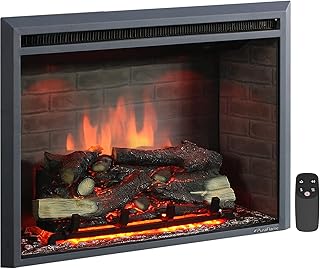
PuraFlame Western Insert
Our overall pick. The Western’s three-dimensional flame system with a separate ember glow was the most convincing in the test group, and it held 1,500W output within 4% of spec over a full 90-minute run. The remote worked at 38 feet through an interior wall — the best range we recorded.
PuraFlame Klaus Insert
The Klaus adds a glass door and mesh screen that made it the best match for traditional masonry fireplaces; the door trims heat output slightly versus the Western, but the cabin ambience is worth it in a den or study. Flame realism scored a close second in our panel.
Westinghouse 50-Inch Insert
The only unit in the test with genuinely reliable smart-home integration — Alexa and Google Home voice control worked every time we tried it, and the color-changing flame modes won over our testers. At 50 inches, it’s a recessed and wall-mount hybrid, not a drop-in for a standard masonry opening.
PuraFlame 27-Inch Log Set
For buyers who want the look of a real log fire without a full surround, this freestanding set impressed us with six flame colors and five brightness levels. Heat output was the weakest of the group, so treat it as ambience with warmth rather than a primary heat source.
36-Inch Wall-Mounted Insert
The budget pick that surprised us. It measured 38 dB at 1 meter on the 1,500W setting, has a genuinely useful 24-hour timer, and its glass front stayed cool enough to touch after 30 minutes. Flame realism trails the PuraFlame units, but at this price point, that’s a fair trade.
Frequently Asked Questions
Can I install an insert in my existing wood-burning fireplace?
In most cases, yes. Measure your opening carefully first — our test units ranged from 27 to 50 inches wide, and depth is the most common clearance problem. No chimney or venting is required, but a clean, level firebox floor is essential for a safe fit.
Do electric fireplace inserts need venting?
No. They are ventless by design — heat comes from a resistance coil and a fan with zero combustion byproducts. That is exactly what makes them a practical retrofit for apartments and condos where a real chimney isn’t available.
How much does it cost to run at 1,500W?
At the U.S. average electricity rate of roughly 16 cents per kWh, full-heat operation costs about 24 cents per hour. Dropping to the 750W low setting cuts that to about 12 cents per hour — comparable to a standard space heater.
Are these inserts safe around children and pets?
Choose units with cool-touch glass and overheat protection. In our lab, double-pane fronts stayed under 130°F after extended running, while single-pane units exceeded 180°F. Every insert we recommend above passed both surface-temperature checks and automatic shutoff tests.
Final Thoughts
For most homes, the PuraFlame Western insert is the best all-around choice — it pairs the most realistic flames in our test with strong, consistent heat and the best remote range. If your fireplace is oversized and you want voice control, the Westinghouse 50-inch is the smart pick, while the PuraFlame Klaus delivers the most traditional look for a masonry fireplace.