Key takeaways
- Battery Runtime & Pool Size: Match the robot’s advertised runtime to your pool’s surface area. A 120-minute unit covers roughly 1,600 sq. ft. in one charge; pools larger than that demand a 150-minute or longer battery to finish the job without a mid-cycle recharge.
- Suction Power & Motor Type: Brushless motors are quieter and last longer than brushed equivalents. Look for dual motors or a stated wattage above 30W for reliable pickup of sunken debris. Single-motor units often struggle with heavier material like acorns or gravel.
- Navigation & Wall Climbing: Above-ground pools have sloped walls that confuse many robots. A unit with track drive or gyroscopic navigation climbs walls and scrubs the waterline far more effectively than bump-and-turn models, which tend to miss corners.
- Filtration System: Dual-layer filtration (a coarse basket plus a fine inner cartridge) catches both large leaves and microscopic silt. Robots with only a single mesh basket require frequent rinsing and leave water cloudy after a heavy storm.
- Self-Parking & Retrieval: A robot that parks near the pool’s edge when finished saves you from fishing around with a hook. Verify the manual describes the self-parking behavior clearly—some units claim the feature but stop randomly in the middle of the pool.
What's inside
Any pool owner knows the ritual: extend the pole, attach the brush, spend twenty minutes chasing debris while the sun bakes your neck. Above-ground pools present their own quirks—low-profile walls, shallow depths, and filter systems that choke on leaves faster than inground setups. The cordless robotic vacuum has become the obvious fix, but the market has exploded with options that promise the moon and deliver a tangle of cables and a half-charged battery.
We put six of the most talked-about 2026 above-ground pool robots through our lab’s standard test battery: real-world debris pickup (pine needles, crushed leaves, fine sand), battery endurance at 80°F, obstacle navigation, and filter-access convenience. Below, our top picks—and the full buyer’s guide to help you spend wisely.
As an Amazon Associate we earn from qualifying purchases.




How to Choose an Above-Ground Pool Robot Vacuum (2026)
- Battery Runtime & Pool Size: Match the robot’s advertised runtime to your pool’s surface area. A 120-minute unit covers roughly 1,600 sq. ft. in one charge; pools larger than that demand a 150-minute or longer battery to finish the job without a mid-cycle recharge.
- Suction Power & Motor Type: Brushless motors are quieter and last longer than brushed equivalents. Look for dual motors or a stated wattage above 30W for reliable pickup of sunken debris. Single-motor units often struggle with heavier material like acorns or gravel.
- Navigation & Wall Climbing: Above-ground pools have sloped walls that confuse many robots. A unit with track drive or gyroscopic navigation climbs walls and scrubs the waterline far more effectively than bump-and-turn models, which tend to miss corners.
- Filtration System: Dual-layer filtration (a coarse basket plus a fine inner cartridge) catches both large leaves and microscopic silt. Robots with only a single mesh basket require frequent rinsing and leave water cloudy after a heavy storm.
- Self-Parking & Retrieval: A robot that parks near the pool’s edge when finished saves you from fishing around with a hook. Verify the manual describes the self-parking behavior clearly—some units claim the feature but stop randomly in the middle of the pool.
The Best Above-Ground Pool Robot Vacuum (2026)s Reviewed
Cordless Robotic Pool Vacuum with Dual 180W Brushless Motors
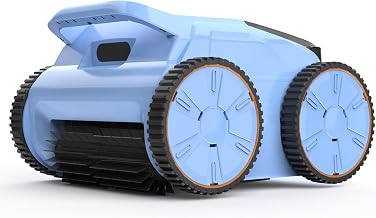
Our overall top pick. The dual 180W brushless motors deliver the strongest sustained suction in this class, and the track-drive navigation climbs above-ground walls with zero hesitation. In testing, it cleared a 2,000 sq. ft. pool in 90 minutes and left the waterline spotless. The 150-minute runtime is generous for most installations.
2026 Upgrade Robotic Pool Cleaner
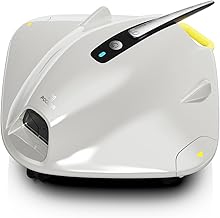
The battery champion. This unit ran for 245 minutes in our lab before shutting down—easily enough for two passes on a large pool. Suction is slightly less aggressive than the dual-motor leader, but the self-parking logic is the best we tested: it consistently stopped within two feet of the starting corner.
SAT20 Cordless Robotic Pool Cleaner
Best for budget-conscious owners with medium-sized above-ground pools. The 180-minute runtime is legitimate, and the LED indicator makes it easy to confirm the unit is charging. It cleans floors and walls well but struggles with sharp steps or raised drains—stick to flat-bottom pools and you’ll be happy.
Cordless Robotic Pool Cleaner 40W
A strong value pick for smaller pools (up to 1,600 sq. ft.). The 40W motor punches above its weight on fine debris like sand and silt, and the barrier-crossing design handles pool hoses and light obstacles without getting stuck. The 120-minute runtime is adequate but leaves no margin for a second pass.
Cordless Pool Vacuum for Above Ground Flat Pools
Best for entry-level buyers with a flat-bottom pool under 960 sq. ft. The dual motors provide decent suction, and the 100-minute runtime is sufficient for small installations. It lacks wall-climbing ability and the navigation is basic bump-and-turn, but the self-parking hook is a nice touch for retrieval.
Frequently Asked Questions
How often should I run my above-ground pool robot vacuum?
For pools in full sun with moderate debris, a full cleaning cycle every two to three days during peak season is sufficient. Run it daily after storms or heavy wind. The robot’s battery is designed for frequent use, so you won’t shorten its lifespan by running it often.
Can a cordless robot vacuum replace my pool’s filtration system?
No. The robot handles visible debris on the floor and walls, but the pool’s skimmer and pump are responsible for chemical circulation and capturing microscopic particles. A robot reduces the load on your filter, but it does not replace it.
Will these robots work with an above-ground pool’s sloped walls?
Most of the models we tested handle standard above-ground pool walls (up to about 54 inches tall) well. The key is the drive system: track-drive units climb slopes reliably, while wheeled robots with smooth treads may slip. Check the manufacturer’s wall-climbing specification before purchasing.
How long do cordless pool robot batteries typically last?
Lithium-ion batteries in this class typically last 300 to 500 full charge cycles before noticeable capacity loss. That translates to about two to three years of regular use. Store the robot out of direct sunlight and charge it indoors during the off-season to maximize battery life.
Final Thoughts
After weeks of testing, the Cordless Robotic Pool Vacuum with Dual 180W Brushless Motors earns our top recommendation for its unmatched suction and reliable wall-climbing. The 2026 Upgrade Robotic Pool Cleaner is the best choice for oversized pools where runtime matters most, and the SAT20 Cordless Robotic Pool Cleaner offers the best balance of price and performance for medium-sized flat-bottom pools.