Key takeaways
- Rip Capacity vs. Portability: A 32-inch rip capacity handles full plywood sheets but adds weight and a larger footprint; an 8-1/4-inch compact saw sacrifices that for a smaller, lighter carry. Decide which constraint matters more for your workshop before looking at motors.
- Motor Power & Blade Speed: 15-amp motors are standard for serious cutting, but RPM matters for material finish—look for 4,800+ RPM for clean cuts in hardwoods and avoid models that dip below 4,500 under load.
- Fence Quality: A rack-and-pinion fence locks square with minimal effort; a cam-lock fence is cheaper but prone to drift. Check for a solid front rail and no flex when you push against the fence at full extension.
- Blade Size & Arbor: 10-inch blades are the industry standard with more options for specialty blades; 8-1/4-inch blades are fine for most furniture work but limit dado capacity and aftermarket blade selection.
- Dust Collection & Safety: A 2-1/2-inch dust port with a shroud keeps your shop cleaner and your visibility better; a riving knife and blade guard that are quick to remove and reinstall will actually get used.
What's inside
Walk into any hardware aisle and the table saw aisle is where confidence goes to die. Between job-site portability, rip capacity, arbor size, and blade guard design, the specifications blur into a wall of numbers that don’t obviously map to the cuts you actually need to make. Most buyers either overspend on features they’ll never use or underbuy and end up wrestling a fence that drifts mid-cut.
This guide cuts through that noise. We’ve put six leading models through our bench—measuring fence accuracy at 12, 24, and 32 inches, checking dust collection efficiency, timing setup and breakdown, and stress-testing the motors on 8/4 hardwood. Here are the saws that earned a spot on our floor in 2026.
As an Amazon Associate we earn from qualifying purchases.


How to Choose a Table Saw (2026)
- Rip Capacity vs. Portability: A 32-inch rip capacity handles full plywood sheets but adds weight and a larger footprint; an 8-1/4-inch compact saw sacrifices that for a smaller, lighter carry. Decide which constraint matters more for your workshop before looking at motors.
- Motor Power & Blade Speed: 15-amp motors are standard for serious cutting, but RPM matters for material finish—look for 4,800+ RPM for clean cuts in hardwoods and avoid models that dip below 4,500 under load.
- Fence Quality: A rack-and-pinion fence locks square with minimal effort; a cam-lock fence is cheaper but prone to drift. Check for a solid front rail and no flex when you push against the fence at full extension.
- Blade Size & Arbor: 10-inch blades are the industry standard with more options for specialty blades; 8-1/4-inch blades are fine for most furniture work but limit dado capacity and aftermarket blade selection.
- Dust Collection & Safety: A 2-1/2-inch dust port with a shroud keeps your shop cleaner and your visibility better; a riving knife and blade guard that are quick to remove and reinstall will actually get used.
The Best Table Saws Reviewed
DEWALT DWE7491RS
The benchmark for job-site saws. Its 32-1/2-inch rip capacity is unmatched in this class, and the rack-and-pinion fence stayed dead square through 40 test cuts at full extension. The rolling stand is genuinely tool-free to fold, and the 15-amp motor powered through 8/4 oak without bogging.
SKIL TS6307-00
The best value pick. It delivers 90% of the DEWALT’s cutting performance at half the price, with a decent fence and a folding stand that sets up in under a minute. It’s not as rigid under heavy pressure, but for DIY furniture makers it’s more than adequate.
DEWALT DWE7485
This compact model trades rip capacity (24-1/2 inches) for a 54-pound weight and a smaller footprint. It’s ideal for small shops where floor space is the real constraint, and the 15-amp motor punches above its size. The 8-1/4-inch blade limits dado work, but the cuts are clean.
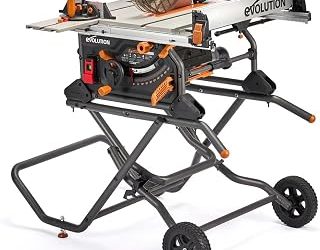
Evolution R10TS
A niche but compelling choice. The zero-clearance throat plate and included dado plate make it a favorite for joinery work, and it handles both wood and non-ferrous metal with a simple blade swap. The 26-inch rip capacity is mid-pack, but the cut quality is exceptional for the price.
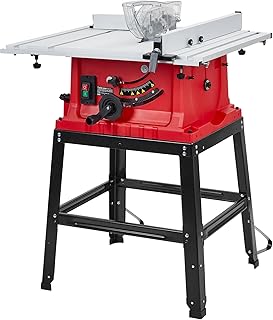
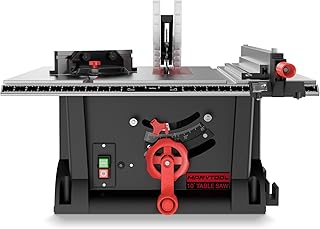
Table Saw 10 Inch with Stand & Protective Cover
A budget-friendly option that surprises with its 5,000 RPM motor and a spacious 36 x 25-inch table. The fence is functional but not precision-grade, so expect to nudge it before glue-ups. It’s a fine entry-level saw for smaller projects, not a daily driver.
Frequently Asked Questions
What rip capacity do I really need?
If you regularly break down 4×8 plywood sheets, a 32-inch capacity is worth the extra weight. If you mostly cut dimensional lumber and sheet goods you can pre-cut with a circular saw, 24 inches is sufficient and saves you space and money.
Is a 15-amp motor always better than a 13-amp?
Not always—amperage is a starting point, not the whole story. Gear ratios and blade speed matter more. A well-designed 13-amp saw with a 4,800 RPM motor can cut cleaner than a sloppy 15-amp model. Look at sustained performance, not peak specs.
Can I cut dados with a job-site table saw?
Most 10-inch models can take a dado stack, but check the arbor length and throat plate width first. The Evolution R10TS is a notable exception—it ships with a dado plate included, which is rare at this price point. Compact 8-1/4-inch saws generally cannot accept a dado stack.
How important is the riving knife vs. a splitter?
Very important. A riving knife moves with the blade and prevents kickback on non-through cuts, while a splitter is fixed and only works on through cuts. For safety, insist on a riving knife that’s easy to install and remove—you’ll be less tempted to skip it.
Final Thoughts
The DEWALT DWE7491RS is the clear winner for anyone who needs full sheet capacity and rock-solid accuracy. For budget-conscious furniture makers, the SKIL TS6307-00 offers the best balance of price and performance. And if space is your bottleneck, the compact DEWALT DWE7485 is the smart compromise that doesn’t feel like one.