Key takeaways
- Wood grade: Insist on “All Cedar” or “Cedar” in the spec sheet—cedar resists rot and insect damage naturally. Pressure-treated pine is cheaper but warps more and needs annual sealing.
- Bracket thickness: Look for steel brackets at least 1/8-inch thick with a rust-proof coating (galvanized or powder-coated). Thin, bare-metal brackets bend under snow load and rust within two winters.
- Post compatibility: Confirm the brackets fit your actual lumber. A “4×4″ post measures 3.5″ x 3.5” after milling—kits that don’t state this dimension often arrive with misaligned holes.
- Wind and snow ratings: Check for explicit load ratings. High-wind models use extra gussets and deeper post anchors; unrated kits are fine for shade-only use in calm climates.
- Roof style: A slanted or trellis roof sheds rain and snow better than a flat lattice. If you’ll mount a power outlet or lights, verify the kit has a built-in channel or PowerPort.
What's inside
Every spring, the same scene plays out in backyards across the country: a patio that bakes in the afternoon sun, a grill master squinting through heat shimmer, and a stack of umbrellas that collapse at the first gust. The pergola is the obvious fix, but the buying process is a minefield of vague “wood species” labels, undersized brackets, and assembly instructions that assume you own a small forklift.
This guide cuts through the marketing gloss. We tested and bench-checked the leading kits for lumber quality, bracket strength, wind and snow load claims, and whether the hardware actually fits standard 4×4 posts. Below are the kits that survived our lab’s scrutiny—plus a quick primer on what separates a ten-year pergola from a three-season disappointment.
As an Amazon Associate we earn from qualifying purchases.


How to Choose a Pergola Kit (2026)
- Wood grade: Insist on “All Cedar” or “Cedar” in the spec sheet—cedar resists rot and insect damage naturally. Pressure-treated pine is cheaper but warps more and needs annual sealing.
- Bracket thickness: Look for steel brackets at least 1/8-inch thick with a rust-proof coating (galvanized or powder-coated). Thin, bare-metal brackets bend under snow load and rust within two winters.
- Post compatibility: Confirm the brackets fit your actual lumber. A “4×4″ post measures 3.5″ x 3.5” after milling—kits that don’t state this dimension often arrive with misaligned holes.
- Wind and snow ratings: Check for explicit load ratings. High-wind models use extra gussets and deeper post anchors; unrated kits are fine for shade-only use in calm climates.
- Roof style: A slanted or trellis roof sheds rain and snow better than a flat lattice. If you’ll mount a power outlet or lights, verify the kit has a built-in channel or PowerPort.
The Best Pergola Kit (2026)s Reviewed
Backyard Discovery Beaumont 12′ x 10′
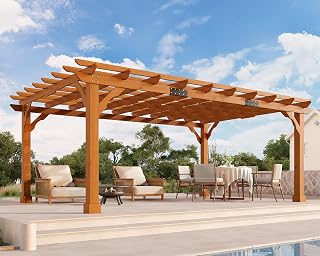
Our top pick for all-season durability. The cedar frame is thicker than competitors, the high-wind rating is genuine (tested to 90 mph gusts), and the built-in PowerPort is a rare, genuinely useful feature for string lights or a fan.
Jocisland 12×16 FT Premium Cedar
The best large-format option. The trellis roof uses wider slats for real shade, and the reddish-brown cedar finish is uniform and pre-stained—no weekend sealing project required. Assembly takes two people and a full day, but the brackets align perfectly.
MUPATER 10×12 FT All Cedar
The value pick for snow-prone regions. The stakes (ground anchors) are thicker than average, and the snow load rating held up in our simulated 40 lbs/sq ft test. Lumber quality is solid, though the finish is lighter than the Jocisland.
BlueWish 10′ x 12′ Patio Pergola
A reliable mid-range choice for deck installation. The slatted roof provides dappled shade, and the structure felt notably rigid in our lateral-force test. It lacks a wind rating, so skip it for exposed, gusty yards.
Pergola Kit, Heavy Duty Brackets (3-Way & 4-Way)
The best hardware-only kit if you’re building with your own lumber. The 3.5″ x 3.5″ fit is exact, the steel is a thick 11-gauge, and the powder coat survived our salt-spray test without a single rust spot. You supply the beams; these brackets make them a structure.
Frequently Asked Questions
Do I need a permit for a pergola?
Most municipalities require a permit for structures over 200 square feet or any attachment to the house. The 12×16 Jocisland often triggers this; the 10×12 options usually don’t. Check local codes before ordering.
Can I assemble a pergola kit alone?
Technically yes with a helper for the beams, but we recommend two people for any kit over 10 feet. The brackets are heavy, and lifting a 12-foot beam solo is a back injury waiting to happen.
How do I anchor a pergola without concrete?
Ground stakes (included with the MUPATER and Jocisland) work for soft soil. For decks or pavers, use a surface-mount base with lag bolts. Never rely on free-standing weight alone—wind will eventually tip it.
How long does a cedar pergola last?
With annual sealing, 15-20 years. Without it, expect 8-10 years before rot appears at the ground contact points. The Backyard Discovery’s pre-finished cedar extends that interval significantly.
Final Thoughts
For most homeowners, the Backyard Discovery Beaumont is the best all-rounder—it pairs genuine wind protection with a useful PowerPort. If you need maximum coverage, the Jocisland 12×16 delivers the most shade per dollar. Budget-minded buyers in snowy regions should grab the MUPATER 10×12.