Key takeaways
- Sliding capacity: Choose a sliding model for wide boards, shelving, and furniture panels; a fixed compound saw is often more compact and rigid for narrower stock.
- Bevel range: Single-bevel saws are adequate for many crosscuts, while double-bevel models make mirrored angled cuts faster and reduce the need to reposition workpieces.
- Accuracy controls: Look for positive stops, a stable fence, clear scales, and adjustments that can be locked securely rather than relying on a laser alone.
- Blade and material range: A quality carbide blade matters as much as motor output. Check the supplied blade and confirm that replacements are readily available for wood, trim, or composite materials.
- Workshop practicality: Consider dust collection, handle comfort, carrying weight, cord placement, and the clearance required behind the saw when the rails extend.
What's inside
Buying a miter saw for furniture projects is less straightforward than comparing motor sizes. A saw that looks powerful on paper may have limited crosscut capacity, awkward bevel controls, poor dust collection, or a fence that requires frequent checking. Sliding action also adds reach, but it can introduce more flex and take up valuable bench space.
From a home-appliance testing-lab perspective, we assess these saws by setup, control layout, cutting capacity, repeatability, visibility, and suitability for common furniture materials. This guide covers dependable workshop options alongside budget-friendly models, with attention to the compromises buyers are most likely to notice after installation.
As an Amazon Associate we earn from qualifying purchases.


How to Choose a Compound Sliding Miter Saw (2026)
- Sliding capacity: Choose a sliding model for wide boards, shelving, and furniture panels; a fixed compound saw is often more compact and rigid for narrower stock.
- Bevel range: Single-bevel saws are adequate for many crosscuts, while double-bevel models make mirrored angled cuts faster and reduce the need to reposition workpieces.
- Accuracy controls: Look for positive stops, a stable fence, clear scales, and adjustments that can be locked securely rather than relying on a laser alone.
- Blade and material range: A quality carbide blade matters as much as motor output. Check the supplied blade and confirm that replacements are readily available for wood, trim, or composite materials.
- Workshop practicality: Consider dust collection, handle comfort, carrying weight, cord placement, and the clearance required behind the saw when the rails extend.
The Best Compound Sliding Miter Saws (2026) Reviewed
DEWALT DWS780
The DEWALT 12-inch Double Bevel Sliding Compound Miter Saw with XPS LED Shadow Light System is the strongest all-rounder here for serious furniture work. Its shadow line provides a more useful cut reference than many basic lasers, while the double-bevel design and large blade suit repeated frame, trim, and casework cuts.
DEWALT DWS779
The DEWALT 12-inch Double Bevel Sliding Compound Miter Saw offers substantial crosscut capacity and a powerful 15-amp, 3,800-rpm motor. It is a compelling choice for builders who value cutting reach and bevel flexibility but do not need the DWS780’s integrated XPS shadow system.
DOVAMAN Updated 10-Inch Sliding Miter Saw
DOVAMAN’s updated 10-inch model is unusually feature-rich for a value-oriented saw, including three TCT blades, ambidextrous operation, a laser guide, and nine positive stops. Its published capacity and multi-material positioning are attractive for occasional furniture projects, though buyers should verify alignment carefully during setup and after transporting it.
NOVORIK Single-Bevel Compound Sliding Miter Saw
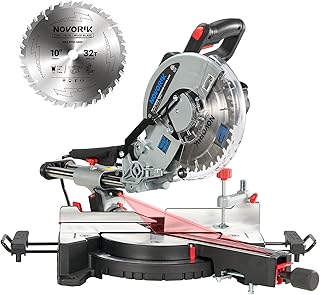
The NOVORIK combines a 15-amp motor, 4,000-rpm speed rating, laser guide, and a 10-inch TCT blade in a relatively approachable package. It makes sense for light-to-medium woodworking when the price and basic sliding function matter most, but its single-bevel layout is less convenient for mirrored compound cuts.
DEWALT DWS715
The DEWALT 12-inch DWS715 is a single-bevel compound saw rather than a sliding model, but it remains a sensible workshop option for wide trim and repeatable crosscuts within its fixed capacity. Its straightforward controls and established design can appeal to users who prefer fewer moving parts and do not routinely cut broad boards.
Frequently Asked Questions
What is the difference between a compound and sliding miter saw?
A compound saw tilts the blade for bevel cuts and pivots for miter cuts. A sliding compound saw also moves the blade forward and backward, allowing it to cut wider boards, although the rail system requires additional depth behind the tool.
Is a 10-inch or 12-inch miter saw better for furniture?
A 10-inch model is typically easier to move and may have lower blade costs, while a 12-inch saw offers greater reach and can handle larger trim and framing stock. For cabinets and smaller furniture, accuracy and blade quality often matter more than diameter.
Do I need a double-bevel miter saw?
Not necessarily. A single-bevel saw can handle many ordinary crosscuts and one-direction bevel cuts. Double-bevel capability becomes especially helpful for crown molding, sloped components, and projects requiring matching left- and right-hand angles.
Is the DEWALT DWS713 a sliding miter saw?
No. The DEWALT 10-inch DWS713 is a single-bevel compound miter saw without sliding rails. It can be a practical compact choice for trim and narrower stock, but shoppers needing wider crosscuts should select a true sliding model.
Final Thoughts
The DEWALT DWS780 is the best choice for demanding, repeatable furniture work, while the DWS779 delivers much of the same large-format capability at a simpler specification. For tighter budgets, the DOVAMAN offers an appealing feature set; choose the compact DEWALT DWS715 instead when fixed-rail rigidity and straightforward operation matter more than maximum width.