Key takeaways
- Compatibility: Confirm the blade’s exact length, width, and thickness against your saw’s manual. Even a high-quality blade is unsuitable if it cannot track correctly or tension safely.
- Tooth pitch: Lower TPI removes material quickly in thick stock, while higher TPI produces a cleaner finish in thinner material. Variable-pitch blades help reduce vibration across mixed workpieces.
- Material: Carbon-steel blades suit many woodworking tasks and are economical. Bi-metal blades, especially those using M42 high-speed-steel teeth, are better equipped for repeated cuts in steel and other tough metals.
- Blade width: Wider blades generally track more steadily for straight cuts. Narrow blades are more maneuverable for curves, but they require careful tensioning and a suitable wheel diameter.
- Tooth set and rake: A regular or wavy set can improve chip clearance, while a positive rake cuts more aggressively. Match the geometry to the material rather than assuming the most aggressive blade is always best.
What's inside
Choosing a band saw blade is rarely as simple as matching the length printed on the package. Tooth pitch, blade width, material, kerf, and the saw’s wheel size all affect whether a cut is smooth and controlled or noisy, slow, and prone to wandering. A blade that excels on steel may be a poor choice for furniture hardwoods, while an aggressive wood blade can quickly dull when it encounters metal.
We approached this roundup like a home-appliance testing lab: checking each blade’s intended material, tooth configuration, dimensions, durability claims, and likely fit for workshop users. The selections below cover portable saws, benchtop and floor-standing bandsaws, hardwood work, and serious metal-cutting jobs, so you can choose a blade that matches both your machine and your projects.
As an Amazon Associate we earn from qualifying purchases.



How to Choose a/an Band Saw Blade (2026)
- Compatibility: Confirm the blade’s exact length, width, and thickness against your saw’s manual. Even a high-quality blade is unsuitable if it cannot track correctly or tension safely.
- Tooth pitch: Lower TPI removes material quickly in thick stock, while higher TPI produces a cleaner finish in thinner material. Variable-pitch blades help reduce vibration across mixed workpieces.
- Material: Carbon-steel blades suit many woodworking tasks and are economical. Bi-metal blades, especially those using M42 high-speed-steel teeth, are better equipped for repeated cuts in steel and other tough metals.
- Blade width: Wider blades generally track more steadily for straight cuts. Narrow blades are more maneuverable for curves, but they require careful tensioning and a suitable wheel diameter.
- Tooth set and rake: A regular or wavy set can improve chip clearance, while a positive rake cuts more aggressively. Match the geometry to the material rather than assuming the most aggressive blade is always best.
The Best Band Saw Blade (2026)s Reviewed
LENOX Portable 44-7/8-Inch Blade, 14 TPI
This five-pack is a practical replacement set for compatible portable band saws, with a moderate 14 TPI pattern that balances speed and control. The LENOX blade is a strong general-purpose choice for installers, DIY renovators, and furniture makers who occasionally cut light metal or tubing rather than running a production shop.
Milwaukee Compact Extreme Thick Metal Blade
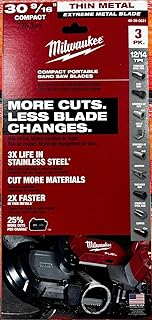
Milwaukee’s 30-9/16-inch 12/14 TPI blade is designed for compact portable saws and thick metal applications. Its variable tooth pitch helps manage changing section thicknesses, making this three-pack appealing for users who need a more capable metal-cutting blade without moving to a full-size machine.
Lenox Classic Tuff Tooth 93-Inch, 18 TPI
The Classic Tuff Tooth combines a bi-metal construction with a wavy set, positive rake, and 18 TPI configuration. Its 93-inch length, 3/4-inch width, and .035-inch thickness suit larger saws and controlled metal cutting, where tooth longevity and steady chip removal matter more than maximum cutting speed.
Timber Wolf 1/2-Inch x 93-1/2-Inch, 4 TPI
With only 4 TPI, this Timber Wolf blade is aimed at fast, open cuts in substantial wood stock rather than thin panels or delicate curves. It is a sensible match for resawing and furniture components where generous gullets clear sawdust efficiently and a clean, confidently guided cut is the priority.
DEWALT DW3983C Portable Blade, 18 TPI
The DEWALT DW3983C is a three-pack of 32-7/8-inch portable-saw blades with an 18 TPI pattern for cleaner cuts in thinner metal and smaller sections. It favors finish and control over the fastest feed rate, making it useful for fabrication, repairs, and workshop jobs where a portable saw must leave a tidy kerf.
Frequently Asked Questions
How long should a band saw blade last?
Service life depends on the material, feed pressure, blade speed, and whether the teeth are allowed to break in. A blade that begins cutting slowly, heats excessively, or requires increased force is usually ready for replacement, even if some teeth remain visible.
Is a higher TPI band saw blade better?
Not universally. Higher TPI blades generally improve results on thin stock and can leave a smoother edge, but their smaller gullets fill quickly in thick material. Choose a tooth pitch that keeps several teeth engaged without packing the gullets.
Can a wood band saw blade cut metal?
Only if the saw is rated for that material and operated at an appropriate speed. Metal-cutting blades such as the Imachinist S933414 M42 93-inch 10/14 TPI bi-metal blade are engineered for the job, but a woodworking saw may still lack the speed control, guarding, or rigidity required for safe metal cutting.
What is the best blade for resawing furniture parts?
A wide blade with a relatively low TPI, such as the Timber Wolf 4 TPI option, is typically effective for straight resaw cuts in thick hardwood. Correct tension, a well-aligned fence, and a sharp blade are just as important as the tooth count.
Final Thoughts
For portable general-purpose work, the LENOX 44-7/8-inch blade is a versatile starting point, while the DEWALT DW3983C is better suited to cleaner cuts in thinner metal. For larger machines and demanding metal work, the Lenox Classic Tuff Tooth stands out; for substantial hardwood and resawing, the Timber Wolf 4 TPI blade is the more appropriate pick.