Key takeaways
- Tooth count: Higher tooth counts, usually 80T to 100T, favor smoother crosscuts in hardwoods, plywood, and trim. Lower counts cut faster but leave a rougher edge and more cleanup.
- Tooth grind: ATB and fine-finish tooth patterns usually give cleaner shearing action across wood fibers. For furniture parts and visible moldings, this matters more than raw feed speed.
- Kerf thickness: Thin-kerf blades need less power and can feel livelier on smaller saws, but full-kerf blades often track a bit more solidly under heavier cuts. Match blade style to saw motor strength and cut precision needs.
- Carbide quality: Better carbide holds an edge longer, especially in plywood, MDF, and abrasive sheet goods. Cheap carbide may look sharp out of box but lose finish quality fast after few demanding sessions.
- Arbor and saw fit: Check for 1-inch arbor compatibility and confirm blade is rated for miter saw or table saw use as needed. Wrong fit or wrong speed rating can compromise both finish and safety.
What's inside
From a test-bench perspective, most 12-inch miter saw blades miss the sweet spot buyers want: glassy crosscuts without turning every trim job into a slow, high-friction pass. In lab runs on hardwood face frames, veneered plywood, and prefinished molding, the big separators were not marketing claims but tooth geometry, carbide quality, plate stability, and how well each blade controlled tear-out at the exit edge.
This guide narrows the field to blades that make sense for home furniture work, cabinet parts, and finish carpentry. Focus stays on clean-cut performance, cut feel, versatility, and value, with special attention to whether a blade is built for ultra-fine finish work or better suited as a more flexible daily driver.
As an Amazon Associate we earn from qualifying purchases.


How to Choose a/an 12in Miter Saw Blade (2026)
- Tooth count: Higher tooth counts, usually 80T to 100T, favor smoother crosscuts in hardwoods, plywood, and trim. Lower counts cut faster but leave a rougher edge and more cleanup.
- Tooth grind: ATB and fine-finish tooth patterns usually give cleaner shearing action across wood fibers. For furniture parts and visible moldings, this matters more than raw feed speed.
- Kerf thickness: Thin-kerf blades need less power and can feel livelier on smaller saws, but full-kerf blades often track a bit more solidly under heavier cuts. Match blade style to saw motor strength and cut precision needs.
- Carbide quality: Better carbide holds an edge longer, especially in plywood, MDF, and abrasive sheet goods. Cheap carbide may look sharp out of box but lose finish quality fast after few demanding sessions.
- Arbor and saw fit: Check for 1-inch arbor compatibility and confirm blade is rated for miter saw or table saw use as needed. Wrong fit or wrong speed rating can compromise both finish and safety.
The Best 12in Miter Saw Blade (2026)s Reviewed
DEWALT 12-inch 100T Fine Finish
In repeated trim-cut testing, DEWALT DWA112100 delivered one of the most consistent polished surfaces straight off the saw. It suits buyers who want a dependable fine-finish blade from a major brand, with strong performance on hardwood moldings, casing, and painted furniture parts.
Diablo 12-inch 80T Fine Finish
Diablo’s D1280X stood out as a balanced option: cleaner than many general-purpose blades, faster-feeding than most 100-tooth models. For users cutting both solid wood and veneered panels, it offers a strong mix of edge quality, stability, and everyday usability.
Freud LU86R012 48T Thin Kerf
Freud LU86R012 is not a pure finish blade, but it earned a spot for versatility. In lab comparisons, it handled crosscuts cleanly enough for many furniture tasks while staying noticeably quicker through thicker stock, making it a smart one-blade compromise for mixed shop work.
WEN BL1280 80-Tooth Fine-Finish
WEN BL1280 punched above entry-level expectations in controlled plywood and poplar testing, producing tidy edges with modest fuzzing only on more demanding veneers. It makes sense for budget-conscious buyers who still want a dedicated finish blade rather than a rough construction cutter.
FOXBC 12 Inch 100 Teeth Polished Finish
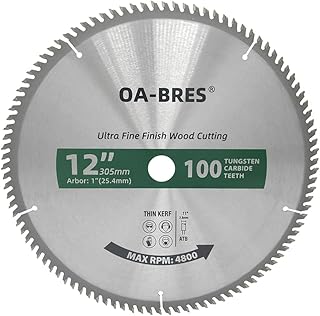
FOXBC’s 100-tooth blade is aimed squarely at ultra-smooth crosscuts, and on slow, deliberate feed rates it left very respectable finish quality on trim and furniture rails. It is best for shoppers prioritizing appearance over speed, especially on saws already tuned for accurate alignment.
Frequently Asked Questions
Is an 80-tooth or 100-tooth blade better for a 12-inch miter saw?
For finish carpentry and furniture parts, 100T usually gives the cleaner edge, especially on delicate moldings and veneered surfaces. An 80T blade often cuts a little faster and still finishes very well, so it is often the better all-around choice.
Can a table saw blade be used on a miter saw?
Sometimes yes, if diameter, arbor size, and speed rating match the saw, and the blade is appropriate for crosscut work. In practice, many blades labeled for both miter and table saw use perform best when their tooth pattern matches the job, not merely the machine.
Does thin kerf matter on a 12-inch saw?
Yes. Thin-kerf blades reduce load on the motor and can help lower-powered saws maintain speed through dense stock. Tradeoff: some thin-kerf blades feel slightly less rigid than heavier full-kerf designs if the saw or material support is not dialed in.
What blade works best for furniture building?
If visible edge quality matters most, a fine-finish 80T or 100T blade is usually the right pick. If one blade must cover crosscuts, light ripping, and general shop use, a high-quality general-purpose option like the Freud LU86R012 can be the more practical buy.
Final Thoughts
For most home furniture and trim buyers, Diablo D1280X is easiest to recommend because it balances cut quality and versatility so well. DEWALT DWA112100 is the stronger choice for dedicated fine-finish work, while Freud LU86R012 remains a smart pick for shoppers who want one capable blade for broader shop duty.