Key takeaways
- Diameter: Match the blade diameter to your table saw. A 10-inch blade is common on full-size saws, while many compact models require an 8-1/4-inch blade.
- Tooth geometry: Flat-top grind teeth are efficient for ripping and can leave a flat-bottomed kerf, while alternate-top-bevel and combination designs are more adaptable to crosscuts and finish work.
- Tooth count: Lower counts, such as 24 teeth, generally clear chips quickly during long rips. Higher counts trade speed for smoother edges and better crosscut performance.
- Kerf: Thin-kerf blades remove less material, which can reduce waste and motor load. Check that the blade is suitable for your saw and that the splitter or riving knife remains properly aligned.
- Material and fit: Carbide-tipped teeth and a correctly sized 5/8-inch arbor can support longer service life, but the blade must be free of damage and installed with the correct orientation and washers.
What's inside
Choosing a table saw rip blade is less straightforward than it looks. Tooth count, kerf width, plate design, carbide quality, and the type of wood being cut all affect whether a blade produces clean, steady rips or leaves burn marks, rough edges, and unnecessary strain on the saw. Product listings can also blur the difference between a dedicated ripping blade and a general-purpose combination blade.
From a home-appliance testing lab perspective, this guide focuses on practical compatibility and cutting behavior: arbor size, blade diameter, tooth geometry, thin-kerf efficiency, and versatility for furniture projects. These picks cover dedicated ripping, glue-line work, budget multipacks, and compact 8-1/4-inch table saws. Always confirm your saw’s manual before installation, and treat the listed tooth counts and configurations as the manufacturer specifies.
As an Amazon Associate we earn from qualifying purchases.

How to Choose a/an Table Saw Rip Blade (2026)
- Diameter: Match the blade diameter to your table saw. A 10-inch blade is common on full-size saws, while many compact models require an 8-1/4-inch blade.
- Tooth geometry: Flat-top grind teeth are efficient for ripping and can leave a flat-bottomed kerf, while alternate-top-bevel and combination designs are more adaptable to crosscuts and finish work.
- Tooth count: Lower counts, such as 24 teeth, generally clear chips quickly during long rips. Higher counts trade speed for smoother edges and better crosscut performance.
- Kerf: Thin-kerf blades remove less material, which can reduce waste and motor load. Check that the blade is suitable for your saw and that the splitter or riving knife remains properly aligned.
- Material and fit: Carbide-tipped teeth and a correctly sized 5/8-inch arbor can support longer service life, but the blade must be free of damage and installed with the correct orientation and washers.
The Best Table Saw Rip Blade (2026)s Reviewed
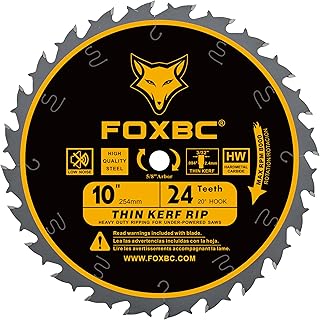
FOXBC 10-Inch Flat Tooth Ripping Blade
This 24-tooth FOXBC blade is aimed squarely at fast, efficient ripping in solid wood and sheet goods. Its flat-tooth profile and thin kerf make it a sensible choice for furniture makers who prioritize material removal and a flat-bottomed cut over highly polished crosscut edges.
Amana Tool 10-Inch Glue Line Ripping Blade
Amana Tool’s 610301 is the specialist option for cabinet and furniture work where adjoining ripped edges need to fit closely. Its 30-tooth TCG design is more refined than a basic low-tooth rip blade, making it worth considering when edge quality and repeatability matter more than maximum cutting speed.
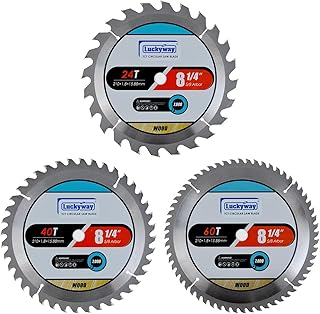
Luckyway 8-1/4-Inch Three-Blade Set
Luckyway’s set gives compact-saw owners three useful configurations: a 24-tooth framing blade, a 40-tooth ripping/crosscutting blade, and a 60-tooth finish blade. It is a practical value choice for occasional home projects, provided the 8-1/4-inch diameter and 5/8-inch arbor match the saw.
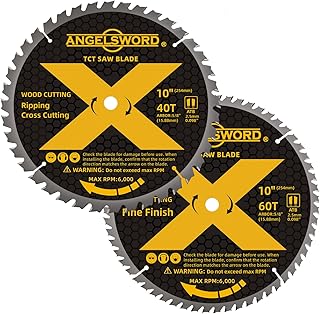
ANGELSWORD 10-Inch Two-Blade Set
This ANGELSWORD multipack pairs a 40-tooth blade for general ripping and crosscutting with a 60-tooth blade for finer wood cuts. The set favors flexibility rather than dedicated high-speed ripping, making it useful for a workshop that handles furniture panels, trim, and ordinary dimensional lumber.
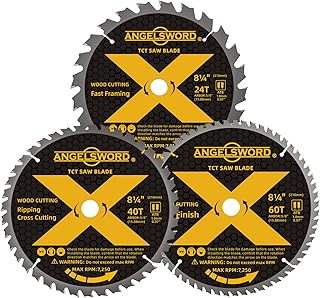
ANGELSWORD 8-1/4-Inch Three-Blade Set
Designed for smaller table saws and compatible circular saw applications, this three-piece set covers framing, general-purpose ripping and crosscutting, and fine finishing. It offers a convenient way to keep different tooth counts available without buying separate blades immediately, though users should verify that each blade is approved for their specific saw.
Frequently Asked Questions
Is a 24-tooth blade best for table saw ripping?
Often, yes, especially for long cuts in solid lumber where fast chip clearance is useful. A 24-tooth blade may leave a rougher edge than a 40- or 60-tooth blade, so the best choice depends on whether the ripped edge will be glued, jointed, or displayed.
Can I use a ripping blade for crosscutting?
You can, but it is usually not ideal. Dedicated ripping blades are optimized for cutting with the grain, while combination or higher-tooth-count blades generally provide cleaner and safer-feeling results across the grain.
What does thin kerf mean?
Thin kerf describes the width of material removed by the blade. Because less wood becomes sawdust, a thin-kerf blade can reduce waste and cutting resistance, but correct alignment with the saw’s riving knife or splitter is essential.
How often should a table saw blade be replaced?
Replace or professionally sharpen a blade when cuts become consistently rough, burning persists after alignment and cleaning, teeth are chipped, or the blade vibrates. Cutting abrasive materials, dirty reclaimed wood, or heavily glued panels can shorten its useful life.
Final Thoughts
For straightforward, efficient ripping, the FOXBC 10-Inch Flat Tooth blade is a strong starting point. Amana Tool’s Glue Line Ripping blade is the more furniture-focused pick for refined adjoining edges, while the Luckyway 8-1/4-Inch set offers the broadest configuration range for compact saw owners.