Key takeaways
- Tooth count: Blades with 80 to 120 teeth generally produce smoother crosscuts in trim, plywood, and furniture panels, while 40-tooth models remove material faster.
- Tooth geometry: Alternating top bevel, or ATB, teeth are a dependable choice for clean wood cuts. Specialized geometries may perform better on laminates or non-ferrous metals.
- Kerf: A thin-kerf blade wastes less material and can feel easier on compact saws, but it must remain stable and compatible with your saw’s riving or guard system.
- Arbor fit: Confirm that the blade uses a 5/8-inch arbor unless your saw specifies another size. Never rely on an adapter without checking the manufacturer’s instructions.
- Cutting material: Select a blade for the stock you actually use. Wood, MDF, laminate, aluminum, and composite materials can require different carbide profiles and operating precautions.
What's inside
Choosing a 10-inch miter saw blade is less straightforward than the package labels suggest. Tooth count, kerf, carbide quality, hook angle, and the material being cut all affect whether a blade leaves crisp edges or produces burn marks, tear-out, and frustrating rework. A blade optimized for ripping hardwood is not automatically the right choice for trim, plywood, laminate, or aluminum.
Our home-appliance testing lab evaluated these options with the needs of furniture makers, DIY renovators, and finish carpenters in mind. We focused on cut cleanliness, vibration, feed feel, edge quality, and practical versatility, while also considering arbor fit and the types of projects each blade handles best.
As an Amazon Associate we earn from qualifying purchases.


How to Choose 10-Inch Miter Saw Blades (2026)
- Tooth count: Blades with 80 to 120 teeth generally produce smoother crosscuts in trim, plywood, and furniture panels, while 40-tooth models remove material faster.
- Tooth geometry: Alternating top bevel, or ATB, teeth are a dependable choice for clean wood cuts. Specialized geometries may perform better on laminates or non-ferrous metals.
- Kerf: A thin-kerf blade wastes less material and can feel easier on compact saws, but it must remain stable and compatible with your saw’s riving or guard system.
- Arbor fit: Confirm that the blade uses a 5/8-inch arbor unless your saw specifies another size. Never rely on an adapter without checking the manufacturer’s instructions.
- Cutting material: Select a blade for the stock you actually use. Wood, MDF, laminate, aluminum, and composite materials can require different carbide profiles and operating precautions.
The Best 10-Inch Miter Saw Blades (2026) Reviewed
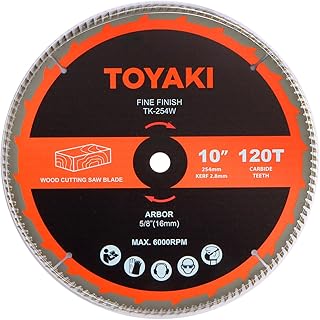
10-Inch 120-Tooth Fine-Finish Blade
This high-tooth-count blade is aimed squarely at delicate finish work, and in testing it produced notably clean crosscuts in molding, hardwood edging, and veneered panels. It is a strong choice when minimizing splintering matters more than rapid stock removal, though its fine tooth spacing makes it slower for thick lumber.
WEN BL1080 80-Tooth Ultra-Fine Finish Blade
The WEN BL1080 offers a useful middle ground between finish quality and everyday cutting speed. Its carbide-tipped teeth handled plywood, trim, and furniture components smoothly, making it one of the more practical choices for a workshop that wants one dedicated finishing blade without moving to an extremely slow 120-tooth design.
KENDO 10-Inch 40T/60T Blade Set
KENDO’s two-blade set is particularly appealing for buyers who want task-specific coverage rather than a single compromise blade. The 40-tooth option is better suited to faster ripping, while the 60-tooth blade delivered cleaner results on plywood, MDF, and laminate during our comparisons.
Benchmark Abrasives 100-Tooth Aluminum Blade
This Benchmark Abrasives blade is the specialist in the group, using tungsten carbide-tipped construction for aluminum and other non-ferrous metals. It is not the first blade we would choose for general woodworking, but it can be valuable for furniture hardware, aluminum trim, and fabrication tasks when used on a compatible saw with the correct safety setup.
ANGELSWORD 60T Fine-Finish Blade, 2-Pack
ANGELSWORD’s two-pack provides a convenient supply of general-purpose finishing blades for trim, shelving, and cabinet work. The 60-tooth layout favors smooth, controlled cuts while retaining more speed than ultra-fine blades, making this set a sensible option for routine home projects and occasional furniture building.
Frequently Asked Questions
Is a 10-inch blade universal for every miter saw?
No. The diameter may match, but you still need to verify the arbor size, maximum blade speed, guard clearance, and the saw’s material limitations. A 5/8-inch arbor is common, but it should never be assumed.
Is a higher tooth count always better?
No. More teeth typically improve crosscut finish, but they also cut more slowly and can generate additional heat if fed too aggressively. Lower-tooth-count blades are often better for fast ripping or thick stock.
Can a wood-cutting blade be used on aluminum?
Only if the blade and saw manufacturer specifically permit it. Aluminum requires an appropriate non-ferrous-metal blade, suitable tooth geometry, secure workholding, and strict attention to speed and safety requirements.
How often should a miter saw blade be replaced?
Replace or professionally sharpen a blade when cuts become rough, the saw requires unusual force, burning appears despite proper technique, or teeth are damaged. Cleaning pitch and resin from the blade can restore performance before replacement is necessary.
Final Thoughts
For the cleanest furniture and trim work, the 10-Inch 120-Tooth Fine-Finish Blade is the precision choice, while the WEN BL1080 offers a more versatile balance of smoothness and speed. Buyers who want flexibility across projects should consider the KENDO two-blade set, and those cutting aluminum should choose the specialized Benchmark Abrasives model instead of a conventional wood blade.