Key takeaways
- Sensor reheat: Detects moisture and stops when food is heated, reducing dried edges and cold centers.
- Sensor cook: Automatically selects time and power for foods such as vegetables, potatoes, rice, or frozen entrées.
- Inverter or variable-power cooking: Delivers lower power more smoothly than repeatedly switching full power on and off. This can help with defrosting and delicate foods.
- Quick-start keys: Useful for one- to six-minute heating without navigating a menu.
- Control lock: Valuable in homes with children or pets that can reach the panel.
- Mute option: Prevents beeps from disturbing sleeping children or an open-plan household.
- Keep warm: Helpful for holding food briefly, but it is not a substitute for safe temperature control during long storage.
The best built-in microwaves for most modern kitchens are 30-inch, 1.4–1.6-cubic-foot models with a matching trim kit, sensor cooking, at least 1,000 watts of power, and a cabinet opening measured from the manufacturer’s installation drawing—not from the microwave’s advertised width.
Best built-in microwaves by kitchen situation
| Kitchen situation | Best choice | What to prioritize | Typical price range |
|---|---|---|---|
| Small apartment or narrow remodel | 24-inch compact built-in | 0.9–1.2 cu. ft., 900–1,200 watts, shallow depth | $500–$1,000 |
| Family kitchen | 30-inch countertop-style microwave with trim kit | 1.4–1.6 cu. ft., 1,000 watts or more, sensor reheating | $700–$1,400 |
| Frequent cooking and browning | Combination speed oven | Microwave plus convection or broil, stronger ventilation planning | $1,500–$4,000+ |
| Children and pets | Built-in unit with recessed controls and door lock | Control lock, cool-touch door, easy-clean interior | $700–$1,600 |
| Replacing an existing appliance | Same-brand or same-opening replacement | Exact cutout width, height, depth, hinge clearance, and trim-kit model | $700–$1,500 |
Our strongest built-in microwave categories
Best all-around: a 30-inch, 1.4–1.6-cubic-foot microwave
This is the most practical choice for a full-size kitchen. It accommodates a standard dinner plate, a medium casserole dish, and many 9-by-13-inch rectangular containers, although the turntable and interior corners determine whether a particular dish actually fits. Look for 1,000–1,200 watts, ten or more power levels, sensor reheat, sensor cook, a keep-warm function, and a removable glass turntable.

Frigidaire Gallery Series GMBS3068BF 2.2 cu. ft. Built-in Microwave Oven, Trim Kit Sold Separately
Included for 'Best Built-In Microwaves for Modern Kitchens' because the listing specifies Trim Kit Sold Separately, details this guide uses to compare options.
View on Amazon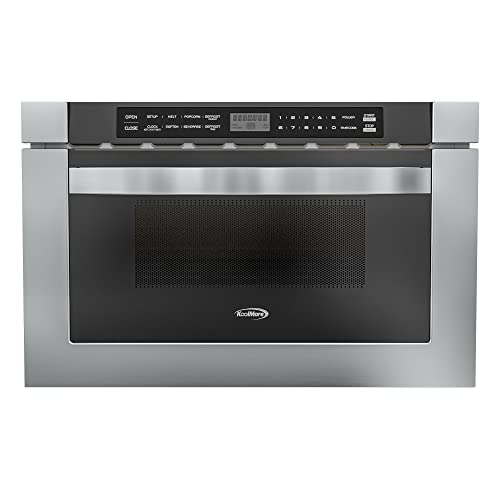
KoolMore 24 Inch Stainless-Steel Microwave Drawer with 1.2 cu. ft. Capacity, 1000W Power with 10 Custom Cooking Levels, Memory, and Timer Functions, Wall-Mounted with Flat Bottom (KM-MD-1SS)
Included for 'Best Built-In Microwaves for Modern Kitchens' because the listing specifies 1000W Power with 10 Custom Cooking Levels and Memory, details this guide uses to compare options.
View on Amazon
Summit 24" Built-in Microwave with Trim Kit, Stainless Steel - SMBI24
Included for 'Best Built-In Microwaves for Modern Kitchens' because the listing specifies Stainless Steel and SMBI24, details this guide uses to compare options.
View on Amazon
CAMPLUX 30" Over-the-Range Microwave Oven with Convection, 1.5 Cu. Ft.
Included for 'Best Built-In Microwaves for Modern Kitchens' because the listing specifies 1.5 Cu. Ft., details this guide uses to compare options.
View on AmazonExamples of this category include the Bosch 500 Series HMB50152UC, KitchenAid KMBS104ESS, and comparable built-in models from GE Profile and Frigidaire. Confirm the current model number and trim-kit compatibility before ordering; manufacturers sometimes change the required kit even when the microwave’s exterior looks similar.
Best for a small kitchen: a 24-inch compact built-in
A compact model saves cabinet width but gives up usable cooking area. Around 0.9–1.2 cubic feet is suitable for reheating bowls, mugs, vegetables, and ordinary plates. It may not comfortably fit a large casserole or a tall travel mug while the turntable is installed.
Compact microwaves are useful in apartments and secondary kitchen zones, but measure the door swing carefully. A 24-inch cabinet opening can leave little space for a neighboring wall, refrigerator, or tall filler panel. Allow at least 2 inches of open space beside the hinge side unless the installation instructions specify otherwise.
Best for replacing a wall oven: a combination speed oven
Speed ovens combine microwave energy with convection heat, broiling, or both. They can bake, brown, and crisp foods that a conventional microwave cannot. The trade-off is cost, learning curve, and installation complexity. A speed oven is not automatically a replacement for a full-size wall oven: its cavity is usually smaller, and some models require a dedicated electrical circuit.
GE Profile Advantium models are a well-known example of this category. Bosch, Miele, and other premium manufacturers also sell combination ovens. Choose one when you will actually use convection or broiling several times a week; otherwise, a simpler microwave offers better value and fewer functions to maintain.
Capacity is more important than the exterior width
Manufacturers describe capacity in cubic feet, but that number does not tell you the maximum usable dish size. Check the turntable diameter, interior height, and cavity width. A 1.5-cubic-foot microwave with a smaller turntable may be less useful for a wide rectangular dish than a differently shaped 1.4-cubic-foot model.
For family meals, measure the largest plate or container you use. Add roughly 1 inch of clearance on each side so it can rotate without striking the cavity wall. If you regularly heat tall containers, confirm the interior height with the turntable in place. A removable turntable can help with rectangular dishes, but it does not solve a low ceiling.
Trim-kit fit and installation dimensions
A built-in microwave is usually a countertop microwave enclosed by a metal trim kit, or a purpose-built appliance designed for a cabinet opening. The trim kit is not merely decorative: it supplies the finished border, directs airflow, and establishes the required clearances. Never combine a microwave and trim kit solely because both are the same width.
| Dimension to measure | Useful planning range | Why it matters |
|---|---|---|
| Nominal cabinet width | 24 or 30 inches | Matches the trim-kit family, not necessarily the appliance body |
| Opening height | About 15–18 inches for many standard units | A few extra millimeters can prevent the trim frame from fitting |
| Opening depth | Usually at least 21–24 inches | Accounts for the appliance, rear cord space, and ventilation |
| Side clearance | Often 0–2 inches, model-specific | Protects the door swing and nearby cabinet finish |
| Front projection | Commonly 23–26 inches | Prevents collision with a walkway or adjacent drawer |
These are planning ranges, not universal specifications. Use the installation sheet for the exact model. A cabinet installer should also leave room for the power cord and avoid trapping it behind the unit. Many built-in microwaves use a standard grounded receptacle, while combination ovens may require a higher-amperage dedicated circuit.
Ventilation: microwave air is not always cooking ventilation
A standard built-in microwave needs airflow to remove heat from its electronics. Its vents may be located at the front, sides, top, or rear, so a tightly enclosed cabinet can cause overheating even when the appliance physically fits. Follow the required upper, side, and rear clearances rather than sealing gaps with trim or caulk.
Do not assume a built-in microwave replaces a range hood. A microwave installed in a wall oven-style cabinet usually does not capture steam, smoke, grease, or combustion products from a cooktop. If the appliance is above a range, it must be specifically designed for over-the-range installation and may require ducted or recirculating ventilation. For a separate wall installation, keep a real range hood over the cooking surface.
Sensor functions and controls worth paying for
- Sensor reheat: Detects moisture and stops when food is heated, reducing dried edges and cold centers.
- Sensor cook: Automatically selects time and power for foods such as vegetables, potatoes, rice, or frozen entrées.
- Inverter or variable-power cooking: Delivers lower power more smoothly than repeatedly switching full power on and off. This can help with defrosting and delicate foods.
- Quick-start keys: Useful for one- to six-minute heating without navigating a menu.
- Control lock: Valuable in homes with children or pets that can reach the panel.
- Mute option: Prevents beeps from disturbing sleeping children or an open-plan household.
- Keep warm: Helpful for holding food briefly, but it is not a substitute for safe temperature control during long storage.
Touchscreens look polished but can be slower when your hands are wet or greasy. Physical buttons and a rotary dial are often easier to operate quickly. A bright display is helpful, but avoid a model whose controls are unreadable from your normal standing position.
Cleaning and durability realities
Stainless-steel interiors resist discoloration better than painted interiors, while enamel or ceramic surfaces can be easier to wipe clean after splatters. The most useful feature is a removable turntable and roller ring that can be washed in the sink. A recessed or sealed control panel leaves fewer crevices for grease, but aggressive cleaners can damage printed labels and touch-sensitive surfaces.
The parts most likely to become inconvenient first are the door switches, turntable coupler, roller ring, and touch-control membrane. Repeatedly slamming the door, running the oven empty, or blocking ventilation shortens service life. A microwave should sit level; an uneven installation can make the turntable wobble and put extra stress on the door.
Moving a built-in unit is also less casual than moving a countertop microwave. The appliance may weigh roughly 50–90 pounds, and a speed oven can be heavier. Plan for two-person lifting, protect the trim frame, and check that the unit can pass through the narrowest doorway or hallway. A 30-inch trim frame may need to be removed before delivery into a tight kitchen.
How to choose the right model
- Measure the cabinet opening at its narrowest points, including width, height, and depth.
- Measure your largest plate, casserole, and tallest container.
- Decide whether you need microwave-only heating or convection and broiling.
- Download the installation guide and verify trim-kit, outlet, and ventilation requirements.
- Choose controls you can read and operate without reaching awkwardly.
- Confirm the door swing, neighboring clearances, cleaning method, warranty, and replacement-part availability.
For most households, the best built-in microwaves are not the ones with the longest feature list. A correctly fitted 30-inch model with useful sensors, reliable airflow, an easy-clean cavity, and controls you will use every day is a better choice than a powerful appliance that requires cabinet changes or leaves your favorite dishes outside.