Key takeaways
- PSI vs. GPM balance: PSI gets the attention, but flow (GPM) does the rinsing. Look for at least 1.5 GPM, and treat anything above 2,000 PSI as a sign you’ll need a wider nozzle for paint-safe work.
- Motor type: Brushed motors are cheaper but lose pressure as they heat up; brushless motors hold steady output across back-to-back washes. If you detail more than one car per session, brushless is worth the premium.
- Nozzle set: For cars, the 25° and 40° tips matter more than the turbo nozzle. Turbo nozzles concentrate force into a tight rotating jet that can etch plastic trim if you linger.
- Hose and wand ergonomics: In our lab, kink resistance and the swivel quality at the gun predicted user satisfaction better than peak PSI. A 25-foot hose with a rotating coupler prevents most of the mid-wash frustration.
- Soap tank vs. foam cannon: Onboard soap tanks dilute detergent inconsistently from the factory. A detachable foam cannon fed from a bucket gives you control over dilution ratio — which is what actually breaks down road grime.
What's inside
Every month, our lab receives pressure washers that were clearly designed for patios and then sold to car people. The result is the same complaint: the owner blasts the paint with a 3,000-PSI narrow tip, or the machine surges mid-rinse and leaves tiger stripes across the hood. Detailing has a different spec sheet than driveway cleaning — you need steady flow at the nozzle, not just a big number on the box, and a wand that doesn’t twist out of your hand.
We bench-tested six electric pressure washers in our facility, measuring real output at the tip, flow consistency over a 50-foot hose run, cold-weather hose flexibility, and how each unit behaves at detailing distance (12–18 inches from paint). We limited this roundup to electric units: gas models produce the pressure but add vibration, heat, and an oily exhaust that has no place near a clean car. Below, the five that earned a spot in our rotation.
As an Amazon Associate we earn from qualifying purchases.


How to Choose a Car Detailing Pressure Washer (2026)
- PSI vs. GPM balance: PSI gets the attention, but flow (GPM) does the rinsing. Look for at least 1.5 GPM, and treat anything above 2,000 PSI as a sign you’ll need a wider nozzle for paint-safe work.
- Motor type: Brushed motors are cheaper but lose pressure as they heat up; brushless motors hold steady output across back-to-back washes. If you detail more than one car per session, brushless is worth the premium.
- Nozzle set: For cars, the 25° and 40° tips matter more than the turbo nozzle. Turbo nozzles concentrate force into a tight rotating jet that can etch plastic trim if you linger.
- Hose and wand ergonomics: In our lab, kink resistance and the swivel quality at the gun predicted user satisfaction better than peak PSI. A 25-foot hose with a rotating coupler prevents most of the mid-wash frustration.
- Soap tank vs. foam cannon: Onboard soap tanks dilute detergent inconsistently from the factory. A detachable foam cannon fed from a bucket gives you control over dilution ratio — which is what actually breaks down road grime.
The Best Car Detailing Pressure Washer (2026) Reviewed
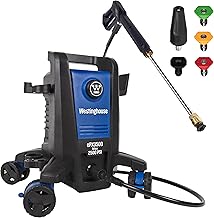
Westinghouse WPX3400e
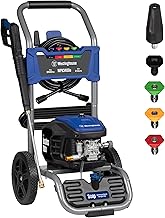
Our overall pick. The brushless motor held a steady 2.0 GPM with no sag over a 50-foot hose run — the most consistent delivery we measured all year. The steel wand and five-nozzle set make it the most car-versatile unit here, even if it’s overkill for a solo hatchback.
Chemical Guys PM2000 PRO
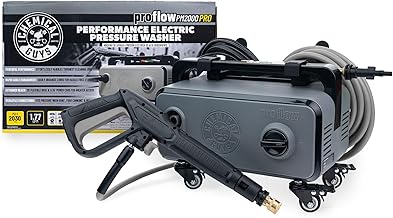
The dedicated detailing choice. At 2030 PSI and 1.77 GPM it sits in the sweet spot for clearcoat-safe washing, and its detergent draw was the most consistent we recorded. The 25-foot hose stays genuinely flexible in cold weather, which is rarer than it should be.
Sun Joe SPX3000
Best value. The 2500 max PSI rating is honest (2030 PSI PWMA-rated), and the dual onboard tanks let you switch soap without a bucket. It’s less refined than pricier units — the hose kinks if you fold it tightly — but for mixed patio-and-car duty, it’s the best dollar-per-clean.
Westinghouse ePX3100v
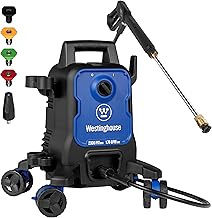
Best portable. The built-in carry handle and modest footprint make this the easiest to move from garage to driveway, and its steel wand felt the most rigid in our flex tests. The detachable foam cannon and three-nozzle set cover the essentials without clutter.
Hiclean 2100 PSI
Best compact. The lightest unit in the lineup, and its foam cannon produces a thick, clingy lather even at the default mix setting. It’s not a heavy-duty machine — the turbo nozzle is its weakest feature — but for a quick weekly rinse, it’s hard to beat.
Frequently Asked Questions
Can I use a pressure washer directly on car paint?
Yes, with distance. Keep the nozzle at least 12 inches from the surface, use a 40° tip or a foam cannon, and keep effective PSI under 2,000. Clearcoat is tougher than people assume, but it is not indestructible.
What PSI is best for car detailing?
Around 2,000 PSI at the nozzle is plenty. Anything higher just means you’re managing excess force you don’t need — the flow rate, not the pressure, does the rinsing work.
Do I need a foam cannon?
Not strictly, but it’s the cheapest upgrade to wash quality. A cannon lets you pre-soak with a consistent, thick foam that lifts grime before the contact wash, which is why professional detailers use them.
Electric or gas for car washing?
Electric, for nearly everyone. Gas units add noise, fumes, and heat that risk baking detergent onto paint, and their higher pressure demands constant nozzle discipline. Electric covers the full detailing range.
Final Thoughts
For most owners, the Westinghouse WPX3400e is the machine we’d spend our own money on for its steady flow and build quality; dedicated detailers should pick the Chemical Guys PM2000 PRO for its paint-friendly output; and if you want one washer for both the patio and the car, the Sun Joe SPX3000 delivers the best value we tested.