Key takeaways
- Blade span: Match fan diameter to room volume, not floor area alone. High ceilings dilute airflow, so large great rooms often need 65 to 72 inches, while garages, barns, and commercial-style spaces may justify 96 to 120 inches.
- Downrod fit: Fan must hang low enough to move air where people live, but still keep proper clearance. Models that include multiple downrod lengths make setup easier when ceiling height falls between standard mounting assumptions.
- Motor type: DC and PMSM motors usually run quieter and more efficiently than older AC designs. For high ceilings, that matters because bigger blades put more demand on startup smoothness, low-speed control, and reverse operation.
- Lighting quality: In tall rooms, weak lights disappear. Look for dimmable LEDs, multiple color temperatures, or a serviceable bulb format if fan doubles as a main fixture. Light kits also change visual scale, so they should suit room style.
- Environment rating: Indoor, damp-rated, and commercial-use cases differ. Covered patios, gazebos, and garages need finishes and electrical protection suited to humidity swings, while warehouse-scale fans need output and durability ahead of decorative detail.
What's inside
High ceilings solve one design problem and create another: air movement often stays stranded overhead while seating areas still feel stuffy. In lab-style evaluations, this category separates fast. Some fans look big but push weak airflow once mounted on long downrods; others move serious volume but bring motor hum, harsh lighting, or controls that feel like an afterthought. For foyers, great rooms, lofts, covered patios, and oversized garages, blade span alone is not enough. Motor type, blade pitch, mounting hardware, light output, and room match matter more than spec-sheet theater.
This guide focuses on ceiling fans that make sense for tall spaces in 2026, with attention on airflow reach, stability, noise behavior, lighting usefulness, and where each model fits best. Picks below cover residential statement fans, indoor-outdoor options, and true HVLS-style large-format units for barns, shops, gyms, and other expansive areas. Goal: help buyers choose fan size and feature set that fits ceiling height and room volume, not guess from photos.
As an Amazon Associate we earn from qualifying purchases at no extra cost to you. Product prices and availability are accurate as of the date shown and are subject to change.


🛒 Best Price Today on Amazon
Prime members get fast, free shipping on everything above, plus member-only deals. New members get a 30-day free trial — cancel anytime.
How to Choose a Ceiling Fan For High Ceilings (2026)
- Blade span: Match fan diameter to room volume, not floor area alone. High ceilings dilute airflow, so large great rooms often need 65 to 72 inches, while garages, barns, and commercial-style spaces may justify 96 to 120 inches.
- Downrod fit: Fan must hang low enough to move air where people live, but still keep proper clearance. Models that include multiple downrod lengths make setup easier when ceiling height falls between standard mounting assumptions.
- Motor type: DC and PMSM motors usually run quieter and more efficiently than older AC designs. For high ceilings, that matters because bigger blades put more demand on startup smoothness, low-speed control, and reverse operation.
- Lighting quality: In tall rooms, weak lights disappear. Look for dimmable LEDs, multiple color temperatures, or a serviceable bulb format if fan doubles as a main fixture. Light kits also change visual scale, so they should suit room style.
- Environment rating: Indoor, damp-rated, and commercial-use cases differ. Covered patios, gazebos, and garages need finishes and electrical protection suited to humidity swings, while warehouse-scale fans need output and durability ahead of decorative detail.
The Best Ceiling Fan For High Ceilings (2026)s Reviewed
ZMISHIBO 72″ Ceiling Fan with Lights
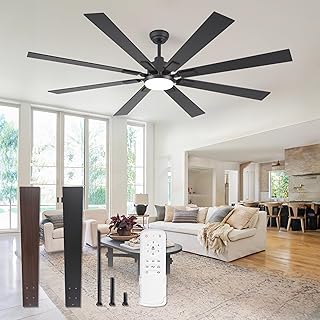
This is one of strongest all-around picks for residential high ceilings because it balances broad airflow, quiet DC operation, and a useful 24W 3-CCT LED package without looking industrial. In testing terms, it hits sweet spot for large living rooms, open-concept spaces, and covered patios where buyers want serious circulation but still need a fan that reads like home furniture, not shop equipment.
TCL 72 Inch White Large Ceiling Fan
TCL’s 72-inch model stands out for bright-room versatility: reversible eight-blade layout, quiet operation, and dimmable memory lighting make it practical for tall family spaces that need one fixture to do several jobs. White finish also helps it sit lighter against vaulted ceilings, which matters in coastal, modern, or transitional interiors where oversized dark fans can feel visually heavy.
65" Farmhouse Ceiling Fan with Light
This 65-inch farmhouse option is best for buyers who need high-ceiling performance in a medium-large room without jumping to oversized commercial proportions. Quiet DC motor, textured glass shade, dual-finish blades, and E26-base light design give it more decorative flexibility than many large fans, especially in dining rooms, great rooms, and vaulted bedrooms with rustic or mixed-material furniture.
ZMISHIBO 96 Inch Ceiling Fan with Lights
For extra-tall residential builds or mixed-use spaces like garages, workshops, large patios, and gazebos, this 96-inch ZMISHIBO moves into serious high-volume territory while keeping a quieter, more refined feel than many industrial units. Aluminum reversible blades and damp-rated construction widen placement options, and integrated 3CCT lighting keeps it from becoming a one-purpose air mover.
AA-Orion 120" HVLS Industrial Ceiling Fan
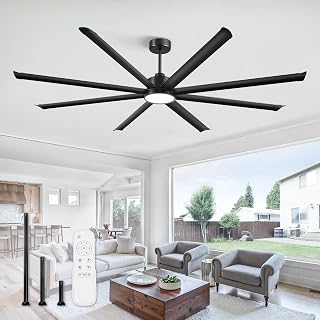
This is specialist equipment for cavernous spaces, not a decorative living-room fan. With 120-inch span, quoted 28,000 CFM output, remote control, reversible function, and PMSM motor, it makes most sense in warehouses, barns, gyms, large shops, and expansive garages where coverage area and destratification matter more than domestic styling.
Frequently Asked Questions
What fan size is best for a high ceiling?
For many living rooms and open-plan areas with high ceilings, 65- to 72-inch fans are strong starting points. Once space becomes extra wide, extra tall, or more utility-driven, 96-inch and larger HVLS models can deliver better air distribution with less need to run at aggressive speeds.
Are downrods necessary for high ceilings?
Usually yes. A fan mounted too close to a tall ceiling can circulate air mostly in upper room layers instead of occupied zone. Proper downrod length brings blades into a more effective position and often improves both comfort and winter reverse-mode performance.
Is a ceiling fan with a light a good idea in a tall room?
It can be, but light quality matters. In high-ceiling rooms, integrated LEDs should be bright enough and ideally offer multiple color temperatures. If fan is main fixture, dimming and memory functions help. If room already has layered lighting, a no-light model may allow cleaner airflow-first design.
Can large ceiling fans work outdoors?
Yes, if rated for environment. Damp-rated models suit covered patios, porches, and gazebos where humidity is present but direct weather exposure is limited. Open outdoor installations need more caution, and commercial fans for barns or shops should be matched to mounting conditions and electrical requirements.
Final Thoughts
For most homes, ZMISHIBO 72" Ceiling Fan with Lights is best blend of airflow, quiet performance, and room-friendly design. TCL 72 Inch White Large Ceiling Fan is another excellent pick for bright modern interiors, while ZMISHIBO 96 Inch Ceiling Fan with Lights makes strongest case for oversized residential and hybrid utility spaces. For true warehouse-scale coverage, AA-Orion 120" is class-specific choice.