Key takeaways
- Hammer mechanism: A standard hammer drill uses rapid impacts for small masonry holes; an SDS rotary hammer delivers a more forceful mechanical action and is the better choice for frequent or larger concrete drilling.
- Chuck and bits: A 1/2-inch keyless chuck is versatile for ordinary drill bits and masonry bits, while an SDS chuck accepts specialized bits that transfer impact energy more efficiently.
- Battery capacity: Concrete work draws significant power. Two batteries or a higher-capacity pack reduce interruptions, especially when drilling several holes in succession.
- Control: Variable speed, multiple gear ranges, and a clutch help prevent slipping and make it easier to start holes cleanly without damaging anchors or fasteners.
- Workload: Match the drill to the job. Occasional shelves and wall anchors need less tool than repeated drilling, deep holes, or hard aggregate, where an SDS model is usually the safer bet.
What's inside
Concrete exposes the weak points in cordless drills quickly: a tool that feels capable in wood can bog down, overheat, or lose its grip when faced with masonry. Buyers also have to sort through very different categories, from compact hammer drills for occasional wall anchors to SDS rotary hammers designed for repeated drilling in hard concrete.
From a home-appliance testing lab perspective, this guide focuses on usable drilling performance rather than headline torque alone. We considered hammer action, chuck or bit compatibility, control, battery provisions, handling, and the type of concrete work each model realistically suits.
As an Amazon Associate we earn from qualifying purchases.



How to Choose a Cordless Hammer Drill For Concrete (2026)
- Hammer mechanism: A standard hammer drill uses rapid impacts for small masonry holes; an SDS rotary hammer delivers a more forceful mechanical action and is the better choice for frequent or larger concrete drilling.
- Chuck and bits: A 1/2-inch keyless chuck is versatile for ordinary drill bits and masonry bits, while an SDS chuck accepts specialized bits that transfer impact energy more efficiently.
- Battery capacity: Concrete work draws significant power. Two batteries or a higher-capacity pack reduce interruptions, especially when drilling several holes in succession.
- Control: Variable speed, multiple gear ranges, and a clutch help prevent slipping and make it easier to start holes cleanly without damaging anchors or fasteners.
- Workload: Match the drill to the job. Occasional shelves and wall anchors need less tool than repeated drilling, deep holes, or hard aggregate, where an SDS model is usually the safer bet.
The Best Cordless Hammer Drills For Concrete (2026) Reviewed
DEWALT 20V MAX SDS Rotary Hammer Drill
The DCH273B is the specialist pick for serious masonry work, with three application modes and an SDS design that is better suited to concrete than a conventional keyless chuck. It is a bare tool, so existing DEWALT 20V MAX owners have the clearest value proposition; new buyers must budget for a compatible battery and charger.
Dong Cheng 20V Brushless Heavy-Duty Impact Drill
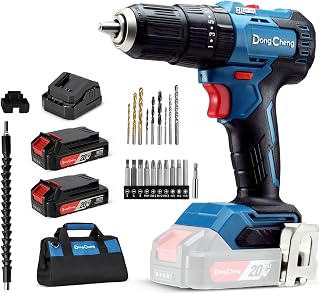
This kit combines a brushless motor, a metal 1/2-inch chuck, a 20+1+1 clutch, and two batteries, making it a practical all-around option for homeowners. Its stated 27,000 impacts per minute should handle light-to-moderate masonry tasks, although it is better viewed as a general-purpose hammer drill than a replacement for an SDS rotary hammer.
CRAFTSMAN V20 Cordless Hammer Drill Kit
The CMCD711C2 is appealing for routine household jobs because it includes two batteries and a charger rather than requiring a separate power investment. Its conventional hammer-drill format is appropriate for smaller holes in brick or concrete block, with the compact, familiar layout also lending itself to furniture assembly and general repairs.
DCA 20V Brushless Hammer Drill
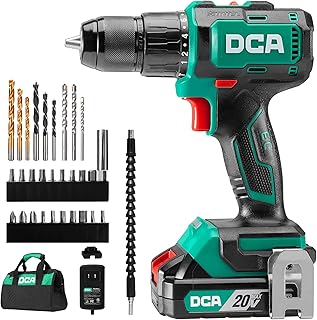
The ADJZ2055i offers a useful balance of compact size, brushless operation, an all-metal chuck, and a supplied 2.0Ah battery and charger. Its 18+1+1 clutch and two-speed range provide sensible control for mixed materials, while the included battery is best suited to intermittent drilling rather than extended concrete sessions.
DCK 20V Brushless Hammer Drill
The KDJZ05-13 stands out on paper with a 4.0Ah battery, 22+1+1 clutch, all-metal chuck, and a high stated impact rate. That combination makes it attractive for buyers wanting more runtime and adjustment range in a general-purpose tool, though larger or repeated holes in dense concrete still favor the DEWALT SDS format.
Frequently Asked Questions
Can a cordless hammer drill drill into concrete?
Yes, provided it uses masonry bits and has a functioning hammer mode. Standard hammer drills are most comfortable with smaller holes; drilling slowly, using light pressure, and clearing dust can help prevent overheating and bit binding.
Is an SDS rotary hammer better than a hammer drill for concrete?
For hard concrete, larger holes, or repeated work, usually yes. SDS tools transmit impact energy more effectively and generally reduce effort, but they are less versatile for ordinary screwdriving and require SDS-compatible bits.
Do I need a high-torque drill for wall anchors?
Not necessarily. For typical shelves, brackets, and light fixtures, speed control and a suitable masonry bit matter as much as torque. Excessive force can enlarge the hole or damage the surrounding surface.
Should I buy a bare tool or a complete kit?
A bare tool makes sense if you already own compatible batteries. Otherwise, a kit with at least one battery and a charger is usually simpler and can be more economical, particularly for occasional household projects.
Final Thoughts
The DEWALT 20V MAX SDS Rotary Hammer is the strongest choice for demanding concrete work, while the Dong Cheng 20V and DCA 20V models are versatile kit options for lighter masonry and general home repairs. For buyers who prioritize runtime and a broad adjustment range, the DCK 20V is also worth considering.