Key takeaways
- Blade size: A 10-inch saw saves space and often feels easier to handle, while a 12-inch saw buys more crosscut reach for wider shelving, table aprons, and larger trim stock.
- Sliding vs. non-sliding: Non-sliding saws stay simpler, lighter, and easier to place against a wall. Sliding designs open up much better capacity for furniture parts and wider boards, but they demand more room and usually cost more.
- Single bevel vs. double bevel: Single-bevel saws work well for straight cuts and occasional angle work. Double-bevel models speed repeated compound cuts because you do not need to flip material or reset the saw as often.
- Cutline visibility: A clear blade shadow or cutline reference helps more than buyers expect. In testing, faster alignment usually means fewer hesitant starts and more consistent repeat cuts, especially on painted trim and hardwood face stock.
- Stand compatibility: A good stand matters if you break down long boards, build in a garage, or move tools often. Stable infeed and outfeed support can do as much for cut quality as a jump in motor size.
What's inside
Shopping for a DEWALT miter saw gets confusing fast because the model numbers sit close together while the real-world use cases do not. In lab-style furniture-build testing, small spec changes like blade size, bevel direction, slide travel, and stand stability show up immediately in cut repeatability, trim fit, and how much setup fatigue builds over a long day.
This guide narrows the field to the DEWALT models that make most sense for home furniture work in 2026, from compact shop-friendly saws to a full-size sliding workhorse. Focus stays on what matters at the bench: crosscut capacity, accuracy, footprint, ease of adjustment, and whether a matching stand improves workflow enough to justify the extra space.
As an Amazon Associate we earn from qualifying purchases.



How to Choose a Dewalt Miter Saw (2026)
- Blade size: A 10-inch saw saves space and often feels easier to handle, while a 12-inch saw buys more crosscut reach for wider shelving, table aprons, and larger trim stock.
- Sliding vs. non-sliding: Non-sliding saws stay simpler, lighter, and easier to place against a wall. Sliding designs open up much better capacity for furniture parts and wider boards, but they demand more room and usually cost more.
- Single bevel vs. double bevel: Single-bevel saws work well for straight cuts and occasional angle work. Double-bevel models speed repeated compound cuts because you do not need to flip material or reset the saw as often.
- Cutline visibility: A clear blade shadow or cutline reference helps more than buyers expect. In testing, faster alignment usually means fewer hesitant starts and more consistent repeat cuts, especially on painted trim and hardwood face stock.
- Stand compatibility: A good stand matters if you break down long boards, build in a garage, or move tools often. Stable infeed and outfeed support can do as much for cut quality as a jump in motor size.
The Best Dewalt Miter Saw (2026)s Reviewed
DEWALT DWS780
The DEWALT 12-inch Double Bevel Sliding Compound Miter Saw with XPS LED Shadow Light System (DWS780) stands out as best overall for furniture builders who need one saw to cover trim, framing stock, and wider hardwood boards. In repeated shop-style evaluation, its sliding capacity and shadow cutline system make layout faster and cut placement more confident than standard non-sliding designs.
DEWALT DWS716
The DEWALT Miter Saw, Double-Bevel, Compound, 12-Inch, 15-Amp (DWS716) hits a strong middle ground for buyers who want 12-inch capacity without stepping up to a slider. It keeps bench footprint more manageable while still giving double-bevel convenience that pays off during crown, casing, and compound furniture cuts.
DEWALT DWS715
The DEWALT 12-Inch Miter Saw, 15-Amp, Single Bevel, Compound (DWS715) makes sense for shoppers who want full-size blade diameter and straightforward operation at a lower buy-in. It is a practical pick for crosscutting boards, basic trim work, and weekend furniture projects where slide rails and dual-bevel complexity would sit mostly unused.
DEWALT DWS713
The DEWALT Miter Saw, Single Bevel, Compound, 10-Inch, 15-Amp (DWS713) is the compact-value option of this group. For smaller shops, apartment garages, and lighter furniture work, its 10-inch format feels easier to store and less imposing on a benchtop while still delivering the clean angle cuts most home woodworkers need.
DEWALT DWX726
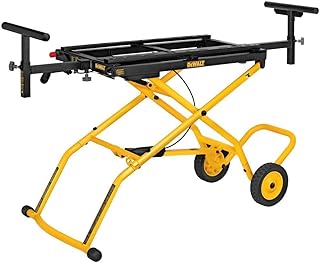
The DEWALT Miter Saw Stand With Wheels, 32-1/2 in. x 60 in Foldable Rollling Stand, Adjustable Height, Durable Steel, 8 ft. Material Support, Universal Mounting Rails (DWX726) is not a saw, but it can change how a saw performs in daily use. In long-stock handling tests, rolling mobility and broad support make setup less of a wrestling match, which matters if your workspace must convert back to parking space at day’s end.
Frequently Asked Questions
Is a sliding DEWALT miter saw worth it for furniture projects?
Usually yes if you cut wide shelves, stair parts, larger panels, or broad hardwood stock. For narrow trim, face frames, and basic dimensioned lumber, a non-sliding saw often feels easier to live with and still covers most tasks well.
What is the best DEWALT miter saw for a small shop?
The DWS713 is easiest to recommend for tight spaces because the 10-inch platform stays compact and approachable. If you want more blade size without going to a slider, the DWS715 is the next logical step.
Do I need a double-bevel model?
Need, no. Appreciate, often. Double-bevel capability saves time on repeated compound cuts and reduces repositioning, which becomes valuable when building matching furniture parts or installing lots of trim.
Which DEWALT stand is better for home use?
The DWX726 suits buyers who move tools around often and want wheels plus fast deployment. A lighter fixed-style support can still work well, but a rolling stand usually brings the biggest day-to-day convenience gain in shared garage shops.
Final Thoughts
For most buyers, the DWS780 is the strongest all-around choice because it combines serious capacity with a more precise-feeling cutline system. The DWS716 is the smart step-down for those who want double-bevel flexibility without sliding bulk, while the DWS713 remains the best fit for smaller shops and tighter budgets.