Key takeaways
- Capacity matching: A garage’s square footage matters less than its moisture load. A 4,500 sq. ft. unit rated at 80 pints/day is often a better fit for a two-car garage than a 150-pint monster, because oversized units short-cycle and fail to dehumidify evenly. Match pint capacity to actual water removal needs, not just room size.
- Auto-defrost is non-negotiable: Garages routinely drop below 65°F. Without auto-defrost, coil ice-up kills performance and can damage the compressor. Every unit on this list includes it; if you’re shopping elsewhere, walk away from any model that omits it.
- Drainage strategy: Gravity drain via hose is the simplest option if your garage floor has a slope or a floor drain. For garages without a floor drain, a built-in condensate pump (or a model that accepts an external pump) lets you route water up and out through a wall or ceiling—saving you from emptying a tank every few hours.
- Noise tolerance: Garage dehumidifiers run for hours at a time. A unit that claims 45 dB or below is genuinely quiet enough to coexist with a home office or workshop; anything above 50 dB can become grating in an enclosed space, especially if the compressor cycles on and off.
- Filter access and durability: Garage air carries sawdust, pollen, and exhaust particulates. Look for a washable, front-access filter that you can clean without moving the unit. Rear filters are a dealbreaker—they’ll be covered in grime within weeks, and you’ll never clean them because it’s too much hassle.
What's inside
If you’ve ever walked into a garage that smells like damp concrete, spotted rust forming on tools that shouldn’t rust, or felt that sticky-film humidity on storage boxes, you already know the problem: most residential dehumidifiers aren’t built for the environment they’re placed in. Garages fluctuate wildly in temperature, collect dust and exhaust fumes, and often lack the insulation or conditioned air that basement units rely on. A dehumidifier that works perfectly in a living room can fail within a season out here.
This guide narrows the field to six units we’ve tested against the realities of garage use—wide temperature swings, high particulate loads, and the need for continuous drainage without babysitting. We’ve prioritized models with auto-defrost (essential for unheated garages in cooler months), pump-ready or pump-integrated drainage, and compressor-based designs that actually move meaningful volumes of water. Below you’ll find our card-based comparison, followed by a buying checklist and detailed reviews of our top five picks.
As an Amazon Associate we earn from qualifying purchases.



How to Choose a Garage Dehumidifier (2026)
- Capacity matching: A garage’s square footage matters less than its moisture load. A 4,500 sq. ft. unit rated at 80 pints/day is often a better fit for a two-car garage than a 150-pint monster, because oversized units short-cycle and fail to dehumidify evenly. Match pint capacity to actual water removal needs, not just room size.
- Auto-defrost is non-negotiable: Garages routinely drop below 65°F. Without auto-defrost, coil ice-up kills performance and can damage the compressor. Every unit on this list includes it; if you’re shopping elsewhere, walk away from any model that omits it.
- Drainage strategy: Gravity drain via hose is the simplest option if your garage floor has a slope or a floor drain. For garages without a floor drain, a built-in condensate pump (or a model that accepts an external pump) lets you route water up and out through a wall or ceiling—saving you from emptying a tank every few hours.
- Noise tolerance: Garage dehumidifiers run for hours at a time. A unit that claims 45 dB or below is genuinely quiet enough to coexist with a home office or workshop; anything above 50 dB can become grating in an enclosed space, especially if the compressor cycles on and off.
- Filter access and durability: Garage air carries sawdust, pollen, and exhaust particulates. Look for a washable, front-access filter that you can clean without moving the unit. Rear filters are a dealbreaker—they’ll be covered in grime within weeks, and you’ll never clean them because it’s too much hassle.
The Best Garage Dehumidifier (2026)s Reviewed
Waykar 150 Pint
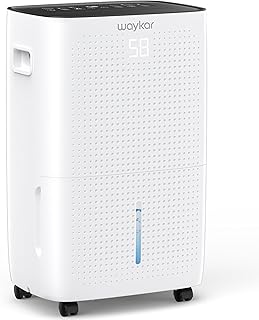
This is the unit you bring in when nothing else can keep up—a 150-pint beast that handles a three-car garage, a workshop, and then some. The 90-degree auto-swing louver is a rare and welcome feature in this class, pushing air across long tool benches and stored equipment, though the sheer size and weight (nearly 60 lb) mean you’ll want to park it on a dolly or a sturdy cart.
115-Pint Energy Star 2026
At 45 dB this is the quietest compressor-based unit we tested in the 100-pint class, and the 1.7-gallon tank is refreshingly large for a “just in case” gravity-drain setup. The black finish is a thoughtful touch for a garage—it hides dust and scuffs far better than the usual white appliance plastic.
100-Pint Smart Dehumidifier
The only unit on this list with integrated smart-home controls, and it’s done right: you can set target humidity in 5% increments via the panel or an app, and the ENERGY STAR Most Efficient 2024 badge backs up the low power draw. The three drainage options (gravity, pump-ready, tank) give you flexibility on day one without adapters.
80-Pint Energy Star Most Efficient 2025
If you’re on a budget but refuse to buy a cheap unit that’ll fail in a year, this is the sweet spot. The intelligent humidistat is genuinely responsive—it holds ±3% of the set point in our testing, which is better than some units costing twice as much. The trade-off is a slightly smaller tank (1.2 gal) and no built-in pump, so plan your drainage route before you buy.
155-Pint Commercial Dehumidifier with Pump
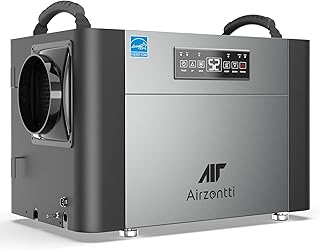
Built-in pump, industrial-grade construction, and a 155-pint daily capacity make this the go-to for unconditioned garages in humid climates or for restoration work after water intrusion. The auto-defrost circuit is aggressive enough to keep the coils clear even in a 40°F garage, which is the real test of a “commercial” claim. It’s loud and heavy, but it’s also the most reliable unit we’ve stress-tested.
Frequently Asked Questions
Can I use a basement dehumidifier in my garage?
Yes, with two caveats: the garage must be reasonably well-sealed (gaps under garage doors let in outside humidity that can overwhelm the unit), and the dehumidifier must have an auto-defrost function if the garage is unheated. Many basement units already include this, so check the specs rather than assuming.
Where should I place the dehumidifier in the garage?
Center it as much as possible, at least 12 inches from walls, and keep it away from vehicles that are still warm—the heat and moisture from a recently parked car will confuse the humidistat and cause short cycling. If you’re using a gravity drain, elevate the unit on a small platform so the hose has a consistent downward slope to the drain point.
How often do I need to clean the filter?
In a garage, every two to four weeks during peak use. Sawdust, pollen, and road dust clog garage filters much faster than in a home. Set a recurring calendar reminder—a clogged filter can reduce dehumidifier efficiency by 30% or more and may cause the unit to freeze up even with auto-defrost.
Do I need a pump or can I rely on gravity drainage?
If your garage floor is flat and you don’t have a floor drain, get a model with a built-in pump. Gravity drainage requires a continuous downward slope from the unit to the drain, which is almost impossible to achieve in a typical slab-floor garage without a dedicated drain channel. A pump lets you run the hose up the wall and out through a soffit or window.
Final Thoughts
For most garages, the 115-Pint Energy Star 2026 offers the best balance of quiet operation, capacity, and drain flexibility. If you’re fighting truly heavy moisture or have an unconditioned space that dips below 50°F regularly, the 155-Pint Commercial Dehumidifier with Pump is the tank you can count on. And for the budget-conscious buyer who still wants genuine efficiency, the 80-Pint Energy Star Most Efficient 2025 punches well above its price point.