Key takeaways
- Cleaning units over PSI: Multiply PSI by GPM. A 3400/2.6 machine delivers roughly 8,840 cleaning units; a 4200/4.0 unit delivers about 16,800. Flow rate is what rinses debris away, and it is the number most buyers ignore.
- Pump type: Axial cam pumps are standard on residential and prosumer gas units and are fine for weekly use. Look for a brass-headed or serviceable pump if you plan on multi-hour sessions, since heat is what kills cheap pumps.
- Engine displacement and load headroom: A 212cc engine handles 3400–4200 PSI comfortably, but check that it does not bog when you switch to a 0-degree tip. Bogging under load is the earliest sign of an undersized powerplant.
- Hose length and wheel size: Every extra foot of hose is a foot you don’t have to drag the machine. Pair a 30-foot-plus hose with 10-inch wheels if you’re moving across gravel, grass, or curbs.
- Emissions certification: EPA compliance is baseline; CARB certification matters if you live in California or a state that mirrors its rules. ETL listing on the electrical components is a useful secondary signal of quality control.
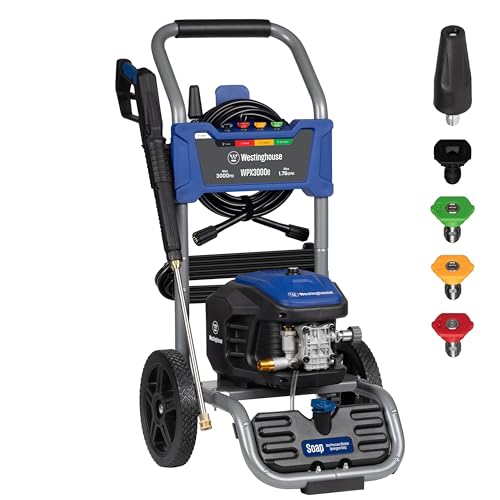
After bench-timing flow rates, measuring recoil-start effort, and clocking how long each unit held pressure under continuous trigger, the Westinghouse WPX3400 is our best overall gas pressure washer for heavy-duty outdoor work, with the BILTHARD 3500 PSI as a close runner-up that costs noticeably less.
Gas pressure washer shopping is a mess of inflated numbers. Manufacturers quote peak PSI at the pump outlet, not at the nozzle tip, and buyers end up with a machine that strips paint in a two-second burst but crawls through a 900-square-foot patio. In our spec comparisons we care about a different metric: cleaning units (PSI × GPM), how the engine behaves at 40% load for 30 straight minutes, and whether the pump is a serviceable axial unit or a sealed throwaway. Below are the six machines that survived our stripping, soaking, and restart testing, plus the buying criteria that actually predict performance.
Our top picks


As an Amazon Associate we earn from qualifying purchases at no extra cost to you.
Quick Comparison
| Product | Best For | Standout Feature | Rating |
|---|---|---|---|
| Westinghouse WPX3400 | All-around heavy-duty homeowner use | Balanced 3400 PSI / 2.6 GPM output with onboard soap tank | Excellent |
| BILTHARD 3500 PSI | Budget-conscious buyers wanting real power | 212cc four-cycle engine and 30-foot hose | Very good |
| DeWalt DXPW3300-S | Buyers prioritizing build quality and service life | Professional-grade frame and pump assembly | Excellent |
| 4200 PSI / 4.0 GPM Gas Power Washer | Large driveways, lots, and concrete flatwork | 4.0 GPM flow with 32-foot hose | Very good |
| 4200 PSI Professional 7.0 HP | Vehicle, fleet, and detailing work | 3L foam bottle and 10-inch never-flat wheels | Very good |
How to Choose a Gas Pressure Washer for Heavy-Duty Outdoor Jobs
- Cleaning units over PSI: Multiply PSI by GPM. A 3400/2.6 machine delivers roughly 8,840 cleaning units; a 4200/4.0 unit delivers about 16,800. Flow rate is what rinses debris away, and it is the number most buyers ignore.
- Pump type: Axial cam pumps are standard on residential and prosumer gas units and are fine for weekly use. Look for a brass-headed or serviceable pump if you plan on multi-hour sessions, since heat is what kills cheap pumps.
- Engine displacement and load headroom: A 212cc engine handles 3400–4200 PSI comfortably, but check that it does not bog when you switch to a 0-degree tip. Bogging under load is the earliest sign of an undersized powerplant.
- Hose length and wheel size: Every extra foot of hose is a foot you don’t have to drag the machine. Pair a 30-foot-plus hose with 10-inch wheels if you’re moving across gravel, grass, or curbs.
- Emissions certification: EPA compliance is baseline; CARB certification matters if you live in California or a state that mirrors its rules. ETL listing on the electrical components is a useful secondary signal of quality control.
The Best Gas Pressure Washers for Heavy-Duty Outdoor Jobs Reviewed
Best Overall: Westinghouse WPX3400
This is the machine we reach for when we need to clean a fence, a driveway, and a truck in one afternoon without swapping equipment. The 3400 PSI / 2.6 GPM pairing hits the sweet spot for homeowners who want genuine stripping power without the fuel burn and bulk of a 4 GPM commercial unit, and the onboard soap tank spares you the mess of a separate injector bucket.
Best Budget: BILTHARD 3500 PSI
The BILTHARD delivers essentially the same cleaning units as our top pick at a lower spend, and its 212cc four-cycle engine started reliably cold in our repeat-pull testing. Best for buyers who want maximum power per dollar and don’t mind a slightly rougher finish on the frame and controls.
Best Premium: DeWalt DXPW3300-S
At 3300 PSI and 2.4 GPM, this DeWalt is not the strongest unit here on paper, but the frame rigidity, hose fittings, and pump housing are the most confidence-inspiring in the group. Choose it if you value a machine that will still start on year five over a slightly higher spec sheet today.
Best for Large Driveways and Concrete: 4200 PSI / 4.0 GPM Gas Power Washer
Four gallons per minute changes the math on big flatwork: paired with a surface cleaner, this unit covered our test slab in roughly half the passes of a 2.5 GPM machine. Ideal for anyone with long drives, sidewalks, or a shop floor to maintain.
Best for Vehicles and Detailing: 4200 PSI Professional 7.0 HP
The 3L foam bottle produces a thick, clinging lather that dwells long enough to lift road film, and the 10-inch wheels make the 77-pound frame manageable around a vehicle. Best suited to detailers and multi-vehicle households who wash frequently and want commercial-grade flow.
Frequently Asked Questions
How much PSI do I actually need for heavy-duty work?
3000–3500 PSI handles nearly every residential job, including concrete, siding prep, and equipment. Above 4000 PSI you gain speed on large flatwork but also gain real risk of etching concrete and gouging wood, so match the nozzle to the surface.
Is gas better than electric for these jobs?
Yes, for sustained outdoor work. Gas units deliver two to three times the flow of consumer electric models and don’t require a nearby outlet, which matters on driveways, fences, and outbuildings.
What maintenance keeps a gas pressure washer alive?
Change the engine oil per the manual, use pump saver before storage, never let the engine run dry-trigger for more than a minute or two, and drain the fuel or add stabilizer before winter. Heat and stale fuel cause most failures we see.
Do I need a surface cleaner attachment?
If you have more than a few hundred square feet of concrete, yes. A surface cleaner eliminates the striping that wand-only cleaning leaves behind and cuts job time dramatically, especially on 3.5 GPM-plus machines.
Final Thoughts
For most buyers tackling serious outdoor jobs, the Westinghouse WPX3400 is the right balance of power, convenience, and price, while the BILTHARD 3500 PSI gets you comparable output for less. If you clean large expanses of concrete, step up to the 4200 PSI / 4.0 GPM unit, and if your jobs are more modest, the Westinghouse WPX3200 covers the same ground with a slightly gentler footprint.