Key takeaways
- Power source: Choose a rechargeable model for roadside convenience, or select dual-power support if you want the security of a vehicle socket or household adapter when the battery is empty.
- Pressure range: A rating around 150 to 160 PSI is more than enough for most passenger tires, bikes, balls, and inflatables. Maximum pressure is less important than maintaining useful airflow under load.
- Inflation speed: Look for clear performance claims tied to a specific tire size and starting pressure. Larger batteries, dual-cylinder designs, and higher airflow generally help with repeated or heavy-duty inflation.
- Controls and accuracy: A readable digital gauge, preset pressure settings, and automatic shut-off reduce guesswork. Confirm the displayed units match the pressure specification for your vehicle or equipment.
- Handling and durability: Check weight, grip, hose length, light placement, and cooling design. A compact compressor is easiest to carry, while a larger battery and sturdier housing may be preferable for multiple tires.
What's inside
A flat tire is inconvenient enough without discovering that a compact inflator is slow, inaccurate, or out of power when you need it. In a home-appliance testing lab, we look beyond headline PSI figures: useful performance depends on inflation speed, pressure accuracy, controls, heat management, portability, and how easily the unit fits into an everyday emergency kit.
This guide compares five handheld air compressors for cars, motorcycles, bicycles, sports balls, and household inflatables. We focus on the features that matter in practical use, including battery flexibility, automatic shut-off, display readability, hose and accessory storage, and whether a model is better suited to occasional top-ups or more demanding jobs.
As an Amazon Associate we earn from qualifying purchases.



How to Choose a Handheld Air Compressor (2026)
- Power source: Choose a rechargeable model for roadside convenience, or select dual-power support if you want the security of a vehicle socket or household adapter when the battery is empty.
- Pressure range: A rating around 150 to 160 PSI is more than enough for most passenger tires, bikes, balls, and inflatables. Maximum pressure is less important than maintaining useful airflow under load.
- Inflation speed: Look for clear performance claims tied to a specific tire size and starting pressure. Larger batteries, dual-cylinder designs, and higher airflow generally help with repeated or heavy-duty inflation.
- Controls and accuracy: A readable digital gauge, preset pressure settings, and automatic shut-off reduce guesswork. Confirm the displayed units match the pressure specification for your vehicle or equipment.
- Handling and durability: Check weight, grip, hose length, light placement, and cooling design. A compact compressor is easiest to carry, while a larger battery and sturdier housing may be preferable for multiple tires.
The Best Handheld Air Compressor (2026)s Reviewed
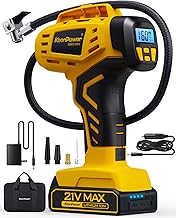
21V Battery-Powered 160PSI Tire Inflator
This compact 21V inflator is a practical generalist for drivers who want cordless operation with a backup power option. Its digital gauge and auto shut-off simplify routine top-ups, while the dual-power design is useful when you would rather not depend solely on battery charge.
AstroAI Cordless Tire Inflator
The AstroAI Cordless Tire Inflator combines a 160 PSI rating with preset controls and dual-power support. It is a sensible choice for a mixed household kit because the same basic format can handle car tires, motorcycle tires, bike tires, and balls without requiring a separate pump for each task.
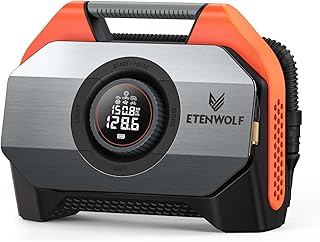
ETENWOLF VORTEX S6
The ETENWOLF VORTEX S6 is the heavy-duty pick in this group, with a 19,200mAh battery, dual-cylinder construction, and a stated 100% duty cycle. Its larger battery and robust design favor repeated inflation and larger vehicles, although that capability comes with more bulk than a minimalist emergency inflator.
150 PSI Cordless Tire Pump
This cordless model emphasizes straightforward everyday use: a 150 PSI digital gauge, LED light, and a claimed two-times-faster inflation design. It suits drivers looking for a relatively simple emergency pump that can also cover bicycles, motorcycles, and sports equipment.
160 PSI DeWalt-Compatible Tire Inflator
For households already invested in DeWalt 20V batteries, this upgraded inflator offers a convenient way to share an existing battery platform while retaining dual power modes. Its advertised four-times-faster inflation claim should be treated as a use-case comparison rather than a universal result, but the platform compatibility can be its strongest advantage.
Frequently Asked Questions
What PSI should I use in a car tire?
Use the vehicle manufacturer’s recommended cold-tire pressure, usually printed on the driver’s door-jamb label or in the owner’s manual. Do not use the maximum PSI molded into the tire sidewall as the target inflation pressure.
Are handheld air compressors suitable for completely flat tires?
Many can refill a tire from low pressure, but speed varies substantially with tire size, battery charge, temperature, and compressor airflow. If the tire will not hold air or has come off the rim, inflation alone is not a safe repair; inspect it and seek professional assistance.
Is a 160 PSI rating necessary?
Not for most cars. Passenger-vehicle tires typically require far less than 160 PSI, so the rating mainly indicates the compressor’s upper operating range. Airflow, thermal performance, gauge behavior, and battery capacity are more useful buying criteria.
How should I maintain a cordless inflator?
Keep the intake vents clear, store the unit dry, recharge the battery according to its instructions, and avoid leaving it in extreme heat. Check the hose connector and power cable periodically, and allow the compressor to cool if the manufacturer specifies rest periods.
Final Thoughts
The AstroAI Cordless Tire Inflator is a balanced everyday choice, while the ETENWOLF VORTEX S6 is better suited to repeated or heavy-duty work. Buyers already using DeWalt 20V batteries should give the DeWalt-compatible inflator serious consideration; for occasional roadside top-ups, the 21V dual-power model offers a useful blend of flexibility and simplicity.