Key takeaways
- Hands-free wringing leaves the pad dry enough for one-pass floors on most surfaces
- Round head reaches tight corners and under low furniture better than flat pads
- Bucket footprint is bulky for small bathrooms or closets where storage space is limited
A buyer looking for the best mop has one concrete problem: they want a floor that dries clean without spending ten minutes wringing a dripping string head or pushing a wet pad back and forth three times over. The difference between a mop that feels effortless and one that feels like punishment comes down to three things — whether the wringing mechanism actually removes water from the pad, how much clean water the bucket can deliver before it turns gray, and how many times the pad survives washing without shedding fibers.
The products below fall into two clear design camps: spin mops with integrated buckets that centrifuge water out of the pad, and flat spray mops that skip the bucket entirely and dispense solution from a trigger. Neither camp is universally superior. Large open kitchens with tile floors favor the spin-mop approach because the bucket lets you rinse the pad mid-job. Quick daily touch-ups on sealed hardwood favor a spray mop because there is no bucket to store and no water to carry. Owner feedback on each model reveals where those lines blur, and that is where this comparison earns its keep.
As an Amazon Associate we earn from qualifying purchases at no extra cost to you. Product prices and availability are accurate as of the date shown and are subject to change.





Quick Picks
| Product | Best for | Price |
|---|---|---|
| O-Cedar EasyWring (Standard) | General tile and vinyl cleaning | $34.99 |
| Spray Mop with Microfiber Pads | Hardwood floors, small apartments | $18.98 |
| O-Cedar EasyWring + 2 Extra Refills | Households needing pad longevity | $44.96 |
| O-Cedar RinseClean | Bone-dirty floors, allergy sufferers | $49.96 |
| O-Cedar MicroTwist MAX | Large floors, hands-free wringing on a budget | $19.11 |
| Swiffer PowerMop | Carpet-adjacent routines, no-bucket preference | $29.49 |
| JOYMOOP Wall Mop and Bucket Set | Ceiling and wall cleaning, commercial use | $31.59 |
| Beyoco Spray Mop | Lowest-cost spray mop for renters | $14.17 |
How We Picked
We compared published specifications, list prices, and aggregate owner feedback across all eight models. The criteria that matter most in this category are wringing effectiveness (how dry the pad comes out, which determines whether your floor finishes in one pass or three), pad durability (how many washes a microfiber pad survives before shedding or losing grip), bucket design (whether the rinse compartment stays clean long enough to avoid re-depositing dirt), and total cost of ownership (replacement pad or refill availability and price beyond the initial kit).
The 8 Best Mop in 2026
O-Cedar EasyWring Microfiber Spin Mop, Bucket Floor Cleaning System, Red, Gray, Standard
This is the default recommendation for anyone with tile, vinyl, or sealed hardwood who mops weekly and does not want to think too hard about technique. The foot-operated spinner wrings the pad without you touching it, and the bucket separates rinse water from spin water. Owner feedback consistently highlights the ease of getting the pad dry enough that floors finish in a single pass. The microfiber head rotates 360 degrees and reaches under furniture where a flat pad cannot.
- Hands-free wringing leaves the pad dry enough for one-pass floors on most surfaces
- Round head reaches tight corners and under low furniture better than flat pads
- Bucket footprint is bulky for small bathrooms or closets where storage space is limited
Skip it if your floors are all sealed hardwood and you only mop twice a month — a spray mop will feel less like a project.
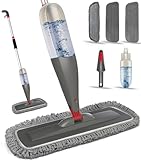
Spray Mop for Hardwood Tile Floor Cleaning with Microfiber Washable Pads
This is the budget spray mop that lets you clean a medium-sized hardwood floor without carrying a bucket around. The trigger dispenses a fine mist directly onto the pad, so you control moisture precisely. Owners like that it transitions from kitchen to hallway without rinsing anything. The microfiber pads are washable and hold shape well across multiple cycles. The tradeoff is capacity: the onboard bottle holds enough solution for roughly one room before you need to refill.
- No bucket means you can store it flat in a closet or under a sink without rearranging plumbing supplies
- Trigger control lets you avoid over-wetting sensitive engineered wood
- Small tank means refilling mid-job on open-plan layouts larger than 800 square feet
Skip it if you mop large tile areas where the pad picks up visible grit — you need a rinse bucket.
O-Cedar EasyWring Microfiber Spin Mop & Bucket Floor Cleaning System + 2 Extra Refills, Red/Gray
Same platform as the standard EasyWring but with two replacement microfiber heads included, which matters because owners report that the pads last the longest when rotated between jobs. If you mop three or four rooms weekly, having a clean pad ready without waiting for a laundry cycle changes the experience meaningfully. The wringing and bucket mechanics are identical to the base model. The price difference over the standard version is modest enough that buying this version outright is easier than tracking down refills later.
- Extra refills reduce downtime between mopping sessions and extend the useful life of the kit
- Proven spin-wring mechanism that owners consistently rate above hand-wring alternatives
- Still the same bucket bulk as the standard version; the added value is in the pads, not storage design
Skip it if you already own a standard EasyWring — the refills alone are cheaper as a standalone purchase.
O-Cedar RinseClean Spin Mop & Bucket System
This is the upgrade for anyone who has noticed their mop water turning gray halfway through a room and wonders whether they are just spreading dirt in a new pattern. The RinseClean bucket uses a two-compartment design that filters rinse water, so the pad contacts cleaner water with each pass. O-Cedar advertises 99 percent bacteria removal in combination with the spin action. Owners with pets or young children on tile floors cite this as the reason they switched from the standard EasyWring. The premium over the base model buys a meaningfully better rinse cycle.
- Filtered rinse water keeps the pad cleaner through longer sessions, reducing streaks and re-soiling
- Spin mechanism combined with clean-water delivery produces the driest finish in this lineup
- Highest price in the group; the bucket mechanism has more parts that owners report needing occasional disassembly to clean
Skip it if your floors are mostly smooth vinyl and you mop weekly — the standard EasyWring will not show a visible difference on that schedule.
O-Cedar MicroTwist MAX Microfiber Twist Mop with 1 Extra Refill
The MicroTwist MAX is for anyone with a large floor area who wants hands-free wringing without committing to a bucket they have to store or carry. The twist mechanism uses a rope-loop handle to squeeze the pad by twisting, which works without electricity or foot pedals. The 18-inch head covers more square footage per pass than any other mop in this list. Owners with open-concept layouts or commercial hallways call it the fastest way to get a large floor dry. The single included refill softens the pad-replacement cost.
- 18-inch head means fewer passes on wide, open floors and faster overall completion
- Twist wringing needs no bucket, no power, and no foot coordination — works on stairs and uneven terrain
- Twisting by hand gets tiring on long sessions; owners with limited wrist strength report discomfort after large areas
Skip it if your floors are small and cluttered — a round or flat head maneuvers better around furniture legs and tight corners.
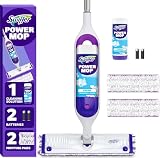
Swiffer PowerMop Mopping Kit
Swiffer’s PowerMop sits in a niche that neither spin mops nor standard spray mops fill: a battery-powered mop that vibrates its pad to loosen grime while dispensing cleaning solution through the same motion. No bucket, no wringing, no refilling a spray bottle. The kit includes two replacement pads, one liquid solution refill, and two batteries. Owners who already use Swiffer Sweeper or wet mops find this a natural step up for stuck-on messes. The vibration helps with dried spills on tile that a static pad struggles to lift.
- Vibrating action helps break up dried or sticky residue without scrubbing
- Completely self-contained: no bucket to store, fill, dump, or clean between uses
- Ongoing cost of proprietary pads and solution refills adds up faster than washable microfiber options
Skip it if you are trying to reduce recurring supply costs or prefer washable pads that do not fill landfills.
JOYMOOP Wall Mop and Bucket Set
JOYMOOP is the only product here designed to be angled for vertical surfaces as well as floors. The flat head with 3 washable microfiber pads works on ceilings, walls, baseboards, and glass partitions in addition to tile and hardwood. The included bucket supports a wring-and-rinse cycle without a spinner mechanism. Commercial cleaners and homeowners tackling bathroom wall mold or high-ceiling dust in stairwells report that this is the simplest tool for jobs where a floor mop cannot reach or stay vertical. The hands-free flat wring means you are not squeezing a pad at arm’s length above your head.
- Handles vertical surfaces and tight spaces (window tracks, shower glass, top of cabinets) in the same session
- Flat wring design requires less grip strength than twist or pedal systems, useful for older users
- Flat pad collects less debris from floor-level grit than a round or twist head; better as a complement than a sole floor mop
Skip it if your primary need is floor-only cleaning on rough tile — a round or twist head grips uneven grout lines better.
Beyoco Spray Mop for Hardwood Floors Cleaning with 3 Washable Pads
At $14.17, this is the lowest-priced entry in the group and the only one under fifteen dollars. The spray mechanism is straightforward: trigger dispenses your own solution mix onto a flat pad, and you wipe. Three washable microfiber pads come in the box. Owners who rent and want a basic tool for laminate or sealed wood floors, or who want a second mop for a garage or mudroom without spending thirty dollars, call it a good value. Build quality is noticeably lighter than the O-Cedar or Swiffer options — the handle flexes under pressure, and the spray bottle seal loosens after heavy use.
- Lowest upfront cost; includes three pads, so no immediate refill purchase is needed
- Lightweight and compact — stores in a narrow closet or under a kitchen sink without rearranging anything
- Handle flexes on dense or textured surfaces; owners report the spray head leaks after a few months of frequent use
Skip it if you mop large open areas weekly or have unsealed grout that needs more rinse capacity than a spray bottle can provide.
Buying Guide
Wringing mechanism determines your actual effort
Three wringing styles exist in this lineup: pedal-driven spin, hand-twist, and no-wring (spray mops and the Swiffer). Pedal spin produces the driest pad with the least physical effort and is the single feature that separates a five-minute job from a twenty-minute one. Hand-twist (the MicroTwist MAX) works without a bucket or power but demands repetitive wrist motion that becomes tiring over large areas. If your floors need to be bone-dry to avoid streaks or slip hazards — bathrooms with tile, kitchens with vinyl — prioritize spin. If you only mop small hardwood rooms and prefer minimal storage, a spray mechanism avoids the wring entirely.
Pad type and replacement cost drive long-term value
Microfiber is the pad material across all eight products, but pad geometry differs: round heads rotate and reach under furniture; flat heads clean edge-to-edge along baseboards. The hidden cost is replacement frequency. Owners report microfiber pads losing their scrub surface after 30 to 50 wash cycles depending on detergent and dryer heat. The EasyWring + Extra Refills bundle addresses this directly. The Swiffer PowerMop relies on proprietary disposable pads that cannot be washed, making it the highest recurring-cost option despite its moderate $29.49 entry price.
Bucket design and water management affect real-world cleanliness
A bucket mop is only as good as how long the rinse water stays clean enough to actually rinse. The RinseClean is the only model here with a filtration step that separates debris from rinse water, which is why its owner reviews mention fewer streaks on dark tile. Standard spin buckets collect dirt in the same compartment used for rinsing, meaning water turns murky within two or three rooms on a messy floor. If your household tracks in visible grit (pets, construction nearby, children), bucket filtration is a decisive feature. If your floors are maintained weekly and mostly show light dust, a standard bucket is adequate and cheaper.
Our Verdict
The overall best mop in this comparison is the O-Cedar EasyWring Microfiber Spin Mop & Bucket Floor Cleaning System + 2 Extra Refills at $44.96. It offers the most proven wringing mechanism, extra pad longevity out of the box, and owner feedback that consistently places it above the competition for general use. The budget pick is the O-Cedar MicroTwist MAX at $19.11 — it delivers hands-free wringing, a wide head for large areas, and an included refill at a price that undercuts most flat spray mops while offering better water control. The one condition under which another product wins outright: if you mop tile floors that look streaky or feel grimy even after cleaning, the O-Cedar RinseClean at $49.96 is the only bucket in this list with a filtration system that keeps rinse water genuinely clean through a whole-floor session.
FAQ
Can I use a spray mop on unsealed grout?
Technically yes, but a spray mop will not rinse dirt away — it only lifts what the damp pad contacts. Unsealed grout absorbs grime deep into its pores, and without a rinse bucket to flush the pad, you will redistribute that grime rather than remove it. For unsealed grout, a spin mop with a bucket is the better tool.
How often should I replace microfiber mop pads?
Most owner-reported data puts the useful life of a microfiber mop pad between 30 and 50 wash cycles, after which fibers begin shedding and grip decreases noticeably. You do not need to replace on a schedule — replace when the pad stops picking up visible lint or leaves streaks on a clean floor.
Is a flat mop or a round mop better for tile?
Round mop heads pivot and fit into grout intersections and under furniture, which makes them better for textured or uneven tile. Flat heads cover large smooth tile faster in straight lines but struggle to reach corners without angling the handle awkwardly. If your tile is smooth porcelain with thin grout, a flat spray mop works well enough for routine cleaning.
Do I need a spin bucket if I already own a regular bucket?
A spin bucket does something a regular bucket cannot: it wrings the pad without your hands touching dirty water. A regular bucket lets you rinse but not wring, so the pad stays oversaturated and leaves floors wet and streaky. The convenience gap is significant enough that most owners who upgrade to a spin system do not return to hand-rinsing, regardless of how heavy or expensive the upgrade was.