Key takeaways
- Rigid framed panels: Usually more durable and efficient per dollar, but heavier and awkward to carry. They need a separate stand or roof-mounting solution.
- Suitcase-style folding panels: The best balance for car camping. Hinges and fabric handles add convenience but are the parts most likely to wear first.
- Fabric-backed foldable panels: Light and packable, but they should not be dragged, sharply bent, or left where water can pool.
- IP65 or IP68 ratings: These indicate resistance to dust and water under defined test conditions, not permission to leave every connector submerged. Keep exposed plugs elevated and dry whenever possible.
Best Portable Solar Panels for Camping
The best portable solar panel for most campers is a foldable 100W panel with a built-in stand, weather-resistant construction, and an MC4 or proprietary connector that matches your power station; choose a 60–80W panel for lightweight travel, 120–200W for backup power, and a USB-equipped panel only when you plan to charge small devices without a battery station.
Portable solar panels are rated under ideal laboratory sunlight, so a “100W” panel will not continuously deliver 100W at a campsite. Angle, cloud cover, heat, shade, cable loss, and the panel’s charge controller commonly reduce useful output. In good midday sun, a 100W panel may produce roughly 50–85W, while a 200W model may deliver about 100–170W. That difference matters more than the printed wattage when you are charging a battery for a fridge, camera equipment, or emergency backup.

Renogy 200W Portable Solar Panel for Power Stations, 25% Efficiency
Included for 'Best Portable Solar Panels for Camping' because the listing specifies 25% Efficiency, details this guide uses to compare options.
View on Amazon
MHPOWOS 220W Portable Solar Panel 40V Folding Solar Panel for Power Station
Included for 'Best Portable Solar Panels for Camping' as a relevant option in this category; details come from the product listing.
View on Amazon
FlexSolar 100W Foldable Portable Solar Panel Charger IP67 Waterproof
Included for 'Best Portable Solar Panels for Camping' as a relevant option in this category; details come from the product listing.
View on Amazon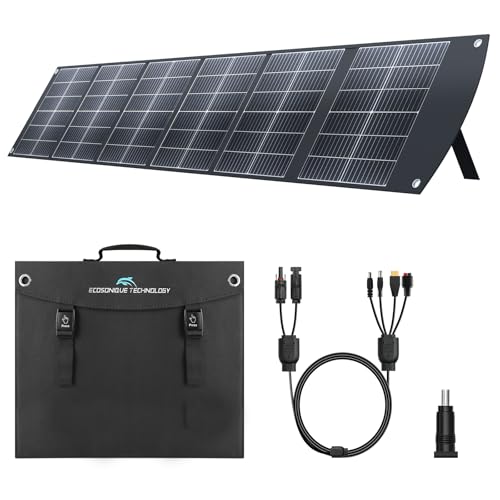
Ecosonique 200W Portable Foldable Solar Panel MC4 Output for Power Station
Included for 'Best Portable Solar Panels for Camping' as a relevant option in this category; details come from the product listing.
View on AmazonBest portable solar panels by camping situation
| Best for | Recommended type | Useful specification | Why it fits |
|---|---|---|---|
| Backpacking and air travel | Lightweight 60–80W folding panel | Under 8 lb; folded length under 25 in | Easier to carry, though slower for power stations |
| Car camping | 100–120W folding panel | About 10–25 lb; built-in kickstand | A practical balance of output, setup time, and packability |
| Portable refrigerator or multi-day camp | 160–220W folding panel | MC4-compatible or parallel-capable connectors | Replaces more battery capacity each sunny day |
| Emergency home backup | 200W or larger portable array | Weather-resistant panels and long extension cables | Better for maintaining a power station during outages |
| Phone-only charging | 20–40W USB solar panel | USB-C output with regulated charging | Compact, but inconsistent in shade and poor weather |
Head-to-head: leading foldable panel options
EcoFlow 110W Portable Solar Panel
The EcoFlow 110W Portable Solar Panel is a strong all-around choice for car camping when you already use an EcoFlow power station. It folds into a suitcase-style case, has an integrated adjustable stand, and uses a rugged fabric-covered construction with an IP68 water- and dust-resistance rating. Its rated output is 110W, and its folded size is approximately 16.5 by 20.2 inches, depending on the version and region. Weight is about 8.8 lb.
Its main advantage is convenience: the stand, case, and compatible connector make it quick to place beside a vehicle. It is better suited to battery stations than direct phone charging because the panel itself is not a general-purpose USB charging hub. Expect a typical market price of roughly $200–$300. Choose it for organized car camping, especially if your power station uses EcoFlow’s solar input without an adapter.
BLUETTI PV120
The BLUETTI PV120 is a 120W folding panel designed for BLUETTI power stations and other systems that accept compatible solar connectors. It weighs approximately 12.5 lb and folds to around 21 by 18 inches. The panel includes a built-in kickstand and is commonly rated IP65 for protection from dust and low-pressure water jets.
Compared with lighter 100W panels, the PV120 gives a modest output advantage without becoming a large two-panel setup. Its trade-off is bulk: 12.5 lb is comfortable in a car but excessive for backpacking. A typical market range is about $200–$300. It is a sensible pick for campers running lights, cameras, laptops, or a small cooler from a BLUETTI battery.
Jackery SolarSaga 100
The Jackery SolarSaga 100 is a widely recognized 100W folding panel for Jackery portable power stations. It weighs about 11.6 lb and folds to approximately 24 by 21 inches. The panel has a built-in stand and USB-A and USB-C ports on versions that include the integrated charging box, allowing some small devices to be charged directly.
The direct USB ports are useful when you do not want to run a power station for a phone or headlamp. However, solar USB charging is vulnerable to brief shade: when the output dips, a phone may pause charging or repeatedly reconnect. The SolarSaga 100 is also typically less weather-protected than panels designed for prolonged exposure, so it should be brought inside during heavy rain. Prices usually fall around $150–$250, depending on the package and model generation.
Anker SOLIX PS100 Portable Solar Panel
The Anker SOLIX PS100 is a 100W folding panel aimed at Anker SOLIX power stations. It is compact for its class, with a suitcase-style fold and an integrated stand, and commonly weighs around 11 lb. Its solar connector and charging compatibility make it most convenient within the Anker ecosystem.
This type of panel is a good travel compromise: more capable than a small USB panel but easier to manage than a 200W array. Check the exact connector and water-resistance rating before purchase because specifications can vary by regional model. A typical market range is approximately $150–$250.
Goal Zero Nomad 100
The Goal Zero Nomad 100 is a foldable 100W panel intended for Goal Zero Yeti power stations and portable off-grid charging. It is designed for outdoor use and includes a built-in stand, but its folded dimensions and weight are generally less compact than lightweight backpacking panels. It is a better match for vehicle-based travel than for hiking several miles from a trailhead.
Choose it when compatibility with an existing Goal Zero setup matters more than minimizing every pound. A typical price range is about $200–$300. As with any ecosystem-specific panel, verify the cable arrangement and input limits of your battery before connecting it.
What the numbers mean at a real campsite
| Panel class | Typical folded size | Typical weight | Good for | Likely useful midday output |
|---|---|---|---|---|
| 20–40W USB panel | About 10–20 in long | 1.5–4 lb | Phones, lights, GPS units | 10–30W in strong sun |
| 60–80W folding panel | About 18–24 in long | 4–8 lb | Short trips and light travel | 30–65W |
| 100–120W folding panel | About 20–25 in long | 8–13 lb | Most car-camping power stations | 50–95W |
| 160–220W folding panel | About 25–35 in long | 15–30 lb | Refrigerators and backup power | 90–170W |
For example, a 500Wh power station receiving an average of 70W for five effective sun-hours could theoretically gain about 350Wh before losses. In real use, allow for conversion losses and changing sunlight. A 100W panel may therefore refill a small station over a sunny day, but it may not keep a compressor refrigerator, laptop, and lighting running indefinitely if the weather is cloudy.
Weather resistance and construction trade-offs
- Rigid framed panels: Usually more durable and efficient per dollar, but heavier and awkward to carry. They need a separate stand or roof-mounting solution.
- Suitcase-style folding panels: The best balance for car camping. Hinges and fabric handles add convenience but are the parts most likely to wear first.
- Fabric-backed foldable panels: Light and packable, but they should not be dragged, sharply bent, or left where water can pool.
- IP65 or IP68 ratings: These indicate resistance to dust and water under defined test conditions, not permission to leave every connector submerged. Keep exposed plugs elevated and dry whenever possible.
Before buying, check more than the panel’s wattage. Confirm the power station’s solar-input voltage range, maximum input current, connector type, and maximum wattage. A panel can be electrically incompatible even when its advertised wattage appears suitable. Some systems also require an adapter, and connecting panels in parallel or series can exceed the station’s limits.
How to set up a panel efficiently
- Place it in full sun. A narrow shadow across one section can reduce the output of the entire panel substantially. Keep it away from trees, roof racks, and tent walls.
- Angle it toward the sun. Adjust the stand every hour or two if maximum charging speed matters. A flat panel usually produces less than one tilted toward the sun.
- Leave cable slack. Position the power station in shade while the panel remains in sun, but avoid tightly bending the cable at the connector.
- Monitor the input. The power station’s display reveals whether repositioning produces a meaningful gain. A cool, clean panel usually performs better than a hot or dusty one.
- Protect it before weather changes. Fold the panel away during heavy rain, strong wind, hail, or when leaving camp. Wind can tip a large panel or damage its hinges.
Are portable solar panels worth buying for travel?
They are worth it when you will stay in one place long enough to collect several hours of sunlight and have a battery worth recharging. They are less useful for a fast-moving itinerary, dense forest campsites, or trips where every pound matters. A small 60W panel is often a better travel choice than a 200W model that remains packed because it is too heavy to deploy.
For most vehicle campers, start with a 100–120W foldable panel and a power station of roughly 300–700Wh. Move to 160–220W when you need to recover energy quickly, operate a refrigerator, or prepare for several days without shore power. Pick a USB-equipped model only for direct small-device charging; for dependable charging of multiple devices, a solar panel feeding a battery station is the more flexible arrangement.