Key takeaways
- Seat Depth: Look for a seat depth of at least 21 inches so your thighs are fully supported without pressure behind the knees—anything shorter will leave you perched rather than reclined.
- Backrest Height: Aim for a backrest that reaches at least 29 inches tall, ideally more, so your head and neck are cradled rather than hovering above the chair’s edge.
- Weight Capacity: Tall people often weigh more, so verify the manufacturer’s limit—a capacity of 350 lbs or higher gives you a wider safety margin and sturdier frame construction.
- Recline Positions: Decide between a 3-position chair for straightforward lounging or a zero-gravity/infinite-position model that lets you fine-tune the angle to your exact leg length and comfort preference.
- Power vs. Manual: Power lift and recline mechanisms offer smoother transitions and independent headrest or lumbar adjustments, which are especially useful for taller users who need precise positioning.
What's inside
Shopping for a recliner when you’re tall is rarely about looks—it’s about whether your knees hang over the edge, whether your head hits the top of the backrest, and whether the lumbar support lands somewhere near your lower back instead of your shoulder blades. Most “standard” recliners are built for a 5’9″ body, which leaves taller users with poor posture, strained necks, and that nagging feeling that you’re merely borrowing someone else’s chair.
This guide cuts through the marketing noise to focus on what actually matters for tall people: seat depth, backrest height, weight capacity, and the difference between a lift chair and a zero-gravity position. We’ve pulled together the most relevant power recliners on the market right now, with an eye on legroom, recline angles, and how well each one accommodates a taller frame without sacrificing comfort or durability.
As an Amazon Associate we earn from qualifying purchases.


How to Choose a Recliner For Tall Person (2026)
- Seat Depth: Look for a seat depth of at least 21 inches so your thighs are fully supported without pressure behind the knees—anything shorter will leave you perched rather than reclined.
- Backrest Height: Aim for a backrest that reaches at least 29 inches tall, ideally more, so your head and neck are cradled rather than hovering above the chair’s edge.
- Weight Capacity: Tall people often weigh more, so verify the manufacturer’s limit—a capacity of 350 lbs or higher gives you a wider safety margin and sturdier frame construction.
- Recline Positions: Decide between a 3-position chair for straightforward lounging or a zero-gravity/infinite-position model that lets you fine-tune the angle to your exact leg length and comfort preference.
- Power vs. Manual: Power lift and recline mechanisms offer smoother transitions and independent headrest or lumbar adjustments, which are especially useful for taller users who need precise positioning.
The Best Recliner For Tall Person (2026)s Reviewed
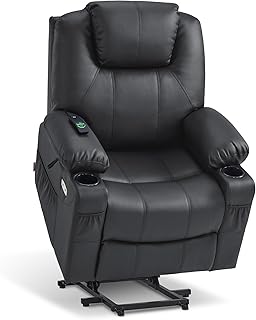
MCombo Power Lift Recliner 7040
A solid entry-level pick that balances price with practicality. The medium size offers a decent seat depth for average-tall users, and the heat and massage functions add genuine value without overcomplicating the experience.
MCombo Oversized Dual Motor R7891
This is the one to beat for big-and-tall shoppers. The dual-motor system lets you independently adjust the backrest and footrest, while the lay-flat capability gives you a near-bed-like recline that taller legs will appreciate.
MCombo Dual Motor 7890 Zero Gravity
An excellent middle-ground option that brings true zero-gravity positioning to the table. The infinite position control means you can dial in exactly the right angle for your height, and the breathable faux leather keeps things cooler during longer sits.
MCombo Oversized Lay Flat R7166
Built with the big-and-tall crowd in mind, this model pairs a generous seat with pet-friendly fabric—a rare combo. The lumbar and seat heating, plus massage, make it a strong choice for anyone who wants therapeutic features without sacrificing legroom.
Watson & Whitely Oversized Genuine Leather Wall Hugger
If you want premium materials and don’t want to sacrifice floor space, this genuine leather option is the standout. The wall-hugger design lets you recline close to the wall, the power headrest adds extra support for taller frames, and the oversized dimensions feel genuinely spacious.
Frequently Asked Questions
What seat depth do I need if I’m 6’3″?
You’ll want at least 21 inches of seat depth, and ideally 22 to 23 inches, so your thighs are fully supported and your knees aren’t forced into an awkward bend. Measure from the back of your knees to your lower back to confirm your personal requirement.
Is a lift chair necessary for tall people, or just the elderly?
Lift chairs aren’t exclusively for seniors—they’re genuinely useful for anyone who struggles to get up from a low seated position, including tall individuals with knee or back issues. The power lift mechanism simply raises the whole chair to help you stand, which can be a lifesaver for taller users who often sink deeper into cushions.
Can a tall person fit in a standard recliner?
Often, but not comfortably. Standard recliners typically have a 19-to-20-inch seat depth and shorter backrests, which leaves taller users with unsupported thighs and a head that sticks out past the top. If you’re over 6 feet, it’s worth paying extra for an oversized model.
What’s the difference between zero gravity and lay flat reclining?
Zero gravity positions your legs above your heart to reduce spinal pressure, while lay-flat simply means the backrest and footrest form a nearly flat surface, closer to a bed. Tall people often prefer lay-flat for stretching out fully, but zero gravity can be more therapeutic for circulation and posture.
Final Thoughts
For most tall buyers, the MCombo Oversized Dual Motor R7891 offers the best combination of adjustability and legroom, while the Watson & Whitely wall hugger is the premium choice if you want genuine leather and space-saving design. If you’re on a budget, the MCombo 7040 still delivers respectable support, but make sure you measure your space—and yourself—before committing to any single model.