Key takeaways
- Diameter: Match the blade diameter specified for your saw—most household miter saws use 10- or 12-inch blades. Never install a blade that exceeds the saw’s guard or capacity.
- Tooth count: Higher tooth counts generally produce smoother crosscuts, while lower counts remove material faster and suit framing or rough ripping.
- Tooth geometry: ATB teeth are effective for clean wood crosscuts, while TCG designs are useful for abrasive materials such as laminate, MDF, and aluminum-rated applications.
- Arbor size: Confirm the arbor opening before ordering. A 10-inch blade commonly uses a 5/8-inch arbor, while many 12-inch models use a 1-inch arbor.
- Cutting purpose: Choose a dedicated fine-finish blade for visible furniture parts, or a multi-pack when you need both fast rough cuts and cleaner finishing passes.
What's inside
Choosing a miter-saw blade is less straightforward than matching the blade diameter to the saw. Tooth count, tooth geometry, kerf, arbor size, and the material being cut all affect whether the result is clean and controlled—or chipped, slow, and frustrating. A blade designed for framing lumber is rarely the best choice for furniture parts, trim, or finished panels.
From a home-appliance testing lab perspective, this guide focuses on practical performance: cut cleanliness, tooth design, material compatibility, versatility, and fit. We compare fine-finish blades and multi-blade sets so you can choose the right option for trim, hardwood, plywood, MDF, laminate, and general workshop projects.
As an Amazon Associate we earn from qualifying purchases.


How to Choose a Saw Blade For Miter Saw (2026)
- Diameter: Match the blade diameter specified for your saw—most household miter saws use 10- or 12-inch blades. Never install a blade that exceeds the saw’s guard or capacity.
- Tooth count: Higher tooth counts generally produce smoother crosscuts, while lower counts remove material faster and suit framing or rough ripping.
- Tooth geometry: ATB teeth are effective for clean wood crosscuts, while TCG designs are useful for abrasive materials such as laminate, MDF, and aluminum-rated applications.
- Arbor size: Confirm the arbor opening before ordering. A 10-inch blade commonly uses a 5/8-inch arbor, while many 12-inch models use a 1-inch arbor.
- Cutting purpose: Choose a dedicated fine-finish blade for visible furniture parts, or a multi-pack when you need both fast rough cuts and cleaner finishing passes.
The Best Saw Blade For Miter Saw (2026)s Reviewed
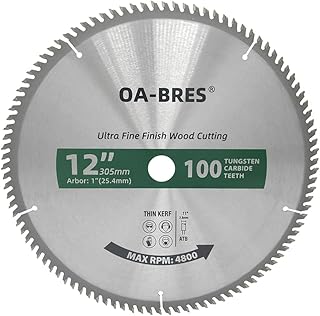
12-Inch 100-Tooth ATB TCT Ultra Fine Finish Blade
This 12-inch blade is aimed squarely at detailed trim, cabinetry, and furniture work where minimizing breakout matters. Its 100-tooth ATB layout and tungsten-carbide construction should deliver exceptionally smooth crosscuts, provided the saw is properly aligned and the workpiece is firmly supported.
10-Inch 120-Tooth TCG Aluminum-Working Blade
The 120-tooth TCG design makes this a specialist option for highly finished cuts and materials that can punish ordinary wood blades. Its 5/8-inch arbor suits many 10-inch miter saws, but buyers should verify the manufacturer’s approved materials and speed rating before cutting anything other than wood-based stock.
KENDO 10-Inch 40T/60T Circular Saw Blade Set
This two-pack is the most practical choice for shoppers who want flexibility rather than one narrowly optimized blade. The 40-tooth blade handles faster general cuts, while the 60-tooth option is better suited to plywood, MDF, laminate, and cleaner crosscuts.
10-Inch 80-Tooth Fine-Finish Woodworking Blade
With 80 carbide-tipped teeth and a stated maximum speed of 7,000 RPM, this blade offers a useful balance between finish quality and cutting efficiency. It is a sensible upgrade for common 10-inch miter saws when the priority is clean wood crosscutting without moving all the way to an ultra-high tooth count.
10-Inch 32T/60T/80T Three-Pack
This three-blade set covers the broadest range of workshop jobs in one purchase. The 32-tooth blade is suited to framing and faster cuts, the 60-tooth blade handles general fine work, and the 80-tooth option is the better pick for visible, ultra-fine wood cuts.
Frequently Asked Questions
Is a higher tooth count always better for a miter saw?
No. More teeth can improve crosscut smoothness, but they also cut more slowly and may generate additional heat. For furniture and trim, 60 to 100 teeth is often useful; rough construction work typically benefits from fewer teeth.
Can I use a table-saw blade on a miter saw?
Sometimes, but compatibility must be confirmed. The blade must have the correct diameter, arbor, tooth configuration, and speed rating, and it must be approved for the saw’s intended direction and guard system.
Which blade is best for cutting laminate or MDF?
A high-tooth-count blade with an appropriate tooth design, such as the 120-tooth TCG model, can help limit chipping and premature wear. Support the panel well and use a steady feed rather than forcing the saw through the cut.
How do I reduce splintering on finished wood?
Use a sharp fine-finish blade, clamp or support the workpiece, and let the saw reach full speed before entering the material. A zero-clearance insert or sacrificial backing board can further support fibers at the exit side of the cut.
Final Thoughts
For the smoothest furniture and trim cuts, the 12-inch 100-tooth ATB blade and the 10-inch 80-tooth woodworking blade are strong focused choices. If you want one purchase to cover rough framing through fine finishing, the KENDO 40T/60T set or the 32T/60T/80T three-pack offers more practical versatility.