Key takeaways
- Diameter: Match the blade diameter specified by your saw, most commonly 10 or 12 inches. Never install a larger blade than the guard and manufacturer allow.
- Tooth count: Lower counts cut faster through construction lumber, while higher counts generally produce smoother crosscuts in trim, plywood, and furniture parts.
- Tooth design: Alternate-top-bevel teeth are a useful all-purpose choice for crosscutting wood. Specialized profiles may improve speed or reduce chipping in particular materials.
- Arbor fit: Confirm the arbor diameter before ordering. A 10-inch blade with a 5/8-inch arbor, for example, is not automatically compatible with every saw.
- Project demands: Choose a durable general-purpose blade for frequent mixed work, or a high-tooth-count finishing blade when visible edges and clean miters matter most.
What's inside
Choosing a miter-saw blade can be surprisingly difficult. Tooth count, kerf, arbor size, carbide quality, and the material being cut all affect whether a blade leaves crisp crosscuts or produces tear-out, vibration, and scorched edges. Product listings also often use “fine finish” broadly, even though two blades with similar tooth counts can perform quite differently.
From a home-appliance testing lab perspective, we look at the details that matter in everyday furniture projects: cut cleanliness, stability, versatility, setup requirements, and value. This guide compares practical options for framing, trim, shelving, cabinetry, and other home woodworking tasks, while explaining how to match a blade to your miter saw and the finish you expect.
As an Amazon Associate we earn from qualifying purchases.


How to Choose a Saw Blades For Miter Saws (2026)
- Diameter: Match the blade diameter specified by your saw, most commonly 10 or 12 inches. Never install a larger blade than the guard and manufacturer allow.
- Tooth count: Lower counts cut faster through construction lumber, while higher counts generally produce smoother crosscuts in trim, plywood, and furniture parts.
- Tooth design: Alternate-top-bevel teeth are a useful all-purpose choice for crosscutting wood. Specialized profiles may improve speed or reduce chipping in particular materials.
- Arbor fit: Confirm the arbor diameter before ordering. A 10-inch blade with a 5/8-inch arbor, for example, is not automatically compatible with every saw.
- Project demands: Choose a durable general-purpose blade for frequent mixed work, or a high-tooth-count finishing blade when visible edges and clean miters matter most.
The Best Saw Blades For Miter Saws (2026)s Reviewed
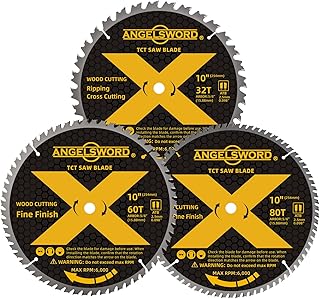
ANGELSWORD 10-Inch 3-Pack
This ANGELSWORD set is built around flexibility, supplying 32-tooth, 60-tooth, and 80-tooth blades for framing through ultra-fine wood cutting. It is a practical starter bundle for a workshop that handles varied projects, provided the included 5/8-inch arbor matches your saw.
WEN BL1080 10-Inch 80-Tooth Blade
The WEN BL1080 is the most finish-oriented 10-inch option in this group, with 80 carbide-tipped teeth intended for clean crosscuts and detail work. It suits furniture components, trim, and shelving where reducing splintering is more important than maximum cutting speed.
WEN BL1280 12-Inch 80-Tooth Blade
For compatible 12-inch miter saws, the WEN BL1280 combines a large cutting diameter with an 80-tooth layout aimed at fine finishes. It is a sensible choice for larger boards, wide trim, and furniture work, but buyers should verify both arbor size and saw clearance before installation.
WEN BL1060 10-Inch 60-Tooth Blade
The WEN BL1060 occupies a useful middle ground between speed and surface quality. Its 60 teeth should be better suited than a framing blade to routine crosscuts, trim, and general home furniture work without making every cut unnecessarily slow.
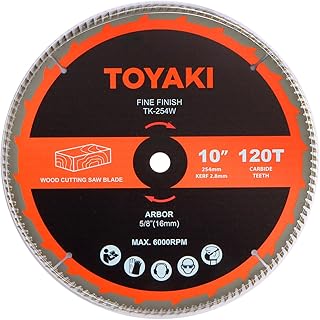
10-Inch 120-Tooth Fine-Finish Blade
This 120-tooth blade is aimed squarely at presentation-grade cuts in wood and wood-based panels. The dense tooth pattern can help produce exceptionally smooth edges, although it is best reserved for controlled finishing work rather than aggressive ripping or heavy construction cutting.
Frequently Asked Questions
Can any miter-saw blade fit any miter saw?
No. The diameter, arbor size, maximum blade speed, kerf, and guard clearance all need to be compatible. Check the saw manual and the blade specifications before fitting a replacement.
Is a higher tooth count always better?
Not always. Higher tooth counts usually favor cleaner, slower crosscuts, while lower tooth counts remove material faster. A 60-tooth blade is often more versatile for household projects than an ultra-high-count finishing blade.
Which blade is best for cutting furniture panels?
For visible edges, choose a sharp fine-finish blade such as the WEN BL1080, WEN BL1280, or 120-tooth option, depending on saw size and compatibility. Support the workpiece well and use a steady feed to limit chipping.
When should a miter-saw blade be replaced?
Replace or professionally sharpen a blade when cuts become rough despite correct setup, burning increases, the saw requires unusual force, or teeth are damaged. Cleaning pitch from the blade can sometimes restore performance before replacement.
Final Thoughts
The ANGELSWORD 10-Inch 3-Pack is the most versatile starting point for mixed home projects, while the WEN BL1080 is a strong focused pick for 10-inch fine finishing. Owners of compatible 12-inch saws should consider the WEN BL1280 when they need a larger-capacity blade with a smooth, furniture-friendly cut.