Key takeaways
- Allow for ventilation: Follow the manual’s specified side, rear, and top clearances. If the manual is not available, do not assume the unit can sit flush against a wall or inside a closed cabinet.
- Account for the door: Check how far it opens and whether it will hit a wall, cabinet, or island. Reversible hinges help only if the model supports reversing and the new swing works in the room.
- Check the plug and outlet: Make sure the cord can reach without being pinched or routed across a walkway.
- Think about loading: Leave enough room to pull out drawers and lift shelves. A narrow gap can make advertised storage hard to access.
The best small refrigerator freezer depends on which matters more: floor space, frozen-food capacity, or lower energy use.
For a tight kitchen or office, a compact top-freezer model around 18–21 inches wide is usually the best balance of fresh-food and freezer space. Choose a cube-style refrigerator when every inch of floor area matters and you only need a small freezer; choose a taller, narrow unit when you want more usable storage without widening the footprint. Before buying, compare the appliance’s outside dimensions with its interior capacity and required ventilation clearance—those measurements can lead to very different fits.
Quick picks by situation
| Your situation | Best layout to consider | Why it fits | Check before buying |
|---|---|---|---|
| Studio or narrow kitchen | Tall, narrow top-freezer refrigerator | Uses height for storage while keeping the footprint modest | Door swing, hinge reversibility, and full-width depth |
| Dorm room or office | Cube-style compact refrigerator with freezer compartment | Fits under some counters and is easy to place in a corner | Small freezer volume and whether it has a separate freezer door |
| Shared household that freezes food | Compact top-freezer with separate doors | More practical frozen-food access than a tiny internal compartment | Usable freezer capacity, not just total cubic feet |
| Low utility use is a priority | ENERGY STAR-certified model, where available | Certification gives a useful efficiency screen within a product category | Annual energy use on the EnergyGuide label and local electricity rates |
Compare dimensions and usable capacity—not just the headline size
“Compact” can describe anything from a small cube refrigerator to a tall apartment-size appliance. A model’s total capacity also combines refrigerator and freezer space, so two units with the same advertised capacity may suit different routines. A large fresh-food section with a shallow freezer works for groceries eaten throughout the week; a separate, more generous freezer is better for frozen meals, ice, or batch cooking.
Use the manufacturer’s listed refrigerator and freezer capacities when available. Then check interior layout: fixed shelves can make tall bottles awkward, while door bins, adjustable shelves, and a crisper drawer can make a smaller refrigerator easier to use. For the freezer, look for a separate door and shelves or bins if you plan to keep more than a few small frozen items.
| Compact format | Typical outside dimensions (W × D × H) | Typical total capacity | Best use | Main compromise |
|---|---|---|---|---|
| Cube-style compact | About 18–20 × 18–22 × 19–23 in. | About 1.5–3 cu. ft. | Desk-side, dorm, or occasional drinks and snacks | Freezer space is often very limited |
| Tall compact, single door | About 18–21 × 19–23 × 32–35 in. | About 3–4.5 cu. ft. | One person or a small office that needs more fresh food | Freezer may be an internal compartment with modest usable space |
| Apartment-size top-freezer | About 18–24 × 23–27 × 50–60 in. | About 7–11 cu. ft. | Small households that want separate refrigerator and freezer sections | Needs more height and door-swing clearance |
These are approximate market ranges, not guaranteed dimensions. Check the exact product specification sheet: handles, hinges, and rear components can add depth, and exterior measurements do not reveal how much space shelves and walls consume.
Measure the installation spot before choosing a layout
Measure the opening’s width, height, and depth at several points; walls, trim, and uneven floors can narrow the usable space. Measure the route into the home too, including doorways, hallways, turns, and stair landings. A refrigerator that fits its final nook may still be difficult to bring through a tight entry.
- Allow for ventilation: Follow the manual’s specified side, rear, and top clearances. If the manual is not available, do not assume the unit can sit flush against a wall or inside a closed cabinet.
- Account for the door: Check how far it opens and whether it will hit a wall, cabinet, or island. Reversible hinges help only if the model supports reversing and the new swing works in the room.
- Check the plug and outlet: Make sure the cord can reach without being pinched or routed across a walkway.
- Think about loading: Leave enough room to pull out drawers and lift shelves. A narrow gap can make advertised storage hard to access.
As a planning example, an 18-inch-wide refrigerator placed in a 20-inch opening leaves only 1 inch per side before accounting for the manufacturer’s clearance requirement. That may be too tight even if the body physically fits. Use the manual’s installation dimensions—not the cabinet opening alone—to make the final call.
Pick the freezer layout that matches what you store
Internal freezer compartment
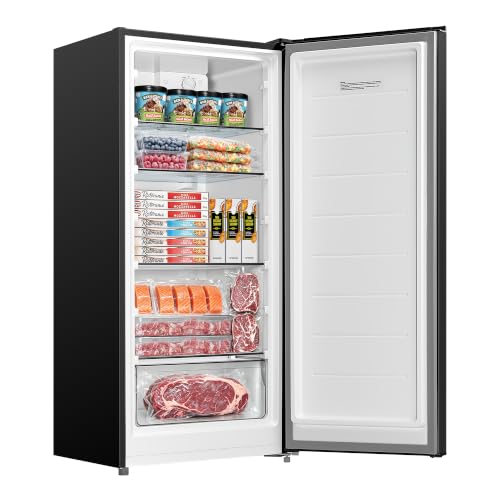
This layout keeps the exterior simple and can work well in a small cube or tall compact refrigerator. It is best for ice trays, a few frozen portions, or short-term storage. A shared refrigerator door can let warm room air reach the freezer whenever you open it, and the compartment may not have room for bulky packaging.
Separate top-freezer door
A dedicated freezer compartment is easier to organize and access without opening the refrigerator. It is usually the more useful arrangement for a small household that regularly stores frozen food. Compare the actual freezer volume and shelf arrangement: a separate door does not automatically mean a large or well-organized freezer.
Freezerless refrigerator
If you already have a chest freezer or rarely freeze food, a compact refrigerator without a freezer can make more of its interior available for fresh groceries. It is not the right choice if you expect the appliance to provide even a small amount of frozen storage.
Energy features: what to check on the label
Look for an ENERGY STAR label if one is available for the model and category, then compare the estimated annual electricity use shown on the EnergyGuide label. The label’s kilowatt-hour estimate is more useful than a broad claim such as “energy saving,” but actual costs vary with electricity rates, room temperature, use, and how often the door opens.
Size matters too: a larger refrigerator generally has more room to cool, so do not buy substantially more capacity than you need solely for a feature list. Keep the condenser and ventilation areas clear as instructed, avoid placing the unit beside a heat source, and let hot food cool before storing it. These habits help the appliance operate under less strain.
Moving, setup, and long-term practicality
Compact does not always mean light. Check the shipping and product weights, and plan for help moving a taller appliance. Before delivery, measure the narrowest doorway and turn in the route. If the refrigerator must be transported on its side, follow the manufacturer’s instructions about how long to leave it upright before plugging it in; the required waiting time can vary by model.
After setup, level the appliance as directed so the doors close properly. Avoid overloading door bins or forcing large containers onto shelves that are not designed for them. Shelves, door seals, and drawers are the parts most likely to be affected by rough handling or repeated strain, so check that replacement parts are available if the appliance will be used for years.
Final choice
For the best all-around small refrigerator freezer, start with a narrow apartment-size top-freezer model if you need dependable fresh and frozen storage. Choose a cube refrigerator for a bedroom, dorm, or office where footprint matters more than freezer volume. If frozen food is a regular part of your routine, prioritize a separate freezer door and its listed capacity; if it is not, put more weight on refrigerator layout and overall fit. The right choice is the one that clears the installation space, leaves the required ventilation room, and gives you usable storage for the food you actually keep.