Key takeaways
- Conventional furnace and air conditioner: Commonly uses R, C, W, Y, and G terminals, though two-stage equipment adds additional control wires.
- Heat pump: Usually includes a reversing-valve wire labeled O or B, plus auxiliary or emergency heat controls. Incorrect O/B selection can make heating and cooling behave incorrectly.
- Boiler or radiant heat: Compatibility varies widely. Zone valves, low-voltage controls, and boiler relays need careful checking.
- Electric baseboard: Often uses line voltage, such as 120 or 240 volts. Most popular low-voltage smart thermostats are not direct replacements.
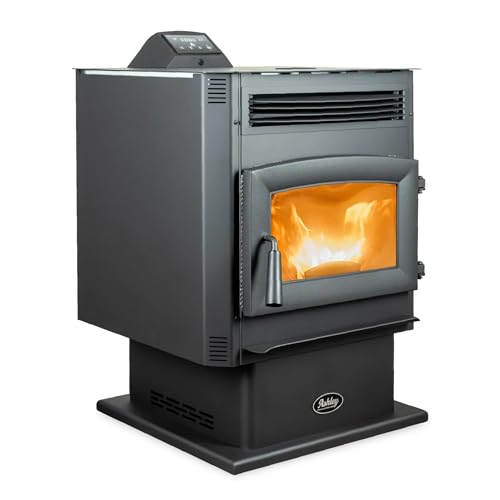
- Millivolt systems: Gas fireplaces and some wall heaters may not provide the power or switching method a standard smart thermostat expects.
The best smart thermostats are the ones that match your HVAC wiring, heating type, room layout, and privacy preferences—not necessarily the model with the most features.
Quick picks by home and HVAC situation
| Situation | Best fit | Why it makes sense | Watch for |
|---|---|---|---|
| Most homes with central forced-air HVAC | Google Nest Learning Thermostat or ecobee Smart Thermostat Premium | Strong scheduling, app control, occupancy features, and broad support for conventional systems | Confirm wiring and equipment compatibility before removing the old thermostat |
| Rooms with uneven temperatures | ecobee Smart Thermostat Premium or Honeywell Home T9 | Remote room sensors can prioritize a bedroom, nursery, office, or living area | Sensor readings improve control, but they do not repair poor ductwork or inadequate insulation |
| Heat-pump home | ecobee Enhanced, ecobee Premium, Nest Learning Thermostat, or a compatible Honeywell Home model | Designed for systems with reversing valves and auxiliary or emergency heat | Verify O/B configuration and auxiliary-heat settings; installation errors can reduce comfort |
| Renter who cannot modify wiring | A compatible battery-powered thermostat, subject to landlord approval | May install without pulling a new cable or adding a common wire | Many smart thermostats still need a C wire or a manufacturer power adapter |
| Privacy-conscious household | A thermostat with schedules and local controls that can operate without constant cloud dependence | Fewer app-connected features and less reliance on occupancy data | Read the current privacy policy and disable location or presence tracking you do not need |
Check compatibility before comparing features
Take a clear photograph of the old thermostat wiring while every wire is still connected. Record the letters beside the terminals, not merely the wire colors: installers do not always follow the expected color convention. A C wire, usually called the common wire, supplies continuous power so the thermostat does not have to draw small amounts of power through the heating or cooling circuit.

Amazon Smart Thermostat, Save money and energy, Works with Alexa and Ring, C-wire required
Included for 'Best Smart Thermostats for More Efficient Home Comfort' because the listing specifies Save money and energy and Works with Alexa and Ring, details this guide uses to compare options.
View on Amazon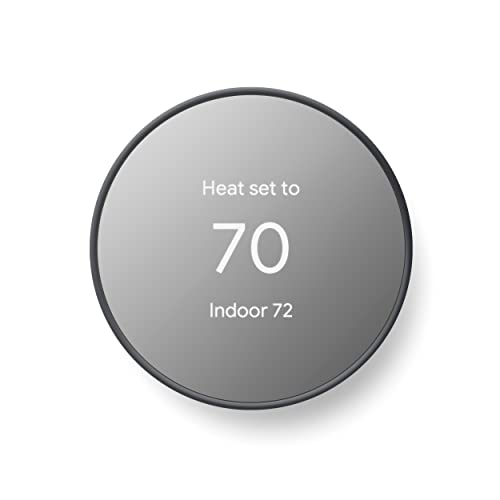
Google Nest Thermostat - Smart Thermostat for Home - Programmable Wifi Thermostat - Charcoal
Included for 'Best Smart Thermostats for More Efficient Home Comfort' because the listing specifies Smart Thermostat for Home and Programmable Wifi Thermostat, details this guide uses to compare options.
View on Amazon
ecobee Smart Thermostat Premium - WiFi, Siri & Alexa Built-In, Smart Sensor
Included for 'Best Smart Thermostats for More Efficient Home Comfort' because the listing specifies WiFi and Siri & Alexa Built-In, details this guide uses to compare options.
View on Amazon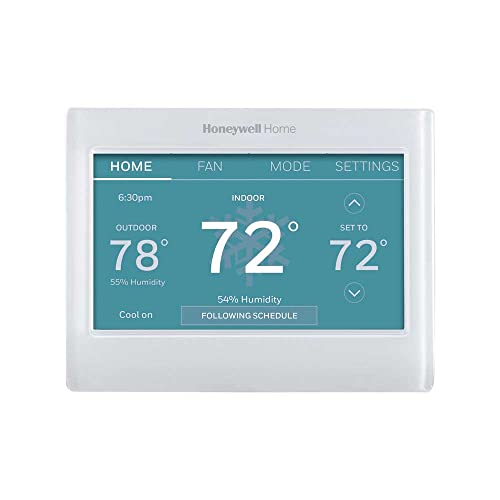
Honeywell Home RTH9600WF Smart Color Thermostat ENERGY STAR Wi-Fi Programmable Touchscreen Alexa Ready - C-Wire Required
Included for 'Best Smart Thermostats for More Efficient Home Comfort' because the listing specifies C-Wire Required, details this guide uses to compare options.
View on AmazonMany modern thermostats work without a C wire in some installations, but “C-wire-free” does not mean universally compatible. A power extender, adapter, or special installation method may be needed. Check the manufacturer’s compatibility checker for your exact terminals, equipment type, and number of heating and cooling stages.
- Conventional furnace and air conditioner: Commonly uses R, C, W, Y, and G terminals, though two-stage equipment adds additional control wires.
- Heat pump: Usually includes a reversing-valve wire labeled O or B, plus auxiliary or emergency heat controls. Incorrect O/B selection can make heating and cooling behave incorrectly.
- Boiler or radiant heat: Compatibility varies widely. Zone valves, low-voltage controls, and boiler relays need careful checking.
- Electric baseboard: Often uses line voltage, such as 120 or 240 volts. Most popular low-voltage smart thermostats are not direct replacements.
- Millivolt systems: Gas fireplaces and some wall heaters may not provide the power or switching method a standard smart thermostat expects.
If the wiring includes thick cables, high-voltage labels, or no familiar low-voltage terminals, stop and consult an HVAC professional. A smart thermostat is not a safe substitute for a line-voltage thermostat.
Head-to-head: which thermostat features matter most?
Google Nest Learning Thermostat
The Nest Learning Thermostat suits households that want the thermostat to create a schedule from repeated adjustments. Its strongest appeal is convenience: it can use temperature changes, activity patterns, app control, and geofencing-style home and away routines to reduce unnecessary heating or cooling.
It is a good choice when the household has fairly predictable routines and prefers a polished interface over manually programming every period. Compatibility must still be verified, particularly for multi-stage systems, heat pumps, humidifiers, dehumidifiers, and unusual wiring. Some installations may benefit from a C wire even when a model can operate without one.
Choose it cautiously if you want detailed room-by-room control. The thermostat’s own room measurement remains the central reference, and the available sensor strategy differs from systems built around multiple room sensors.
ecobee Smart Thermostat Premium and Enhanced
ecobee is often the better fit for a home with noticeably different temperatures between rooms. Its remote sensors can measure temperature and, on supported models and configurations, occupancy. You can set a schedule around a bedroom at night, an office during work hours, or a living room in the evening.
The Premium model adds a broader feature set, while the Enhanced model is a more focused option for households that mainly want smart scheduling, remote sensors, and app control. ecobee also offers strong heat-pump support, but the exact behavior of auxiliary heat and staging depends on the HVAC system and installer settings.
The trade-off is greater dependence on an account and cloud-connected features. Review privacy controls before enabling occupancy detection, voice-assistant integration, or location-based automation.
Honeywell Home T9
The Honeywell Home T9 is a practical choice for people who want remote room sensors without committing to a more elaborate smart-home ecosystem. It is particularly useful in a long house, a home office that overheats from equipment, or a nursery that needs priority at night.
Its value depends on placement. A sensor on a bookshelf beside a heat register will produce a poor picture of the room, just as a thermostat behind a door will. Put sensors around breathing height in the occupied area, away from direct sun, exterior doors, vents, lamps, and televisions.
Sensi Touch 2 and simpler connected thermostats
A simpler connected thermostat can be the sensible choice for someone who wants phone scheduling, remote temperature changes, and energy reports without extensive automation. Models such as the Sensi Touch 2 are worth considering when the priority is a familiar wall-mounted control and a less complicated feature set.
Check whether your system requires a C wire and whether the thermostat supports your number of stages, heat-pump configuration, and accessories. A less expensive thermostat is not a bargain if it requires an electrician or HVAC technician to make an otherwise unnecessary wiring change.
Room sensors, geofencing, and energy reports: what they really do
Room sensors solve a measurement problem, not an airflow problem. If a 10-by-12-foot bedroom is consistently 4–6°F warmer than the hallway because of closed doors, sun exposure, or weak return airflow, a sensor can tell the thermostat which reading to prioritize. It cannot make the duct deliver more conditioned air. First check filters, registers, return paths, insulation, and door undercuts.
Geofencing uses the location of permitted phones to switch between home and away behavior. It can save energy in a household with irregular schedules, but it can fail when one person remains home, a phone battery dies, or guests are present. A schedule with a conservative temperature setback is often more predictable.
Energy reports are useful for spotting patterns rather than proving exact savings. Compare similar weather periods, note changes in occupancy, and avoid judging performance from a single unusually cold or hot month. A thermostat may report runtime accurately while estimated energy cost depends on utility rates and equipment efficiency that it cannot directly measure.
Installation and placement details that affect performance
Mount the thermostat on an interior wall, roughly 52–60 inches above the floor, where air circulates naturally. Keep it away from direct sunlight, supply vents, kitchens, exterior doors, and appliances that produce heat. Leave enough clearance for the display and your hand—about 6 inches of open space on each side is a useful practical target, especially near shelves or furniture.
Before choosing a model, measure the existing wall opening and check whether the new base will cover paint lines or screw holes. A thermostat may fit the electrical box while leaving an unattractive uncovered area around it. A trim plate can help, but it adds visible width and may interfere with nearby molding.
Turn off HVAC power at the service switch or breaker before handling low-voltage wires, label each wire, and do not rely on the old thermostat’s batteries to indicate that the circuit is safe. If you have multiple zones, accessory controls, or uncertainty about the wiring, professional installation is usually cheaper than repairing a damaged control board.
Privacy and smart-home trade-offs
Connected thermostats can collect account details, device information, temperature history, approximate location, and occupancy or presence signals, depending on the features you enable. Before buying, check whether the thermostat supports manual operation when the internet is down, whether schedules are stored locally or in the cloud, and how easily you can disable location tracking.
Use a strong unique account password and two-factor authentication where available. If voice control is unnecessary, leave it off. For a household that wants automation but minimal data sharing, prioritize local schedules, physical controls, and a thermostat that does not require occupancy detection for basic heating and cooling.
Typical price and value
Basic connected thermostats usually cost about $80–$150, midrange models with better displays and sensors about $150–$250, and premium thermostat-and-sensor packages about $250–$400 before installation. Professional installation can add roughly $100–$300, with more for rewiring, line-voltage conversion, new zones, or difficult access.
The best smart thermostat is therefore the one that supports your equipment without workarounds, measures the rooms you actually occupy, and offers automation you will leave enabled. For uneven temperatures, prioritize remote sensors; for irregular schedules, consider geofencing; for heat pumps, prioritize verified equipment support; and for privacy, choose the smallest connected feature set that solves your problem.