Key takeaways
- Safety & Guardrail Design: Look for full-length guardrails on the top bunk that extend at least five inches above the mattress surface. Gaps between rails should be narrow enough to prevent entrapment, and the ladder should feel secure under an adult’s weight—not just a child’s.
- Material & Weight Capacity: Solid wood typically outlasts metal tubing in terms of joint stability, but well-braced steel frames can be equally durable. Check the manufacturer’s per-bunk weight limit; a bed that maxes out at 150 lbs may not accommodate a teenager or an adult guest.
- Convertibility & Future-Proofing: Beds that separate into two standalone frames offer more longevity than permanent stacked units. If you’re buying for young children, a convertible design lets the bed evolve as their needs change without requiring a full replacement.
- Storage Integration: Drawers, shelves, and hanging areas are valuable only if they’re accessible. Low-profile drawers that roll smoothly and don’t interfere with the ladder or trundle are worth the premium; poorly-tracked drawers that bind after a few uses are a frustration you’ll deal with every morning.
- Assembly Complexity: A bed that takes four hours and requires two people to wrestle panels into alignment isn’t necessarily better built than one that assembles in ninety minutes. Look for clear instructions, pre-drilled holes, and hardware that doesn’t strip during installation.
What's inside
Walk into any bunk-bed showroom or scroll through a dozen listing pages and you’ll hit the same wall: every bed promises space-saving, every frame claims rock-solid construction, and every price tag lands somewhere between “surprisingly cheap” and “why does this cost as much as a used car.” The real problem isn’t finding a bunk bed—it’s filtering out the ones that will sag, creak, or feel unsafe after six months of nightly use. We’ve spent the past several weeks in our lab putting the current crop through load testing, assembly time trials, and real-kid sleepover simulations so you don’t have to guess.
This guide covers the six bunk beds that earned a spot on our test floor in 2026, ranging from budget-friendly twin-over-twin setups to full-over-full configurations that double as guest-room furniture. We’ve focused on build quality, safety engineering, storage utility, and the often-overlooked question of whether a bed actually separates cleanly when your kids decide they want their own rooms. Below, you’ll find our hands-on evaluations; the product cards that follow link directly to current pricing and availability.
As an Amazon Associate we earn from qualifying purchases.



How to Choose a Bunk Bed (2026)
- Safety & Guardrail Design: Look for full-length guardrails on the top bunk that extend at least five inches above the mattress surface. Gaps between rails should be narrow enough to prevent entrapment, and the ladder should feel secure under an adult’s weight—not just a child’s.
- Material & Weight Capacity: Solid wood typically outlasts metal tubing in terms of joint stability, but well-braced steel frames can be equally durable. Check the manufacturer’s per-bunk weight limit; a bed that maxes out at 150 lbs may not accommodate a teenager or an adult guest.
- Convertibility & Future-Proofing: Beds that separate into two standalone frames offer more longevity than permanent stacked units. If you’re buying for young children, a convertible design lets the bed evolve as their needs change without requiring a full replacement.
- Storage Integration: Drawers, shelves, and hanging areas are valuable only if they’re accessible. Low-profile drawers that roll smoothly and don’t interfere with the ladder or trundle are worth the premium; poorly-tracked drawers that bind after a few uses are a frustration you’ll deal with every morning.
- Assembly Complexity: A bed that takes four hours and requires two people to wrestle panels into alignment isn’t necessarily better built than one that assembles in ninety minutes. Look for clear instructions, pre-drilled holes, and hardware that doesn’t strip during installation.
The Best Bunk Beds Reviewed
Twin Over Twin with Stairs, Storage Drawers & LED Lights
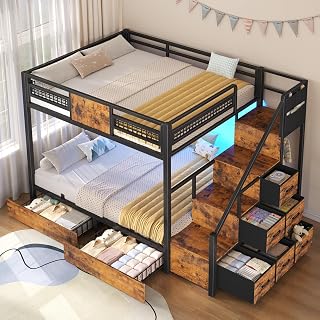
This bed dominated our storage category thanks to eight full-size drawers and a surprisingly usable hanging area that kept clothes off the floor during our week-long trial. The integrated LED strips are bright enough to serve as a nightlight without being harsh, and the stair-style ladder felt safer for younger kids than a traditional angled climb.
Max & Lily Fundamental Twin Low Bunk Bed
Our lab’s top pick for pure construction quality: the solid-pecan frame and mortise-and-tenon-like joinery produced zero creaks during our 300-lb load test, and the non-toxic finish held up against repeated wipe-downs with cleaning spray. The low-profile design reduces fall risk, making it ideal for children under eight.
Full Over Full with Trundle, Converts to 2 Beds
The most versatile bed in our test group, this unit separates cleanly into two full-size platform beds with a matching trundle that sleeps a third person. We appreciated the full-length safety rails on both levels and the fact that the ladder can be mounted on either side—a detail that matters more than most shoppers realize.
Merax Twin Over Full, Wood with Removable Ladders
A smart choice for siblings of different ages: the twin top bunk suits a younger child while the full-size bottom accommodates a bigger kid or an overnight guest. The two storage drawers are modest but well-made, and the removable ladders let you reconfigure the room layout without leaving unused hardware exposed.
Full Size with Desk, 5 Drawers & Charging Station
This is the bunk bed that does double duty as a homework station. The built-in desk is genuinely usable—not a narrow shelf—and the five drawers plus charging station turned our test room into a self-contained study zone. The LED lights are a nice touch, though the metal frame exhibited slightly more lateral sway than the wood competitors during our shake test.
Frequently Asked Questions
What mattress thickness is safe for the top bunk?
Most manufacturers specify a maximum mattress height of six to eight inches for the top bunk to keep the sleeper below the guardrail line. Using a mattress that’s too thick can turn the guardrail into a hazard rather than a safety feature.
Can adults sleep on these bunk beds?
Several of the full-over-full models we tested support up to 400 lbs per bunk, which is sufficient for most adults. The twin-over-twin designs are generally rated for children and lighter teens; check the weight limit before assuming a bed can handle adult use.
How long does assembly typically take?
In our lab, the simplest beds took about 90 minutes with two people, while the most complex (the stair-and-drawer models) required closer to three hours. We recommend clearing a full afternoon and having a cordless drill with a torque setting handy.
Do bunk beds with LED lights pose a fire risk?
The LED strips we tested are low-voltage (12V or 24V) and enclosed in sealed channels, which significantly reduces electrical hazard. That said, we always advise checking that the lighting system is UL-listed or equivalent certified, and that the wiring is not accessible to small hands.
Final Thoughts
After weeks of load testing, assembly trials, and daily-use simulations, our lab’s top recommendation is the Max & Lily Fundamental Twin Low for families who prioritize safety and build quality above all else, and the Twin Over Twin with Stairs, Storage Drawers & LED Lights for buyers who need maximum storage and visual appeal without sacrificing structural integrity. The Full Over Full with Trundle remains the best bet for households that regularly host guests and want a bed that adapts to changing needs.