Key takeaways
- Using a residential 50 pint unit. Rated at 80 degrees and 60 percent humidity, it pulls a fraction of that at 55 degrees and will ice up without auto defrost.
- Sizing by square feet alone. A 4 foot tall crawl space has twice the air volume of a 2 foot space under the same house.
- Ignoring the hatch. A 23 inch wide unit does not go through an 18 by 24 inch opening at any angle that leaves the unit intact.
- Skipping the pump. If the drain is uphill, a gravity unit shuts off on a full reservoir within hours and the space goes back to 75 percent humidity.
- Forgetting the vents. An unencapsulated crawl space with open foundation vents pulls in humid outdoor air all summer. Either close the vents and add a vapor barrier or size up two classes.
- Setting the humidistat too low. Chasing 40 percent runs the compressor nonstop. Aim for 50 to 55 percent, which stops mold growth and wood rot.
- No memory restart. Power blips are common on crawl space circuits. A unit without auto restart sits off until you crawl in to check.
What's inside
The Short Answer
For a typical crawl space, plan on roughly 70 to 80 pints per day for every 1,000 to 1,500 square feet of floor area, and step up to 100 to 130 pints for anything over 2,000 square feet or a space with standing water history. In practice that means a 1,200 square foot home on a crawl space wants an 80 pint commercial unit; a 2,000 square foot home wants 110 to 125 pints; and a 3,000 square foot home or a chronically wet space wants 150 pints or two units. Residential 35 to 50 pint dehumidifiers are sized for open basements at 65 to 75 degrees Fahrenheit and lose 30 to 50 percent of their capacity in a 55 degree crawl space, which is why crawl space units are rated and built differently.
Prices track capacity: expect $320 to $400 for 80 to 125 pint commercial units and $500 to $600 for 150 pint class machines with pumps. Buying one size up costs $50 to $150 more and is almost always cheaper than replacing joists.
As an Amazon Associate we earn from qualifying purchases at no extra cost to you. Product prices and availability are accurate as of the date shown and are subject to change.


Standard Sizes
| Capacity class | Crawl space coverage | Typical unit dimensions (in) | Typical unit dimensions (cm) | Weight | Power draw | Price range |
|---|---|---|---|---|---|---|
| 50 pints/day (residential) | Up to 800 sq ft, mild dampness only | 15 x 11 x 24 | 38 x 28 x 61 | 40 to 50 lb | 450 to 600 W | $200 to $280 |
| 70 to 80 pints/day (commercial) | 1,000 to 1,500 sq ft | 19 x 12 x 15 | 48 x 30 x 38 | 45 to 60 lb | 550 to 750 W | $320 to $400 |
| 110 to 125 pints/day (commercial) | 1,500 to 2,500 sq ft | 21 x 13 x 17 | 53 x 33 x 43 | 55 to 70 lb | 700 to 900 W | $330 to $450 |
| 150 to 160 pints/day (commercial) | 2,500 to 4,000 sq ft or wet space | 23 x 14 x 20 | 58 x 36 x 51 | 65 to 85 lb | 850 to 1,100 W | $500 to $650 |
| Two 80-pint units | Long, segmented crawl spaces over 2,500 sq ft | Two at 19 x 12 x 15 | Two at 48 x 30 x 38 | 90 to 120 lb total | 1,100 to 1,500 W total | $650 to $800 |
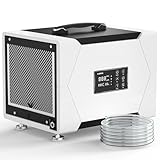
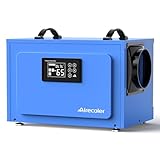
Examples in the current market include the BaseAire 113 pint unit at about $327, the CADPXS 80 pint with pump at about $376, the Airecoler 125 pint at about $394, and the Airzentti 155 pint with pump at about $530. Dimensions above are typical for each class; check the listing for the exact footprint, because the access hatch is the constraint that matters most.
How to Measure Your Space
- Measure floor area. Use the home’s exterior footprint over the crawl space, in feet. Length times width gives square feet. A 30 by 40 foot home is 1,200 square feet.
- Measure clearance height. Drop a tape from the bottom of the floor joists to the ground at three or four spots. Crawl spaces run 18 to 48 inches. This sets the maximum unit height; most commercial dehumidifiers are 15 to 20 inches tall and need a few inches above for airflow.
- Multiply for volume. Square feet times average height in feet. A 1,200 square foot space at 3 feet is 3,600 cubic feet. Dehumidifier capacity scales with volume, so a 4 foot crawl space needs more than a 2 foot one under the same house.
- Measure the access hatch. Record the clear opening in inches. Common hatches are 18 by 24 inches or 24 by 30. The unit must pass through, ideally with 2 inches of margin.
- Rate the moisture. Damp: musty smell, humidity 60 to 70 percent, no visible water. Wet: condensation on ducts or pipes, humidity above 70 percent, dark stains on joists. Standing water: puddles or a history of flooding. Each step up adds one capacity class.
- Locate the drain. Find the lowest point, a sump pit, or an exterior wall where a hose can exit. If the drain is higher than where the unit will sit, you need a built-in condensate pump with 10 to 15 feet of lift.
- Check the power. Find the nearest outlet and confirm it is GFCI protected and on a circuit that can carry 6 to 10 amps continuously.
By Room or Use Case
Small crawl space under 1,000 square feet, damp
A 70 to 80 pint commercial unit handles this with margin. The CADPXS 80 pint class with a built-in pump around $376 fits the common scenario of a hatch on one side and a drain on the other. Expect 550 to 750 watts while running, roughly 5 to 8 kWh a day in humid months.
Mid-size crawl space, 1,000 to 2,000 square feet, damp to wet
This is the range where the 110 to 125 pint units earn their price. The BaseAire 113 pint at about $327 and the Airecoler 125 pint at about $394 are both sized for this footprint, and their auto defrost matters because crawl spaces drop below 60 degrees for much of the year, which frosts the coils on residential units.
Large or wet crawl space, over 2,000 square feet
Go to 150 pints or split into two units. The Airzentti 155 pint with pump at about $530 covers up to 4,000 square feet in a sealed, encapsulated space; in a vented, unencapsulated crawl space, cut that coverage roughly in half. Two 80 pint units placed at opposite ends often dry a long, pier-and-beam space more evenly than one large unit in the middle.
Encapsulated crawl space with vapor barrier
Encapsulation cuts the moisture load dramatically. You can size at the low end of the range, and an 80 pint unit will often hold 50 percent humidity in a 1,800 square foot encapsulated space. Pair it with a humidistat set to 50 to 55 percent and a drain line to a sump or exterior.
Crawl space with HVAC ducts and plumbing
Cold supply ducts and water lines sweat in humid air, adding to the moisture load and dripping onto the soil. Add one capacity class over the floor-area guideline, and position the unit so its discharge blows along the duct runs.
Common Sizing Mistakes
- Using a residential 50 pint unit. Rated at 80 degrees and 60 percent humidity, it pulls a fraction of that at 55 degrees and will ice up without auto defrost.
- Sizing by square feet alone. A 4 foot tall crawl space has twice the air volume of a 2 foot space under the same house.
- Ignoring the hatch. A 23 inch wide unit does not go through an 18 by 24 inch opening at any angle that leaves the unit intact.
- Skipping the pump. If the drain is uphill, a gravity unit shuts off on a full reservoir within hours and the space goes back to 75 percent humidity.
- Forgetting the vents. An unencapsulated crawl space with open foundation vents pulls in humid outdoor air all summer. Either close the vents and add a vapor barrier or size up two classes.
- Setting the humidistat too low. Chasing 40 percent runs the compressor nonstop. Aim for 50 to 55 percent, which stops mold growth and wood rot.
- No memory restart. Power blips are common on crawl space circuits. A unit without auto restart sits off until you crawl in to check.
FAQ
How many pints do I need for a 1,500 square foot crawl space?
About 80 pints per day if the space is merely damp and encapsulated, 110 to 125 pints if it is vented or shows condensation. At 3 feet of height that is 4,500 cubic feet of air, which a 110 pint unit cycles several times an hour.
Why are crawl space dehumidifiers rated so much higher than basement units?
Two reasons. Commercial units are rated under saturation conditions (80 degrees and 60 percent humidity) that produce large numbers, and they are built with larger coils and auto defrost so they keep working at 50 to 60 degrees where a residential unit stalls. The high pint number is partly a rating convention and partly real extra capacity.
Can I use one dehumidifier for both the crawl space and the basement?
Only if they are connected by an open doorway or a duct with active airflow. Otherwise each space needs its own unit, sized independently. A single 155 pint machine with ducted intake and discharge can serve both if a contractor sets it up that way.
How much does it cost to run a crawl space dehumidifier?
An 80 pint unit draws 550 to 750 watts, so 12 hours of runtime is 7 to 9 kWh, or about $1 to $1.50 a day at typical rates. Once the space stabilizes at 50 to 55 percent humidity, runtime in 2026-era ENERGY STAR units drops to 4 to 8 hours a day, roughly $15 to $30 a month in humid season.