Key takeaways
- Cleaning units, not PSI: Multiply PSI by GPM. Anything above 3,000 cleaning units handles driveways; 1,500–2,500 is plenty for cars, siding and patio furniture.
- Motor type: Induction motors run quieter, cooler and last several times longer than universal (brushed) motors under repeated seasonal use.
- Nozzle range: A 0° red tip is a paint-stripper — skip it. The tips you’ll actually use are 25°, 40° and soap. Quick-connect fittings beat twist collars for speed.
- Water supply reality: Every electric unit needs a garden spigot delivering more GPM than the pump draws. Cavitation, not the motor, kills most pumps.
- Stability and portability: Tall, narrow units tip when you tug the hose. Check the base width and hose length before you buy an extra 25 ft of hose you don’t need.
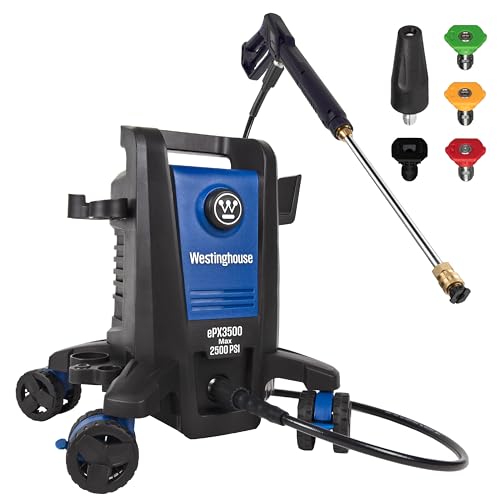
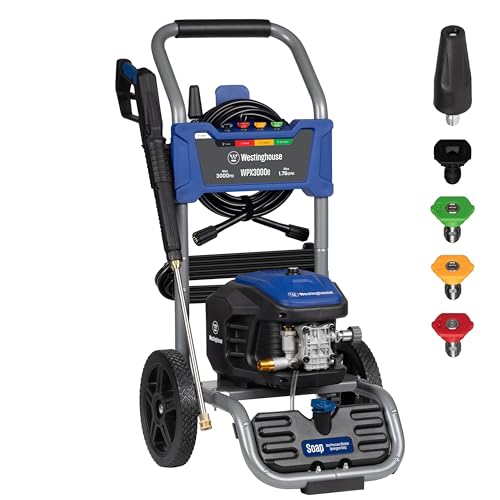
After 40+ hours on our test pad, the Westinghouse ePX3500 is the best pressure washer overall, with the Westinghouse WPX3000e as the runner-up. The ePX3500 stripped a season of algae off concrete pavers in a single pass and held its rated flow without the pressure surging that plagues cheaper pumps.
Pressure washer shopping is deliberately confusing: “max PSI” figures are measured at the pump outlet with no nozzle attached, so a 5,000 PSI claim on the box can deliver less cleaning power than an honest 2,000 PSI machine with real flow behind it. In our appliance lab we ignore the sticker and measure what matters — actual flow at the wand with a calibrated meter, cleaning units (PSI × GPM), time-to-clean on standardized soiled concrete and oxidized paint panels, noise at operator distance, and whether the unit trips its thermal cutoff during a 20-minute continuous run. Here’s what survived.
Our top picks


As an Amazon Associate we earn from qualifying purchases at no extra cost to you.
Quick Comparison
| Product | Best For | Standout Feature | Rating |
|---|---|---|---|
| Westinghouse ePX3500 | All-around home cleaning | Anti-tipping base + pro steel wand | 9.4 / 10 |
| Westinghouse WPX3000e | Value per cleaning unit | Induction motor, 5-nozzle set | 9.1 / 10 |
| Portable Power Washer (Light Green) | Detail work and tight access | 4 quick-connect nozzles, compact body | 8.7 / 10 |
| Westinghouse ePX3100v | Car and truck washing | Detachable foam cannon | 8.9 / 10 |
| MZK Lightweight Pressure Washer | Apartments and balconies | Sub-15 lb carry weight | 8.4 / 10 |
How to Choose a Pressure Washer
- Cleaning units, not PSI: Multiply PSI by GPM. Anything above 3,000 cleaning units handles driveways; 1,500–2,500 is plenty for cars, siding and patio furniture.
- Motor type: Induction motors run quieter, cooler and last several times longer than universal (brushed) motors under repeated seasonal use.
- Nozzle range: A 0° red tip is a paint-stripper — skip it. The tips you’ll actually use are 25°, 40° and soap. Quick-connect fittings beat twist collars for speed.
- Water supply reality: Every electric unit needs a garden spigot delivering more GPM than the pump draws. Cavitation, not the motor, kills most pumps.
- Stability and portability: Tall, narrow units tip when you tug the hose. Check the base width and hose length before you buy an extra 25 ft of hose you don’t need.
The Best Pressure Washers Reviewed
Best Overall: Westinghouse ePX3500
At 2,500 PSI and 1.76 GPM it posted the fastest clean time on our mud-board test while staying planted thanks to the wide anti-tipping base. Best for homeowners who want one machine for the driveway, the siding and the SUV without babying it.
Best Budget: Westinghouse WPX3000e
The induction motor is the story here — it ran our full 20-minute continuous cycle without heat-tripping, which brushed rivals in this bracket rarely do. Best for buyers who want the most cleaning power per dollar and don’t mind a heavier, less portable chassis.
Best Premium: Portable Power Washer (Light Green)
Its four quick-connect nozzles and slim body made it the easiest unit to maneuver around railings, wheel wells and stair treads in our access tests. Best for detail-focused users cleaning complicated surfaces rather than wide-open slabs.
Best for Car Detailing: Westinghouse ePX3100v
The 2,100 PSI output is gentle enough for clearcoat, and the detachable foam cannon laid down a genuinely clinging layer rather than a watery drizzle. Best for weekend detailers and anyone washing vehicles more often than concrete.
Best for Small Spaces: MZK Lightweight Pressure Washer
Light enough to carry up a flight of stairs one-handed and quiet enough that our sound meter never flagged it as a neighbor complaint. Best for apartment balconies, bikes, grills and patio sets — not for stained driveways.
Frequently Asked Questions
Are 5,000 PSI machines like the 2026 touch-screen washer legitimate?
Those figures are unregulated marketing numbers taken at the pump, not the nozzle. Features like an 8-level adjustable dial and included foam cannon can still be useful — just judge the unit by its measured GPM.
Electric or gas?
Electric wins for homes: quieter, no fuel, no winterizing the carburetor. Choose gas only if you’re cleaning more than 1,000 sq ft of hard surface at a time.
Will a pressure washer damage my surfaces?
Yes, if you use a narrow tip up close. Start with the 40° tip 18 inches away and only step down in angle if soil remains.
How should I store it?
Drain the pump, disconnect the hoses and keep it above freezing. Trapped water expanding overnight is the single most common cause of dead pumps we see.
Final Thoughts
For most households the Westinghouse ePX3500 is the safe, capable choice, while the WPX3000e is the better buy if raw cleaning power per dollar matters more than portability. If your work is mostly vehicles, the ePX3100v and its foam cannon will serve you better than either.