Key takeaways
- No UL, ETL, or CSA mark shown on the product label.
- Wattage over 1,500 on a plug-in 120 volt unit. That exceeds what a standard outlet should carry continuously.
- “Heats 500 square feet” claims on a 1,500 watt heater.
- No overheat cutoff mentioned in the specifications.
- Efficiency claims like “saves 50 percent on heating” for an electric resistance heater.
- Mounting hardware limited to drywall anchors with no stud option.
- Cord under 5 feet with no indication of outlet placement.
What's inside
Wall-mounted space heaters solve a specific problem: a room that runs cold, no floor space to give up, and a desire to stop tripping over a cord. The first mistake buyers make is treating them like a wall-hung version of a portable heater. A 1,500 watt fan heater on the wall throws hot air at head height, and if it is mounted too high, that heat never reaches the floor where your feet are. The second mistake is buying a 400 watt convection panel for a 250 square foot living room because the listing said “energy efficient”; every electric resistance heater is roughly 100 percent efficient at turning watts into heat, and 400 watts is 400 watts regardless of how it is packaged. The third mistake is ignoring the circuit: a 1,500 watt heater draws 12.5 amps, which is most of a 15 amp circuit, so sharing that circuit with a TV and a lamp means a tripped breaker.
Choosing well means matching wattage to room size, picking the heating method that suits how the room is used, and mounting the unit where the air will actually circulate.
As an Amazon Associate we earn from qualifying purchases at no extra cost to you. Product prices and availability are accurate as of the date shown and are subject to change.



Decide These 3 Things First
1. Room size and insulation. The rule for supplemental electric heat is 10 watts per square foot in an average-insulated room with 8 foot ceilings. A 12 by 12 foot bedroom (144 square feet) needs about 1,440 watts, so a 1,500 watt heater is right. Poorly insulated rooms, exterior corners, or 10 foot ceilings push that to 12 to 15 watts per square foot. A 400 watt panel covers only 30 to 40 square feet as a primary heater, or about 120 square feet as a gentle supplement.
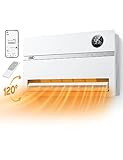
2. Fan or convection. Fan-forced heaters, like the 1,500 watt DREO smart wall heaters at about $89 and $117, heat a room in 10 to 20 minutes and are the right choice for a room you use in bursts. Silent convection panels, like the 400 watt EconoHome at $149, take an hour or more to lift room temperature and suit bedrooms or offices where the heater runs for hours and noise matters.
3. Circuit and outlet location. Confirm a 120 volt outlet within the cord’s reach (usually 5 to 6 feet) and check what else is on that circuit. Most wall heaters plug in; hardwired versions exist but need an electrician. Do not use an extension cord with a 1,500 watt heater.
Wattage and Heat Output
Plug-in wall heaters top out at 1,500 watts, which equals about 5,100 BTU per hour. That covers 150 square feet as primary heat or 250 to 300 square feet as a supplement to central heating. Look for at least two power settings, commonly 750 and 1,500 watts, so you can run at half power once the room is warm. Some smart models modulate output in finer steps. A 400 watt convection panel produces about 1,365 BTU per hour, enough to take the chill off a small bedroom or bathroom or to hold temperature in a well-insulated 100 to 120 square foot room. If the room is over 200 square feet and you want a single heater to carry it, you need 1,500 watts and realistic expectations.
Heating Method
Ceramic fan heaters push air across a PTC ceramic element. They heat fast, self-limit temperature, and distribute warmth across the room, but the fan runs at 40 to 50 dB. Convection panels heat a plate or fin array that warms the air touching it, which rises and circulates naturally. They are silent, run cooler to the touch (surface temperatures of 150 to 200 degrees Fahrenheit versus 250 or more on a fan heater grille), and are safer around children and curtains, but they are slow. Infrared or radiant wall heaters warm objects and people directly rather than the air; they feel warm within seconds if you are in their line of sight and do little for the far side of the room. For a bedroom, convection or a fan heater with a quiet low mode; for a garage workshop or entryway, fan or infrared.
Thermostat and Controls
A built-in thermostat is the difference between a heater that maintains 68 degrees and one that bakes the room until you notice. Look for a digital thermostat with 1 degree increments and a range of at least 40 to 90 degrees Fahrenheit, plus an eco or auto mode that switches between power levels. A remote control is essential on a unit mounted at 4 to 6 feet; the JNDRO 1,500 watt class heater at about $80 includes one, and the DREO smart models add app and voice control, which lets you warm a room before you get home. A 12 or 24 hour timer, a child lock, and a display that dims at night round out the useful features. Skip decorative flame effects unless you specifically want them; they add cost and a little power draw.
Mounting Height and Airflow
Fan heaters work best mounted 3 to 5 feet off the floor so hot air mixes into the room before rising. Mounting at 7 feet or higher, a common placement to keep the unit out of reach, leaves the floor cold and the ceiling warm. Convection panels are usually mounted low, with the bottom edge 4 to 8 inches above the floor, because they rely on natural rise. Keep at least 12 inches of clearance on the sides and 36 inches in front of any heater, and never mount below a shelf, curtain rod, or towel bar. Most wall heaters are 20 to 26 inches wide, 10 to 14 inches tall, and 4 to 6 inches deep, weighing 5 to 10 pounds, and mount to drywall with two or four screws into a stud or with heavy-duty anchors. Panel heaters are thinner, often under 1 inch, but wider, around 24 by 24 inches.
Safety Features
Non-negotiable: overheat protection that shuts the element off if internal temperature climbs, and a listing from a recognized safety laboratory (UL, ETL, or CSA) on the unit itself, not just in the marketing text. Wall heaters do not need tip-over switches, which is one of their advantages, but they should have a cool-touch housing, a grille with openings too small for a child’s finger, and a thermal fuse as a backup to the electronic cutoff. Bathroom use requires a model explicitly rated for it and a GFCI outlet. A heater that stops with a power outage and restarts at its last setting is convenient; one that restarts at full power after an outage is a hazard to be aware of.
Price Tiers
Budget wall heaters run $50 to $85 and give you 1,500 watts, a fan, a basic thermostat, and a remote; the JNDRO at $79.99 sits here. Mid-range units from $85 to $130, such as the DREO smart heaters at $88.99 and $116.98, add app control, precise digital thermostats, quieter fans, and better cutoff sensors. Premium wall heaters from $130 to $300 include silent convection panels like the EconoHome 400 watt at $149, hardwired 240 volt units with 2,000 to 4,000 watt output, and designer models with glass fronts. For pure heat per dollar, budget and mid-range 1,500 watt fan heaters are hard to beat; you pay extra for silence, smarts, or looks.
Spec Checklist
| Spec | Budget | Mid | Premium |
|---|---|---|---|
| Price | $50 to $85 | $85 to $130 | $130 to $300 |
| Output | 750 / 1,500 W | 750 / 1,500 W, modulating | 400 W panel or 2,000 to 4,000 W hardwired |
| Coverage | Up to 150 sq ft | Up to 150 sq ft, faster | 120 sq ft (panel) or 300+ (hardwired) |
| Heating type | Ceramic fan | Ceramic fan, quiet mode | Convection panel or infrared |
| Noise | 45 to 52 dB | 38 to 45 dB | Silent (panel) |
| Thermostat | Digital, 5 degree steps | Digital, 1 degree steps | Digital, 1 degree steps |
| Controls | Remote | Remote, app, voice | Remote or hardwired thermostat |
| Safety listing | ETL | ETL or UL | UL or ETL |
| Warranty | 1 year | 1 to 2 years | 2 to 5 years |
Red Flags
- No UL, ETL, or CSA mark shown on the product label.
- Wattage over 1,500 on a plug-in 120 volt unit. That exceeds what a standard outlet should carry continuously.
- “Heats 500 square feet” claims on a 1,500 watt heater.
- No overheat cutoff mentioned in the specifications.
- Efficiency claims like “saves 50 percent on heating” for an electric resistance heater.
- Mounting hardware limited to drywall anchors with no stud option.
- Cord under 5 feet with no indication of outlet placement.
FAQ
How many square feet will a 1,500 watt wall heater heat?
About 150 square feet as the only heat source in an average room, or 250 to 300 square feet as a supplement to central heat. Poor insulation or high ceilings cut those figures by 20 to 30 percent.
Is a convection panel heater cheaper to run than a fan heater?
Not per watt. A 400 watt panel costs a quarter as much per hour as a 1,500 watt fan heater because it produces a quarter of the heat. It is cheaper to run only because it does less; the advantage is silence and gentle, steady warmth, not efficiency.
Can I install a wall heater in a bathroom?
Only a model specifically rated for bathroom or damp locations, plugged into a GFCI outlet, mounted outside the reach of the tub or shower. Many general-purpose wall heaters are not rated for this; check the manual before buying.
How high should a wall heater be mounted?
Fan heaters do their best work 3 to 5 feet off the floor. Convection panels mount low, 4 to 8 inches above the floor. Either way, keep 36 inches clear in front and 12 inches on each side, and avoid mounting under shelves or curtains. Following those clearances in 2026 is still the single most effective safety step you can take.