Key takeaways
- Measuring the whole window. Only the open gap and the track span matter for the vent panel.
- Assuming any kit fits any window. Included panels are sized for common double-hung windows of 24 to 47 inches; small or tall sliders often need an aftermarket kit.
- Buying by ASHRAE BTU. The SACC figure is 35 to 45 percent lower and is the realistic cooling number. The Shinco’s 12,000 ASHRAE equals 7,500 SACC, good for about 300 to 450 square feet.
- Stretching the hose. A fully extended hose radiates heat back into the room. Keep it under 5 feet with one gentle bend at most.
- Ignoring hose diameter. Older kits are 5 inches; most current hoses are 5.9 inches. A mismatch needs an adapter.
- No seal around the panel. Gaps around a poorly fitted panel let hot air back in. Use the included foam or add weatherstripping.
- Placing the unit in a closet-like corner. Portables need free air on the intake side or they overheat and lose capacity.
What's inside
The Short Answer
A portable air conditioner does not sit in the window; only its exhaust hose does, through an adjustable panel. What you need to fit is that panel, and for a small sliding window that means an opening at least 5.9 inches (15 cm) wide for the hose collar and a slide length the panel can span, typically 20 to 60 inches when mounted vertically or horizontally. The unit itself sits on the floor and takes a footprint of about 13 by 15 inches for an 8,000 BTU class machine up to 18 by 20 inches for a 14,000 BTU class, standing 27 to 34 inches tall. Keep the hose run under 5 feet and the unit within about 4 feet of the window, and nearly any small sliding window from 20 inches wide up will work with the right kit.
Expect to pay $250 to $350 for a single-hose portable unit in the 7,500 to 8,000 BTU SACC range, and $25 to $35 for an aftermarket sliding window or sliding door vent kit if the included one does not fit.
As an Amazon Associate we earn from qualifying purchases at no extra cost to you. Product prices and availability are accurate as of the date shown and are subject to change.



Standard Sizes
| Component | Typical dimensions (in) | Typical dimensions (cm) | Notes |
|---|---|---|---|
| Portable AC unit, 8,000 to 10,000 BTU ASHRAE (5,000 to 6,500 SACC) | 13 x 15 x 27 to 29 tall | 33 x 38 x 69 to 74 | 45 to 60 lb; rooms to 300 sq ft |
| Portable AC unit, 12,000 BTU ASHRAE (7,000 to 8,000 SACC) | 15 x 17 x 29 to 31 tall | 38 x 43 x 74 to 79 | 55 to 70 lb; rooms to 450 sq ft |
| Portable AC unit, 14,000 BTU ASHRAE (9,000 to 10,000 SACC) | 17 x 19 x 31 to 34 tall | 43 x 48 x 79 to 86 | 65 to 85 lb; rooms to 550 sq ft |
| Exhaust hose | 5.0 or 5.9 diameter, 47 to 59 long | 13 or 15 diameter, 120 to 150 long | 5.9 in is the most common current size |
| Standard window slider panel (included) | Extends 20 to 47 | 51 to 120 | Often two or three plastic sections |
| Extended sliding window kit (aftermarket) | Extends 20 to 59 | 51 to 150 | Mounts vertical or horizontal; about $28 |
| Sliding door kit (aftermarket) | Extends up to 90 | Up to 229 | For patio doors and tall sliders; about $30 |
| Hose collar cutout in panel | 5.9 diameter | 15 diameter | Panel must be wider than 6.5 in to house it |
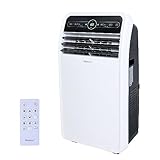
A representative unit is the Shinco 12,000 BTU (7,500 BTU SACC) at about $290, which fits the middle row above and ships with an installation kit. The adjustable vertical/horizontal kit at about $28 and the sliding door kit at about $30 are examples of the aftermarket panels that solve fit problems on small or unusually shaped sliders.
How to Measure Your Space
- Identify the slide direction. A horizontal slider opens side to side; the panel mounts vertically in the gap. A vertical slider (single or double hung) opens up; the panel mounts horizontally on the sill.
- Measure the open gap. Slide the window open as far as it goes and measure the clear opening in the direction of the slide. For a horizontal slider this is the width of the gap; for a vertical slider it is the height. Small sliders often give 12 to 24 inches.
- Measure the panel span. Measure the full dimension the panel must fill: for a horizontal slider that is the height of the window opening from track to track, typically 24 to 60 inches; for a vertical slider it is the width from jamb to jamb.
- Check the gap against the hose. The opening must be at least 6.5 inches in the slide direction to seat a 5.9 inch hose collar with a frame around it. A window that opens only 5 inches will not work without a different vent method.
- Measure the track depth. Panels sit in the window track. Measure the track channel width, usually 0.75 to 1.5 inches, and confirm the panel thickness (about 0.5 to 1 inch) fits.
- Measure from window to floor spot. The unit should sit within 3 to 4 feet of the window so the hose stays short and as straight as possible. Hoses stretch to 47 to 59 inches but cool worse when fully extended.
- Measure the floor footprint and clearance. Allow the unit’s footprint plus 12 to 20 inches of open space on the intake sides, usually the back and one side.
- Locate the outlet. Portable units draw 8 to 12 amps and use a 5 to 6 foot cord. It must reach a grounded outlet without an extension cord.
By Room or Use Case
Small bedroom with a 24 by 36 inch horizontal slider
The window opens to roughly a 12 inch gap on one side, with a 36 inch tall track. Mount the panel vertically; a standard included kit spanning 20 to 47 inches fits. An 8,000 to 10,000 BTU ASHRAE unit (about 5,000 to 6,500 SACC) covers a 150 to 250 square foot bedroom and occupies a 13 by 15 inch spot on the floor.
Home office with a 36 by 24 inch slider (wide and short)
Here the track is only 24 inches tall, at the bottom of most panel ranges. Confirm the kit’s minimum span is 20 inches or less. If the included panel is too long and cannot be cut, an aftermarket adjustable kit with a shorter minimum solves it for under $30.
Living room up to 450 square feet with a small basement-style slider
A 12,000 BTU ASHRAE unit like the Shinco at 7,500 SACC covers the room, but basement sliders are often 30 to 36 inches wide and only 12 to 18 inches tall, and they sit high on the wall. Mount the panel horizontally in the gap and expect to angle the hose upward; keep the unit as close to the wall as its clearance allows so the hose does not kink.
Apartment with a sliding patio door and no usable window
A sliding door kit that extends to 90 inches fills the gap of a standard 80 inch door. It lets you vent through the door while keeping it closed to a 6 to 8 inch opening. Add a foam seal at the top and bottom to stop air leaks.
Small room where a window unit might be easier
If the slider opens at least 22 inches wide and 13 inches tall and the sill is solid, a 5,000 BTU window air conditioner such as the Frigidaire model at about $161 can be cheaper and more efficient than a portable for a room up to 150 square feet, because it exhausts heat directly outside without a hose. Portables are for windows that cannot hold a unit or where the window must remain fully usable.
Common Sizing Mistakes
- Measuring the whole window. Only the open gap and the track span matter for the vent panel.
- Assuming any kit fits any window. Included panels are sized for common double-hung windows of 24 to 47 inches; small or tall sliders often need an aftermarket kit.
- Buying by ASHRAE BTU. The SACC figure is 35 to 45 percent lower and is the realistic cooling number. The Shinco’s 12,000 ASHRAE equals 7,500 SACC, good for about 300 to 450 square feet.
- Stretching the hose. A fully extended hose radiates heat back into the room. Keep it under 5 feet with one gentle bend at most.
- Ignoring hose diameter. Older kits are 5 inches; most current hoses are 5.9 inches. A mismatch needs an adapter.
- No seal around the panel. Gaps around a poorly fitted panel let hot air back in. Use the included foam or add weatherstripping.
- Placing the unit in a closet-like corner. Portables need free air on the intake side or they overheat and lose capacity.
FAQ
What is the smallest sliding window a portable AC can vent through?
The opening in the slide direction must be at least about 6.5 inches to house a 5.9 inch hose collar. Beyond that, the panel needs to span the track, and aftermarket kits go as short as 20 inches. A window that opens to a 7 inch gap on a 22 inch track is workable.
Can I mount the vent panel horizontally in a horizontal slider?
No, the panel goes in the direction that fills the gap. In a horizontal slider the gap is a vertical strip, so the panel mounts vertically. Adjustable kits that advertise both orientations are simply telling you they fit both window types.
How far can the unit sit from the window?
Within about 4 feet, so the 47 to 59 inch hose stays short and straight. Every foot of extra hose and every sharp bend costs cooling and adds heat back into the room.
Will a portable AC block the window entirely?
No. The panel occupies the open gap of about 6 to 8 inches, and the window closes against it. You can remove the panel in a few minutes when the season ends. That is the main reason renters in 2026 choose a portable over a window unit for a small slider.