Key takeaways
- Light carbon layer: A thin carbon-coated prefilter may reduce mild odors briefly, but it saturates quickly in a busy kitchen.
- Moderate carbon filter: Around 0.5–1 pound of carbon is a reasonable minimum for occasional cooking in a small room.
- Heavy carbon canister or bed: Around 2–5 pounds or more is better for frequent frying, open-plan kitchens, pets, or persistent smells.
The best kitchen air purifier for cooking odors is a model with a substantial activated-carbon filter, a published smoke CADR of at least 200–300 CFM for a typical kitchen, and a position that lets it capture contaminated air before it spreads through the home.
An air purifier cannot replace a vented range hood: the hood should capture heat, grease, moisture, and combustion by-products at the source. The purifier’s job is to reduce the odor and fine particles that escape into the room, especially when cooking with oil, spices, fish, or high heat.

Shark NeverChange Air Purifier, HP152, Charcoal
Included for 'Best Kitchen Air Purifiers for Cooking Odors' because the listing specifies HP152 and Charcoal, details this guide uses to compare options.
View on Amazon
WINIX 5510 Air Purifier (New Generation of 5500-2 with App Support) for Home Large Room Up to 1881 Ft² in 1 Hr, True HEPA, High Deodorization Carbon Filter and Auto Mode, Captures Pet Allergies, Smoke
Included for 'Best Kitchen Air Purifiers for Cooking Odors' because the listing specifies True HEPA and High Deodorization Carbon Filter and Auto Mode, details this guide uses to compare options.
View on Amazon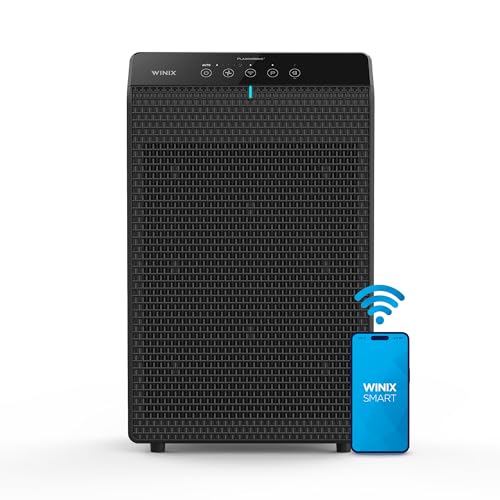
WINIX 5520 Air Purifier for Home Large Room Up to 1882 Ft² in 1 Hr With Air Quality Monitor, True HEPA, High Deodorization Carbon Filter and Auto Mode, Captures Pet Allergies, Smoke, Dust.
Included for 'Best Kitchen Air Purifiers for Cooking Odors' because the listing specifies True HEPA and High Deodorization Carbon Filter and Auto Mode, details this guide uses to compare options.
View on AmazonWhat matters most for cooking odors
1. Activated-carbon capacity
Cooking smells are gases and vapors, so a particle-only purifier will not solve the problem. Activated carbon adsorbs many odor molecules, but performance depends heavily on how much carbon is present and how quickly air passes through it.
- Light carbon layer: A thin carbon-coated prefilter may reduce mild odors briefly, but it saturates quickly in a busy kitchen.
- Moderate carbon filter: Around 0.5–1 pound of carbon is a reasonable minimum for occasional cooking in a small room.
- Heavy carbon canister or bed: Around 2–5 pounds or more is better for frequent frying, open-plan kitchens, pets, or persistent smells.
Manufacturers do not always disclose carbon weight. When they do not, look for phrases such as “carbon pellets,” “carbon bed,” or “deep activated-carbon filter,” rather than relying on “odor filter” alone. A thicker filter usually increases the cabinet depth, replacement cost, and airflow resistance, but it is the most meaningful specification for odor control.
2. Particle filtration
Cooking also creates fine particles from oil, browning, smoke, and gas-stove combustion. Choose a purifier with a true HEPA or high-efficiency particulate filter. A washable mesh prefilter is useful because it catches hair, dust, and larger grease particles before they reach the carbon and HEPA layers.
HEPA filtration does not remove every odor molecule, but it helps clear the smoky haze that carries odor through the home. For kitchens, a removable prefilter that can be vacuumed or washed is particularly valuable. Grease-coated filters lose airflow and become a maintenance problem.
3. Airflow, not just room-size claims
Room-size labels are often based on one air change per hour or another relatively gentle setting. For cooking, compare the published smoke CADR or clean-air delivery rate, then select a model with enough capacity to run below its maximum speed.
For example, a 10-by-12-foot room with an 8-foot ceiling contains 960 cubic feet of air. To achieve about five air changes per hour, the purifier needs approximately 80 CFM of delivered airflow. A model rated at 200–300 CFM gives you useful headroom for filter loading, open doors, and the lower noise of a medium setting.
An open-plan kitchen measuring 15 by 20 feet with an 8-foot ceiling contains about 2,400 cubic feet. Five air changes per hour would require roughly 200 CFM, and a purifier rated around 350–500 CFM is a more practical target. If the kitchen opens into a living room, calculate the combined space rather than using the kitchen’s floor area alone.
| Kitchen or connected space | Example volume | Useful minimum smoke CADR | Recommended carbon capacity |
|---|---|---|---|
| Small kitchen or studio cooking area | 8 × 10 × 8 ft = 640 cu. ft. | 150–200 CFM | 0.5–1 lb where possible |
| Typical enclosed kitchen | 10 × 12 × 8 ft = 960 cu. ft. | 200–300 CFM | 1–2 lb |
| Large kitchen with dining area | 12 × 16 × 8 ft = 1,536 cu. ft. | 300–400 CFM | 1–3 lb |
| Open-plan kitchen and living room | 15 × 20 × 8 ft = 2,400 cu. ft. | 350–500+ CFM | 2–5+ lb |
Best purifier choice by kitchen situation
| Your situation | Best choice | Why |
|---|---|---|
| Small apartment with limited floor space | Compact HEPA purifier with the deepest carbon filter available and at least 150 CFM smoke CADR | It fits beside existing furniture while providing enough turnover for a small room. |
| Frequent frying, grilling, or wok cooking | Large cabinet-style purifier with a replaceable carbon bed and 250–400+ CFM smoke CADR | More carbon delays saturation and higher airflow clears smoke faster. |
| Children, pets, or allergy concerns | True HEPA unit with a washable prefilter, sealed filter compartment, and child lock | Particles and dander matter as much as odor, and the prefilter protects the expensive stages. |
| Renter who cannot install ductwork | Portable purifier with filter-change alerts, low operating noise, and a carry handle | It improves air quality without modifying cabinets, walls, or windows. |
| Open-plan home | One high-CADR unit near the kitchen plus a second smaller unit near the living area if odors travel | Two correctly placed units can outperform one purifier running loudly at the far end of the room. |
| Gas stove user | High-airflow HEPA purifier used with an externally vented hood | The purifier can reduce particles, but it should not be treated as a substitute for combustion ventilation. |
Where to place it for better odor control
Place the purifier approximately 3–8 feet from the stove, off to the side rather than directly above a burner. This lets it intercept escaping air without exposing the filter to concentrated grease, steam, or excessive heat. Keep the intake pointed toward the cooking area and the clean-air outlet directed across the room.
- Maintain at least 12 inches of clearance around air intakes and outlets; 18–24 inches is preferable for a large unit.
- Keep the purifier at least 3 feet from sinks, kettles, dishwashers, and other sources of water.
- Do not place it inside a cabinet, under a tablecloth, behind a sofa, or tight against a wall.
- Keep it on a stable, level floor where spilled oil or foot traffic will not knock it over.
- Run it on high for 15–30 minutes before cooking, continue during cooking, and leave it running for 30–60 minutes afterward.
A purifier on the opposite side of a large room may still clean the air eventually, but it will not control the odor plume as effectively. Avoid placing it directly in the path of the range hood’s exhaust, because that can disturb capture and pull contaminated air away from the hood.
Filter replacement and the reality of odor saturation
Carbon does not regenerate itself during normal use. Once its adsorption sites are filled, the purifier may continue removing particles while odors pass through. Heavy cooking can saturate carbon months earlier than a manufacturer’s general replacement schedule suggests.
Inspect the prefilter every two to four weeks during regular cooking. Vacuum it when dusty and replace it if it becomes greasy or cannot be cleaned. Replace the HEPA and carbon stages according to the filter indicator or the manufacturer’s schedule, but shorten the interval if odors return quickly after cooking or the unit develops a stale smell.
Washable foam or mesh prefilters are convenient, but they must be completely dry before reinstallation. Never wash a HEPA filter or carbon cartridge unless the manufacturer specifically says it is washable.
Features worth paying for—and those to skip
- Worth paying for: high smoke CADR, disclosed carbon weight, a sealed filter compartment, washable prefilter, quiet medium-speed operation, child lock, and readily available replacement filters.
- Useful but secondary: automatic particle sensors, app controls, scheduling, and air-quality displays. These can automate operation but do not compensate for too little carbon.
- Usually unnecessary: fragrance cartridges, ionizers, and ozone-generating modes. Added fragrance masks odors, while ozone is an irritant and is not appropriate for occupied homes.
For most homes, the best buying balance is a purifier rated one size larger than the room, with at least 1–2 pounds of activated carbon if odor reduction is the priority. Choose a substantially larger carbon bed for frequent high-heat cooking, and keep the range hood running whenever possible. That combination handles both the source and the residue: ventilation captures the plume, while the purifier cleans what escapes.