Key takeaways
- Weekend carry-on: One small cube for underwear and tops, plus a medium cube for trousers or a spare outfit. Avoid a single overfilled large cube, which can be awkward to reposition.
- One-week mixed-weather trip: A small, medium, and large set provides more sorting options. Put compressible basics in the large cube and reserve the medium for layers you may need to reach en route.
- Cold-weather packing: Choose a deeper cube with reinforced seams, but keep coats out of it when possible. A compression cube is better for sweaters and thermal layers than for a bulky jacket.
- Business travel: Prioritize a rectangular shape that fits the suitcase cleanly and use a non-compressed cube for dress shirts. Compression can save space around them, but may create creases in garments that need to arrive crisp.
- Family or shared luggage: Pick a set with multiple sizes and distinct colors, or add simple labels. Several medium cubes are often easier to distribute than one huge cube that is difficult to lift and unpack.
Best Compression Packing Cubes for Suitcases: The Right Pick by Trip Type
The best compression packing cubes for suitcases are a set of differently sized cubes with a separate compression zipper, strong seam construction, and dimensions that fit your luggage—not simply the set that claims the greatest volume reduction. For most travelers, a lightweight nylon set with a small, medium, and large cube offers the best balance; choose a more structured set for frequent heavy packing, or breathable mesh panels when visibility matters more than squeezing clothes to their smallest possible size.
Quick comparison by packing situation
| Situation | Best cube style | Useful capacity or dimensions | Trade-off to expect |
|---|---|---|---|
| Carry-on, 2–4 days | Two small or one small and one medium | About 10–14 in wide; roughly 5–10 L per cube | Compression helps most with soft layers, not shoes or rigid toiletries |
| Week-long trip with mixed clothing | Small, medium, and large set | About 5–20 L total per cube, depending on shape | A full large cube can crowd a carry-on’s corners |
| Bulky sweaters or cold-weather layers | Deep, rectangular cube with a reinforced compression zipper | About 4–6 in deep when uncompressed | Thick fabric compresses, but still occupies substantial space and weight |
| Shared suitcase or quick outfit changes | Color-coded cubes with a mesh window or panel | Choose widths that fit side by side across the suitcase | Mesh improves identification but may snag or show contents |
| Frequent travel and heavy use | Higher-denier nylon, taped or bound seams, substantial zipper coil | Check listed cube dimensions against the suitcase interior | Heavier construction adds a little weight and may cost more |
What compression actually does—and what it does not
A compression cube has a packing zipper and a second zipper that closes around the cube’s perimeter to reduce its depth. It can remove trapped air and hold soft clothes in a tighter shape. It does not make clothing lighter, and it cannot shrink a rigid load. A cube of jeans, shoes, and toiletries may become flatter only slightly; one filled with T-shirts, underwear, or fleece usually compresses more.
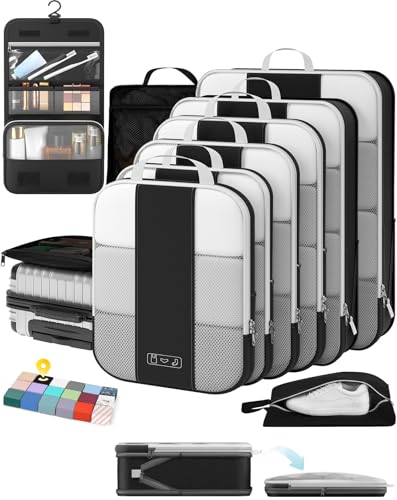
OlarHike 10 Set Compression Packing Cubes for Travel Essentials,Compressible Expandable Space Saver Bags for Organizing Clothes,Luggage Suitcase Garment Bags with Over 1000 pcs Mesh Holes(Black)
Included for 'Best Compression Packing Cubes for Suitcases' as a relevant option in this category; details come from the product listing.
View on Amazon
BAGAIL 4 Set/6 Set/8 Set Compression Packing Cubes Travel Accessories Expandable Packing Organizers (Half Mesh, 6-Black)
Included for 'Best Compression Packing Cubes for Suitcases' because the listing specifies 6-Black), details this guide uses to compare options.
View on Amazon
LeanTravel Premium Compression Packing Cubes for Travel - Suitcase Organizer Bags with Double Zipper & Breathable Mesh Panel - Space Saving Carry On Luggage Essentials (6-Pack, Grey)
Included for 'Best Compression Packing Cubes for Suitcases' because the listing specifies Space Saving Carry On Luggage Essentials (6-Pack and Grey), details this guide uses to compare options.
View on Amazon
BAGSMART 6 Set Compression Packing Cubes for Travel, Lightweight Luggage Organizer Bags, Durable Space Saver Bags Travel Essentials
Included for 'Best Compression Packing Cubes for Suitcases' because the listing specifies Lightweight Luggage Organizer Bags and Durable Space Saver Bags Travel Essentials, details this guide uses to compare options.
View on AmazonLook for a two-way compression zipper or a zipper track with enough room to close without forcing the corners. Treat dramatic volume-reduction claims cautiously: results depend on the garment, folding method, and how tightly the cube is packed. Overfilling to chase a smaller shape puts strain on the zipper ends and seams—the parts most likely to fail first.
How to choose: six details that matter
1. Compression zipper durability
The compression zipper takes more strain than the cube’s ordinary opening. A broader coil, well-finished zipper ends, and fabric reinforcement around the track are useful signs of a more durable design. Smooth operation matters too: if the fabric puckers into the teeth while closing, repack rather than pulling harder. A two-way slider can help you close a cube from either end, but it is not a substitute for adequate capacity.
2. Fabric strength versus weight
Lightweight ripstop nylon is easy to carry and resists small tears, making it a sensible choice for occasional or carry-on travel. Higher-denier nylon is generally more substantial and better suited to frequent use, though the denier number alone does not guarantee good stitching or zipper quality. Polyester can be a budget-friendly, easy-care option, but compare seam finishing and fabric feel rather than relying on fiber name alone.
Mesh helps identify contents and can allow damp items to air out briefly, but large mesh panels are less protective and can snag. A fabric-front cube with a smaller mesh window is a practical middle ground. Compression cubes are not waterproof unless specifically designed and sealed for that purpose.
3. Suitcase fit and expansion capacity
Measure the usable interior of your suitcase, not its outside dimensions. Wheels, handles, and curved corners reduce the flat packing area. As a rough planning example, a carry-on interior around 20 × 13 × 8 inches may fit two cubes about 10–12 inches wide next to each other, but the wheel-end taper can make that arrangement tighter in practice. Leave room for the suitcase’s lining and for the cubes to flex.
An expandable cube gives you extra room when the compression zipper is open. That is useful for the outbound trip, when you may pack loosely, then compress clothes on the return. But expansion adds depth, so check both the cube’s open and compressed dimensions. A tall cube may fit in a large checked case but waste space in a shallow carry-on.
4. Visibility, access, and clothing load
Mesh panels make it easier to find a shirt without opening every cube. Opaque fabric keeps clothing less visible and can make a packed suitcase look neater. For a family or shared bag, assign each traveler a color; for a solo trip, use different sizes or colors to separate clean clothes, laundry, and accessories.
Use compression for flexible garments such as T-shirts, leggings, underwear, and soft sweaters. Pack delicate or wrinkle-prone shirts loosely, or place them in a non-compressed cube. Keep shoes and toiletries separate; their rigid shapes limit compression and can press against clothing.
Best cube setup by trip
- Weekend carry-on: One small cube for underwear and tops, plus a medium cube for trousers or a spare outfit. Avoid a single overfilled large cube, which can be awkward to reposition.
- One-week mixed-weather trip: A small, medium, and large set provides more sorting options. Put compressible basics in the large cube and reserve the medium for layers you may need to reach en route.
- Cold-weather packing: Choose a deeper cube with reinforced seams, but keep coats out of it when possible. A compression cube is better for sweaters and thermal layers than for a bulky jacket.
- Business travel: Prioritize a rectangular shape that fits the suitcase cleanly and use a non-compressed cube for dress shirts. Compression can save space around them, but may create creases in garments that need to arrive crisp.
- Family or shared luggage: Pick a set with multiple sizes and distinct colors, or add simple labels. Several medium cubes are often easier to distribute than one huge cube that is difficult to lift and unpack.
Buying checklist
| Check before buying | Why it matters |
|---|---|
| Cube width and depth | Confirms the cube fits the suitcase’s flat interior and wheel-end taper |
| Open and compressed dimensions | Shows how much expansion room you gain and how much depth compression removes |
| Compression zipper and reinforced ends | Reduces stress at the points that bear the most pull |
| Fabric and seam construction | Helps balance pack weight against resistance to abrasion and tearing |
| Panel design and color options | Makes contents easier to identify or keeps them less visible |
| Set size range | Prevents paying for oversized cubes that do not suit your usual luggage |
Bottom line
For a general-purpose pick, choose a three-size set made from lightweight ripstop or sturdier nylon, with reinforced compression zipper ends and dimensions matched to your suitcase. Choose mesh or color-coded cubes if fast identification matters; choose deeper, stronger cubes if you regularly pack soft winter layers. If your usual load is mostly rigid items or wrinkle-prone clothing, prioritize organization and suitcase fit over maximum compression.