Key takeaways
- Choose boundary wire when your lawn is small, satellite reception is obstructed, or you want a system that does not depend on an RTK antenna.
- Choose RTK virtual boundaries when you want easy zone changes and have a clear sky view for the positioning station.
- Choose camera-assisted navigation when obstacle avoidance is a priority, but still remove toys, hoses, and pet waste before mowing.
- Choose a hybrid or advanced system when the lawn contains several separated areas and you want app-controlled routes rather than manually moving wire.
The best robot lawn mowers depend less on brand than on four measurements: your lawn’s total cutting area, narrowest passage, steepest slope, and whether you can install a boundary wire or need a wire-free system.
| Yard situation | Best fit | Useful target specifications | Typical price range |
|---|---|---|---|
| Small, mostly flat lawn | Compact wired mower | 18–22 cm cutting width; 300–600 m² rated area; 20–30% slope capability | $500–$1,000 |
| Medium lawn with several zones | Wire-free RTK or camera-assisted mower | 20–24 cm cutting width; 800–1,500 m² range; app-managed zones | $1,000–$2,000 |
| Large or steep property | All-wheel-drive robotic mower | 32–40 cm cutting width; 2,000 m² or more; 45–75% slope rating | $2,000–$4,000+ |
Best robot lawn mowers by yard type
Best for a small, simple yard: compact boundary-wire mower
A compact mower such as a smaller Worx Landroid or entry-level Husqvarna Automower is usually the sensible choice for a lawn under about 500–600 m². These models generally use a perimeter wire to define the work area, return to a charging station automatically, and cut with a narrow deck of roughly 18–22 cm.
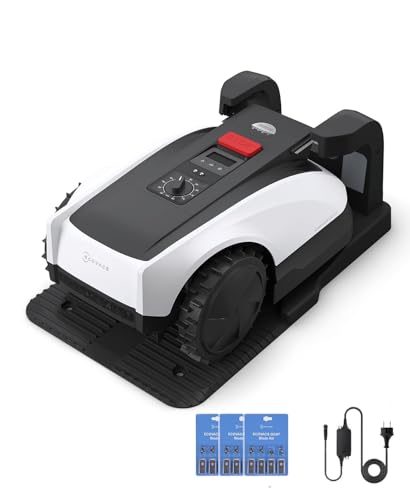
ECOVACS Goat O1000 RTK Care Robot Lawn Mower, RTK Navigation, 1/4 Acre
Included for 'Best Robot Lawn Mowers for Every Yard' because the listing specifies RTK Navigation and 1/4 Acre, details this guide uses to compare options.
View on Amazon
(Upgraded) DREAME A3 AWD 1000 LiDAR Robot Lawn Mower, 45-Min Fast Charge
Included for 'Best Robot Lawn Mowers for Every Yard' because the listing specifies 45-Min Fast Charge, details this guide uses to compare options.
View on Amazon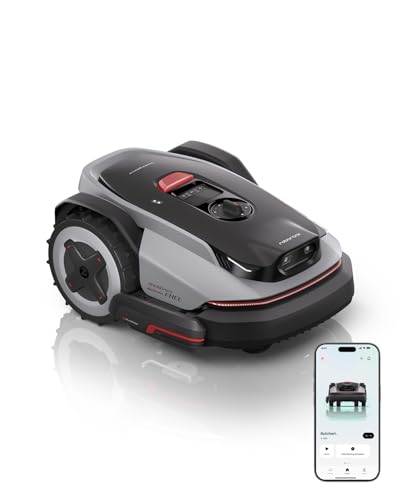
Roborock RockNeo Q110H Robot Lawn Mower, Wire-Free Robotic Lawn Mower with Full-Band RTK + VSLAM Navigation, Auto Mapping, AI Vision Obstacle Avoidance, App Control, 45% Slope, Covers Up to 1/4 Acre
Included for 'Best Robot Lawn Mowers for Every Yard' because the listing specifies Auto Mapping and AI Vision Obstacle Avoidance, details this guide uses to compare options.
View on Amazon
MOVA LiDAX Ultra 1000 Robot Lawn Mower Wire Free for 1/4 Acre, RTK-Free+360° 3D LiDAR+AI Vision Auto Mapping, Zero-Edge Cutting, Cutting Height 1.2"-3.9", 45% Slope, Up to 150 Managed Zones Dual Maps
Included for 'Best Robot Lawn Mowers for Every Yard' because the listing specifies RTK-Free+360° 3D LiDAR+AI Vision Auto Mapping and Zero-Edge Cutting, details this guide uses to compare options.
View on AmazonThe narrow deck is an advantage around garden beds and tight side passages. A mower that is 40–45 cm wide can often pass through a 60 cm opening, but that does not mean it will navigate comfortably. Allow at least 10 cm of clearance on both sides for reliable travel, and more where the ground is uneven or the mower must turn.
Boundary-wire systems require more installation work than their price may suggest. The wire must be pinned securely, kept at the manufacturer’s specified distance from edges, and routed around trees, ponds, play equipment, and separate lawn sections. Expect several hours for a small lawn, plus time to correct missed strips or accidental crossings during the first week.
Best for a medium yard and multiple zones: wire-free RTK mower
For a 600–1,500 m² lawn with front and back sections, a wire-free mower such as the Segway Navimow i-series or a comparable RTK-enabled model is easier to reconfigure after installation. RTK satellite positioning creates a virtual boundary through an app, while onboard sensors help the mower avoid trees, walls, and other obstacles.
These mowers typically cut about 20–24 cm per pass and can manage several mapped zones. Their main limitation is positioning reliability. The antenna needs a reasonably open view of the sky; tall buildings, dense tree cover, and narrow passages can reduce accuracy. A “wire-free” installation may still require careful placement of the antenna, Wi-Fi coverage, and a boundary review in the app.
Choose a model with camera-based obstacle recognition if children’s toys, pet bowls, hoses, or fallen branches commonly appear on the lawn. Recognition reduces collisions, but it does not replace clearing the yard. Small objects can still be missed, and a mower may treat a low shrub or dark garden edging differently from the way you expect.
Best for steep or rough ground: all-wheel-drive mower
The Mammotion LUBA 2 AWD is designed for demanding lawns where ordinary two-wheel-drive mowers may lose traction. Its all-wheel-drive layout and larger cutting deck—about 40 cm on applicable models—make it suited to broad lawns and slopes. Advertised slope capability reaches approximately 75% on some versions, equivalent to about 37 degrees, although actual performance depends on wet grass, soil, tire grip, and the direction of travel.
All-wheel drive is valuable on slopes, but it does not solve every terrain problem. Avoid deep ruts, exposed roots, loose gravel, and abrupt drops. Measure the steepest continuous section rather than relying on the overall appearance of the property. A short, dry slope may be manageable; the same slope after rain can become a traction and stopping problem.
For large flat yards, a wider deck reduces total mowing time. For complicated yards with many trees and narrow corridors, a wide mower can be less efficient because it needs larger turning areas. Measure the narrowest passage before choosing a 32–40 cm cutting deck.
Head-to-head comparison of important specifications
| System or example | Cutting width | Boundary method | Typical slope class | Best use |
|---|---|---|---|---|
| Worx Landroid compact models | About 18–20 cm | Perimeter wire | Usually gentle to moderate slopes | Small, uncomplicated lawns |
| Husqvarna Automower compact and mid-size models | About 22 cm on many models | Perimeter wire; selected models add advanced navigation | Often around 22° on suitable models | Reliable scheduled mowing with established layouts |
| Segway Navimow i-series | About 21–23 cm | Virtual boundary using RTK positioning | Often around 30–45%, model dependent | Medium yards and multiple zones |
| Mammotion LUBA 2 AWD | About 40 cm | Virtual boundary using positioning technology | Up to roughly 75% on certain models | Large, uneven, and steep lawns |
Specifications vary by exact model, battery version, firmware, and market. Treat the manufacturer’s area figure as a maximum planning number, not a promise of perfect coverage. A yard divided into four zones, with narrow gates and a 35% slope, demands more from a mower than one open rectangle of the same size.
Battery range: calculate for real mowing conditions
Robot mower battery claims are normally expressed as maximum lawn area per charge or recommended area per day. Wet grass, frequent obstacles, slopes, low temperatures, and repeated trips between zones reduce effective range. A useful rule is to select a mower rated for at least 25–30% more area than your measured lawn.
For example, a 700 m² property should not automatically receive a mower rated for exactly 700 m². A model rated for roughly 900 m² or more gives the mower time to recharge and maintain the lawn without operating continuously. This matters especially during spring growth, when the mower may need a longer daily schedule.
Most robotic mowers cut for a limited period, return to the dock, recharge, and resume automatically. Check whether the stated area assumes 24-hour access to the lawn. If you need the mower silent during evenings, weekends, or children’s outdoor play, choose additional capacity.
Boundary wire or virtual mapping?
- Choose boundary wire when your lawn is small, satellite reception is obstructed, or you want a system that does not depend on an RTK antenna.
- Choose RTK virtual boundaries when you want easy zone changes and have a clear sky view for the positioning station.
- Choose camera-assisted navigation when obstacle avoidance is a priority, but still remove toys, hoses, and pet waste before mowing.
- Choose a hybrid or advanced system when the lawn contains several separated areas and you want app-controlled routes rather than manually moving wire.
Wire-free does not mean maintenance-free. You may need to position an antenna, extend Wi-Fi, create no-go zones, and re-map after moving a shed or changing a garden bed. Boundary wire is harder to install initially but can be predictable once correctly buried or pinned.
Setup and durability realities
Before buying, measure the charging-station location, the narrowest gate, and the distance from the dock to the farthest zone. The dock needs a level approach and enough clear space for the mower to enter and leave. Keep furniture, raised edging, and decorative stones outside the mower’s route where possible.
Robot mowers are designed for outdoor use, but the parts that usually need attention are blades, wheels, wheel bearings, charging contacts, and the perimeter-wire connections. Replaceable blades may need changing several times during a growing season, depending on lawn area and debris. Clean grass from the underside without directing a pressure washer at seals, motors, or electronics.
Most models weigh roughly 10–20 kg, while larger all-wheel-drive machines can be heavier. You should be able to lift the mower safely over a step or carry it indoors for winter storage. If a narrow side gate is the only route to the lawn, compare the mower’s actual body width—not just its cutting width—with the opening.
Quick buying decision
- Under 500 m² and mostly flat: buy a compact wired model with a 18–22 cm deck.
- 500–1,500 m² with multiple lawn areas: choose RTK mapping, provided the antenna has a clear sky view.
- Large lawn with steep grades: prioritize all-wheel drive, traction, and a manufacturer slope rating over app features.
- Many obstacles or pets: prioritize obstacle detection, generous clearance, and a schedule that keeps the mower away from active play times.
- Frequent layout changes: avoid a permanently wired system unless you are comfortable reinstalling boundary wire.
The best robot lawn mowers are the ones whose cutting width, navigation method, battery capacity, and slope rating match the physical constraints of your yard. Measure first, add capacity for real-world conditions, and treat installation quality as part of the mower—not an afterthought.