Key takeaways
- Polypropylene or similar rigid plastic: light, corrosion-resistant, and affordable; it can crack if dropped in cold weather or overloaded.
- Clear polycarbonate-style lids: make contents easy to see, but scratches and brittle hinges can become problems after years of rough use.
- Stainless or corrosion-resistant hardware: preferable for saltwater, though every metal part should still be rinsed with fresh water.
- Rubber gaskets: improve splash resistance but need to remain clean and unpinched.
- Fabric bags: lighter and easier to compress into storage, but zippers, seams, and the bottom panel usually wear before the rest of the bag.
The best tackle boxes depend on where you fish: a waterproof, adjustable box suits kayak anglers; a larger modular system works best on a boat; and a compact shoulder-friendly tray is usually the smartest choice from shore.
Quick picks by fishing situation
| Fishing setup | Best box type | Useful target size | What matters most |
|---|---|---|---|
| Shore fishing and walking | Compact 3600-size tray or soft tackle bag | 12–15 in. long; under 6 lb loaded | Portability, quick access, shoulder comfort |
| Kayak fishing | Waterproof, low-profile hard box | 14–17 in. long; about 3–4 in. high | Water resistance, latches, low height |
| Small boat or jon boat | One or two 3700-size modular trays | 16–18 in. long; 10–12 in. wide | Capacity, stackability, adjustable dividers |
| Large boat and mixed techniques | Modular tackle-bag system with removable trays | Multiple trays rather than one oversized box | Organization, carrying efficiency, expansion |
The best tackle boxes for different setups
Best all-around hard box: Plano EDGE 3700
The Plano EDGE 3700 is a strong choice for anglers who want a durable hard tray with generous capacity and better water protection than a basic open-compartment box. Its 3700 footprint is approximately 16.75 inches long, 11.25 inches wide, and just over 3 inches high, so it accommodates larger lure collections without becoming excessively tall.

Plano Guide Series StowAway 4-By Rack System Tackle Box, Holds 4 3700 Utility Tackle Boxes, Quick-Access Top Storage with DuraView Lid, Durable Construction, Flexible, Adaptable Fishing Box
Included for 'Best Tackle Boxes for Every Fishing Setup' because the listing specifies Holds 4 3700 Utility Tackle Boxes and Quick-Access Top Storage with DuraView Lid, details this guide uses to compare options.
View on Amazon
Plano Two-Tray Tackle Box, Green/Tan, Rust-Proof Brass Latch, Top-Access Tray with Deep Storage, Made in the USA, Portable Fishing Gear Storage Organizer
Included for 'Best Tackle Boxes for Every Fishing Setup' because the listing specifies Green/Tan and Rust-Proof Brass Latch, details this guide uses to compare options.
View on Amazon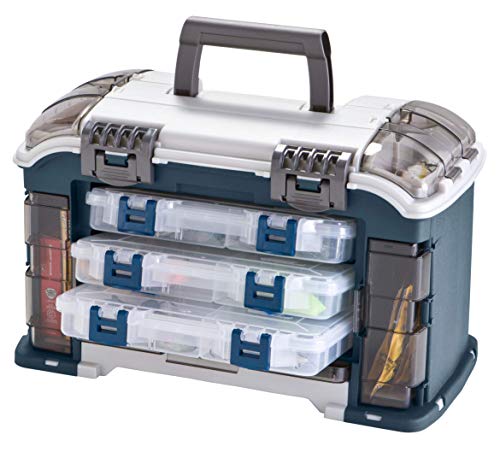
Plano Angled Tackle System with Three 3560 Stowaway Boxes, Fishing Tackle Storage, Premium Tackle Storage
Included for 'Best Tackle Boxes for Every Fishing Setup' because the listing specifies Fishing Tackle Storage and Premium Tackle Storage, details this guide uses to compare options.
View on Amazon
Flambeau Outdoors 4007 Tuff Tainer, 24 Compartments, 12 Zerust Dividers
Included for 'Best Tackle Boxes for Every Fishing Setup' because the listing specifies 24 Compartments and 12 Zerust Dividers, details this guide uses to compare options.
View on AmazonIts adjustable interior is useful for separating hard baits, terminal tackle, soft-plastic packets, and tools. The main trade-off is weight: once filled with hooks, jigs, and metal lures, a 3700 box can become uncomfortable to carry any distance. It is better stored in a boat, vehicle, or larger tackle bag than carried loose along a shoreline.
Choose it when capacity and protection matter more than minimum weight. Depending on the version and retailer, comparable premium 3700-size boxes usually fall in the $35–$70 range.
Best compact tray for shore fishing: Plano EDGE 3600
A 3600-size tray is easier to carry and fits in smaller backpacks, sling bags, and kayak compartments. The Plano EDGE 3600 measures roughly 14 inches long, 9 inches wide, and about 2 inches high, making it a practical size for a day of bass, trout, panfish, or inshore lure fishing.
The reduced depth limits the number of bulky crankbaits or large spinnerbaits it can hold, but that limitation can improve organization. Instead of bringing every lure you own, you can build a focused box for the water and season. A loaded 3600 tray commonly weighs around 4–7 pounds, depending on the amount of metal tackle inside.
For shore anglers, the best arrangement is often one compact hard tray inside a waterproof backpack, rather than a large box with a molded handle. That setup leaves room for water, pliers, a rain layer, and snacks while keeping the total load manageable.
Best for wet conditions: Flambeau waterproof tackle boxes
Flambeau’s waterproof tackle-box lines are worth considering for kayak fishing, rainy shore trips, and boat storage where spray is unavoidable. Look for a model with a continuous gasket and latches that compress the lid evenly. A gasket is more useful than a marketing label alone: it helps keep splash and brief immersion from reaching hooks and reels, although it does not make a box permanently submersible.
Waterproof boxes usually sacrifice some convenience. Their seals can make the lid harder to close when the box is overfilled, and a tightly divided interior may provide less usable volume than an open tray. Drain or dry wet lures before closing the box for long-term storage; trapped water still promotes rust, even inside a sealed container.
For kayak use, select a box no taller than the space beneath the seat or inside the deck hatch. A low-profile box is less likely to interfere with paddling and is easier to retrieve without shifting your balance. Comparable waterproof hard boxes generally cost about $20–$60.
Best flexible system: a tackle bag with removable trays
A soft tackle bag is the most practical option for anglers who switch between shore, kayak, and boat fishing. Models from brands such as Plano, Flambeau, and KastKing commonly use removable 3600- or 3700-size trays, exterior tool pockets, and a shoulder strap. The bag itself usually weighs less than a large rigid case and is easier to carry through uneven ground.
The fabric body also uses space efficiently around irregular items such as line spools, sunglasses, gloves, and bait jars. However, soft bags are less protective against crushing and are not automatically waterproof. Check whether the base is molded or coated, whether the zipper has a rain flap, and whether the included trays have secure latches.
This is the best choice for a mixed collection, but avoid buying a bag much larger than your current tackle. Empty space encourages disorganized piles, while an overstuffed bag strains zippers and shoulder straps.
Storage capacity: 3600 versus 3700
The 3600 and 3700 labels are useful industry size categories, but interior layouts vary between manufacturers. A 3600 tray is usually the better personal-carry size. A 3700 tray offers noticeably more room for long leaders, larger lures, and separate lure categories, but its filled weight can quickly exceed what is comfortable for a long walk.
| Feature | 3600-size tray | 3700-size tray | Large soft tackle bag |
|---|---|---|---|
| Typical outside length | 13–15 in. | 16–18 in. | 16–22 in. |
| Typical outside width | 8–10 in. | 10–12 in. | 10–14 in. |
| Typical height | 2–4 in. | 3–5 in. | 8–13 in. |
| Comfortable loaded-carry target | 4–7 lb | 6–12 lb | 8–18 lb, depending on contents |
| Best use | Walking and limited lure selection | Boat storage and broader collections | Mixed tackle and accessories |
Compartment adjustability and organization
Adjustable dividers are valuable only when they lock firmly. Loose dividers slide when a box is carried vertically, allowing treble hooks and small terminal tackle to migrate between sections. For hard baits, create compartments slightly wider than the lure body and leave enough clearance for treble hooks to lie flat.
Use separate sections for hooks, swivels, weights, and lures. Small removable containers or labeled zip pouches are often better for tiny items than a large open compartment. Clear lids make it possible to identify a box without opening it, but avoid stacking boxes so tightly that the lid cannot be viewed or opened.
For boat fishing, label the outside by technique rather than by lure color: “topwater,” “shallow crankbait,” “jigs,” or “saltwater terminal.” This saves more time than arranging every lure by brand or color. For shore fishing, label boxes by trip instead, such as “trout creek” or “inshore light tackle,” so the load stays intentionally small.
Construction details that affect durability
- Polypropylene or similar rigid plastic: light, corrosion-resistant, and affordable; it can crack if dropped in cold weather or overloaded.
- Clear polycarbonate-style lids: make contents easy to see, but scratches and brittle hinges can become problems after years of rough use.
- Stainless or corrosion-resistant hardware: preferable for saltwater, though every metal part should still be rinsed with fresh water.
- Rubber gaskets: improve splash resistance but need to remain clean and unpinched.
- Fabric bags: lighter and easier to compress into storage, but zippers, seams, and the bottom panel usually wear before the rest of the bag.
Before buying, measure the actual storage space. A tackle box that fits a boat locker may not fit through a kayak hatch. Allow at least half an inch of clearance on each side for gripping and removal; a box that exactly matches the compartment dimensions is difficult to extract when wet or full.
How to choose without overbuying
- Measure the narrowest hatch, locker, backpack opening, or vehicle compartment.
- Choose the largest box that leaves clearance for your fingers and lid movement.
- Estimate the loaded weight, not the empty-box weight. Lead, hooks, and metal lures add up quickly.
- Prioritize a gasket for kayak and exposed boat storage; prioritize a shoulder strap for long shore walks.
- Buy adjustable compartments only if you will reorganize them by technique or lure size.
- Keep wet tackle separate until it is dry, even when the box is advertised as waterproof.
For most anglers, the best tackle boxes are not one enormous container but a small system: a compact 3600-size tray for walking, a waterproof low-profile box for kayak use, and one or more 3700-size trays or removable-bag compartments for boat storage. That combination provides useful capacity without turning every fishing trip into a heavy lifting exercise.