
Key takeaways
- Separate airborne noise from structural noise: Motor whine travels through air and is easy to reduce with a closed door. The low-frequency thrum travels through the building and is the one that annoys neighbors. Isolation, not volume, is the fix.
- Build a decoupling stack: A dense rubber horse-stall mat over closed-cell foam under the plate breaks the direct path into the floor. This single measure does more than any difference between models.
- Favor enclosed motors: Units with a fully shrouded motor and rubber-isolated mounts are quieter from the first day and stay quieter as bearings age. Open vents usually mean you will hear the motor clearly.
- Stay in the lower speed band: Most plates get dramatically louder above roughly the two-thirds mark of their range. Since the training benefit of extreme speeds is questionable anyway, staying low is free and effective.
- Check placement against the structure: Position the plate near a load-bearing wall rather than in the middle of a room span. Floor deflection is greatest at mid-span, which is exactly where resonance is worst.
What's inside
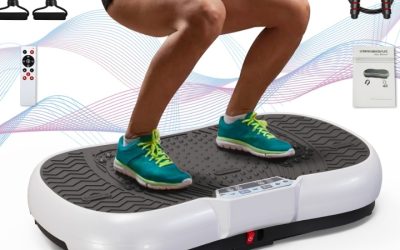
A vibration plate is, mechanically, a device for pumping energy into your floor. That is fine on a concrete slab in a basement. On a suspended timber floor in an apartment or the second story of a house, it is a different proposition: joists resonate, the low-frequency hum travels through the structure, and the neighbor below hears a persistent drone with no obvious source. Of all the home fitness gear people buy, plates generate the most complaints per minute of use, and it catches owners completely by surprise.
The good news is that the problem is manageable and largely predictable. Motor enclosure quality, plate mass, and the isolation you put underneath it determine almost everything. The six machines below range from a well-damped curved unit to large 450-pound-capacity platforms that transmit more energy simply because there is more mass moving. Here is how they compare on noise and transmitted vibration, and what to put under them so a fifteen-minute session does not become a housing dispute.
As an Amazon Associate we earn from qualifying purchases at no extra cost to you. Product prices and availability are accurate as of the date shown and are subject to change.

#1 Pick

#2 Pick

#3 Pick

#4 Pick

#5 Pick

#6 Pick

#7 Pick

Quick Comparison
| Product | Best For | Standout Feature | Watch Out For |
|---|---|---|---|
| MERACH CV30 Pro Curved | Apartments and shared walls | Enclosed motor keeps airborne noise low | Still needs isolation matting underneath |
| 130-Level Vibration Plate | Running at low, quiet settings | Granular control to stay below the noisy range | Upper speeds get audibly buzzy |
| Lifepro Waver | Ground-floor rooms with band workouts | Steady motor tone rather than a rattle | Band anchors click against the housing |
| SEDOZIK Vibration Plate | Users who need remote speed control | Adjusting without stepping off avoids thumps | 450 lb frame transmits more to timber floors |
| HVX Vibration Platform | Basements and concrete slabs | Heavy deck feels planted at high speeds | Loudest transmission through suspended floors |
| Renoj 3D Vibration Platform | Short quiet recovery sessions | Gentle multi-direction motion at low levels | 3D movement spreads energy in more directions |
How to Choose
- Separate airborne noise from structural noise: Motor whine travels through air and is easy to reduce with a closed door. The low-frequency thrum travels through the building and is the one that annoys neighbors. Isolation, not volume, is the fix.
- Build a decoupling stack: A dense rubber horse-stall mat over closed-cell foam under the plate breaks the direct path into the floor. This single measure does more than any difference between models.
- Favor enclosed motors: Units with a fully shrouded motor and rubber-isolated mounts are quieter from the first day and stay quieter as bearings age. Open vents usually mean you will hear the motor clearly.
- Stay in the lower speed band: Most plates get dramatically louder above roughly the two-thirds mark of their range. Since the training benefit of extreme speeds is questionable anyway, staying low is free and effective.
- Check placement against the structure: Position the plate near a load-bearing wall rather than in the middle of a room span. Floor deflection is greatest at mid-span, which is exactly where resonance is worst.
Top Picks Reviewed
Quietest Unit: MERACH CV30 Pro Curved
The enclosed motor and curved deck produce a lower, softer tone than most competitors, and at moderate speeds it fades into background noise in a way that makes it usable in a flat.
Quiet in the air is not the same as quiet through the floor. Even this one needs a proper rubber and foam stack underneath if anyone lives below you.
Best Low-Speed Control: 130-Level Vibration Plate
A very fine speed range lets you find the highest setting that stays acceptably quiet in your specific room, rather than being forced to choose between two coarse options.
Push it toward the top of the range and the housing develops a distinct buzz. The upper levels exist, but they are not the ones to use in a shared building.
Best Band Workouts Downstairs: Lifepro Waver
The motor produces a consistent tone rather than a rattle, which is much easier to live with over a fifteen-minute session, and the bands let you train without adding jumping or impact.
The band anchors tap lightly against the housing during pulling movements. It is a small sound, but in a quiet flat at 6 a.m. it is noticeable.
Best Convenience Controls: SEDOZIK Vibration Plate
Being able to change speed by remote means you are not repeatedly stepping off and back on, and those step-offs are actually the loudest thing most sessions produce on a timber floor.
The larger 450-pound-capacity frame carries more mass and puts more energy into the structure. On an upper floor it needs more isolation than a lighter unit would.
Best on Concrete: HVX Vibration Platform
On a slab, the heavy wide deck is an advantage: it feels immovable at high speeds and gives room for kneeling and plank work without any wobble.
On a suspended wooden floor it is the worst offender here for transmitted rumble. This is a basement or garage machine, not a bedroom one.
Gentlest Session: Renoj 3D Vibration Platform
Ten quiet minutes at a low setting for post-exercise recovery is a modest ask of any building, and this unit is comfortable running at the calm end of its range.
Multi-directional motion distributes energy in more planes, which can excite floor resonance in ways a simple oscillating plate does not. Test it before committing to an early-morning routine.
Frequently Asked Questions
How loud is a vibration plate in decibels?
Most run in the range of a household fan or a quiet dishwasher at moderate speeds. The perceived nuisance comes from the low-frequency component, which is not well captured by a single decibel number.
Does a yoga mat underneath help?
Barely. A thin mat protects the floor from scratches but does almost nothing for vibration transmission. You need dense rubber, ideally over closed-cell foam, to decouple it properly.
Will it disturb people through a wall or only the floor?
Primarily the floor and the structure beneath. Neighbors to the side usually hear far less than the household directly below, which is why apartment placement matters so much.
Can I use one on carpet?
Yes, but carpet lets the unit rock slightly and does not stop structural transmission. Place a rigid board on the carpet, then the rubber isolation layer, then the plate.
Final Thoughts
If you live above someone, choose an enclosed-motor unit, run it in the lower half of its speed range, and spend on isolation matting before you spend on extra features. On a concrete slab, buy the heaviest and most stable platform you can fit, because the noise concern largely disappears. The machine matters less than what sits between it and your building.


Write Your Review
No reviews yet. Be the first to share your experience!