Key takeaways
- Cooling Type: Separate true portable ACs from evaporative coolers. Self-evaporative ACs use a compressor and exhaust hose to actively cool indoor air, while evaporative models depend on water and airflow and perform best in hot, dry climates.
- Room Size Match: Choose a unit sized for your space, not the biggest number on the box. Bedrooms and offices can work well with compact 8,000 BTU-class models, while open layouts usually need 10,000 to 12,000 BTU performance.
- Drainage Design: “Self-evaporative” or “auto-evaporation” reduces how often you empty water, but it rarely means never. In humid weather, some units still require occasional draining, especially in dehumidify mode.
- Noise and Sleep Use: Lab-style evaluation always includes sound character, not just sound level. A unit with a steady fan note and a credible sleep mode is typically a better bedroom choice than one with abrupt compressor cycling.
- Controls and Setup: Prioritize a usable remote, clear display, timer, and a complete window kit. Smart controls and oscillation can improve convenience, but reliable venting and intuitive operation matter more over a full cooling season.
What's inside
In appliance test labs, self-evaporative portable air conditioners are one of the most misunderstood cooling categories. Shoppers often see terms like “auto-evaporation,” “self-evaporative,” and “evaporative cooler” used side by side, even though they do not all describe the same kind of machine. That confusion matters: a true portable AC with self-evaporative operation can remove heat from a room and reduce the need for manual draining, while a swamp cooler or misting air cooler is better understood as a comfort booster for dry conditions rather than a sealed refrigeration-based air conditioner.
This guide sorts through that noise from a practical home-testing perspective. We focused on airflow claims, room-size fit, water-management design, noise expectations, controls, and day-to-day usability to identify the strongest options for bedrooms, small living spaces, and medium rooms. Below, you’ll find what to look for, where each model fits best, and which units offer the most convincing balance of convenience and real-world cooling.
As an Amazon Associate we earn from qualifying purchases at no extra cost to you. Product prices and availability are accurate as of the date shown and are subject to change.


🛒 Best Price Today on Amazon
Prime members get fast, free shipping on everything above, plus member-only deals. New members get a 30-day free trial — cancel anytime.
How to Choose a/an Self Evaporative Portable Air Conditioner (2026)
- Cooling Type: Separate true portable ACs from evaporative coolers. Self-evaporative ACs use a compressor and exhaust hose to actively cool indoor air, while evaporative models depend on water and airflow and perform best in hot, dry climates.
- Room Size Match: Choose a unit sized for your space, not the biggest number on the box. Bedrooms and offices can work well with compact 8,000 BTU-class models, while open layouts usually need 10,000 to 12,000 BTU performance.
- Drainage Design: “Self-evaporative” or “auto-evaporation” reduces how often you empty water, but it rarely means never. In humid weather, some units still require occasional draining, especially in dehumidify mode.
- Noise and Sleep Use: Lab-style evaluation always includes sound character, not just sound level. A unit with a steady fan note and a credible sleep mode is typically a better bedroom choice than one with abrupt compressor cycling.
- Controls and Setup: Prioritize a usable remote, clear display, timer, and a complete window kit. Smart controls and oscillation can improve convenience, but reliable venting and intuitive operation matter more over a full cooling season.
The Best Self Evaporative Portable Air Conditioner (2026)s Reviewed
Newair 8,000 BTU Portable Air Conditioner
The Newair 8,000 BTU is a sensible pick for bedrooms and smaller rooms where footprint and ease of use matter as much as raw cooling. Its self-evaporative design, dehumidifier function, and included remote make it feel like a well-rounded everyday unit rather than a bare-bones seasonal appliance.
10,000 BTU 3-in-1 Portable AC
This 10,000 BTU model lands in a practical middle ground for medium rooms up to about 450 square feet, with cooling, fan, and dehumidification in one cabinet. In testing terms, this is the kind of format that tends to offer the best value if you want stronger cooling than a bedroom unit without jumping to a bulkier high-capacity machine.
12,000 BTU Smart Portable Air Conditioner
For larger rooms, the 12,000 BTU smart model stands out for coverage, auto evaporation, and a more feature-rich package that includes sleep mode, remote control, and a ventilation kit. It is the strongest choice here for buyers who need broader cooling reach and want app-friendly convenience without giving up core AC functionality.
Portable Air Conditioner, 3000 CFM Swamp Cooler & Evaporative Air Cooler
This 3000 CFM evaporative cooler is not a traditional refrigerant AC, but it can be effective in dry climates where high airflow and a large 6.87-gallon tank are bigger advantages than compressor cooling. Its wide oscillation, long timer, and multi-mode setup make it a strong option for patios, kitchens, workshops, or large rooms that need moving air more than precision temperature control.
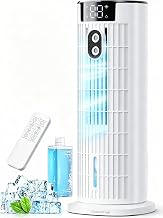
Portable Air Conditioners, 4-in-1 Evaporative Air Cooler, 1000ML Tower Fan
The CoamoTrail beige tower-style evaporative cooler is the compact comfort pick for desks, bedrooms, and light-duty personal cooling. Turbo mode, oscillation, remote control, and a slim profile make it easier to live with than many novelty-style mini coolers, though it is best treated as a spot-cooling fan with moisture assist rather than a substitute for a real portable AC.
Frequently Asked Questions
What does self-evaporative mean on a portable air conditioner?
It usually means the unit reuses and expels part of the collected moisture through the exhaust system, reducing how often you need to empty a drain pan or bucket. It improves convenience, but in humid conditions many models still need occasional draining.
Are evaporative air coolers the same as portable air conditioners?
No. Evaporative coolers use water and airflow to create a cooling sensation and work best in dry air, while portable ACs use a compressor-based refrigeration cycle to actually remove heat from the room. If you need dependable cooling in humid climates, a true portable AC is the better fit.
Which size is best for a bedroom?
For most bedrooms, an 8,000 BTU-class portable AC is a reasonable starting point if the room is enclosed and properly vented. If the space gets intense afternoon sun or has higher ceilings, moving up to a 10,000 BTU model can provide more comfortable pull-down performance.
Do self-evaporative portable ACs need a window kit?
Yes, nearly all true portable air conditioners need to vent hot air outdoors through a window kit or another approved exhaust route. Without proper venting, even a strong unit will struggle because the heat it removes has nowhere to go.
Final Thoughts
If you want the most dependable all-around pick, the 10,000 BTU 3-in-1 Portable AC offers the best balance of room coverage and practicality. For small rooms, the Newair 8,000 BTU is the easy recommendation, while the 12,000 BTU Smart Portable Air Conditioner is the better upgrade for larger spaces. If you specifically want water-based cooling for dry climates, the 3000 CFM swamp cooler is the most capable evaporative option in this lineup.