Key takeaways
- Airflow: perforated liners have holes that keep bottoms crisp; solid parchment traps steam and can leave food soggy underneath.
- Safety: both are usually rated to 425°F, but a liner weighted down by food is far less likely to fly up than a loose parchment sheet in an empty basket.
- Fit: liners come pre-cut in 8-inch squares and rounds sized for 5-8QT baskets; parchment must be cut or folded to fit, and overhang can singe.
- Convenience: grab-and-drop liners take one second; parchment needs measuring, cutting, and sometimes weighting.
- Cost: a 200-count pack of liners runs a few cents each, while a parchment roll is cheaper still if you cut your own.
- Bleaching: unbleached options exist in both, but many liners like the OLESBUR set are explicitly unbleached and food-grade.
If you own an air fryer, you have almost certainly wondered whether to line the basket at all, and if so, whether to reach for a pre-cut disposable liner or a sheet torn from a roll of parchment paper. The two look similar, but they behave very differently once hot air starts moving at 400°F, and the wrong choice can either wreck your food’s crisp or, in the worst case, float up into the heating element.
This comparison breaks down how purpose-made air fryer liners such as the Reynolds Kitchens Air Fryer Liners stack up against plain parchment paper for airflow, safety, cleanup, and cost, so you can decide which belongs in your kitchen. Both have a place; the right pick depends on how often you fry and what you cook.
Our top picks





As an Amazon Associate we earn from qualifying purchases at no extra cost to you. Ratings are shown as listed on Amazon.
⚡ Save on Your Next PC — Amazon Prime
Prime members get fast free shipping on the systems above, plus early access to Prime Day & Black Friday PC deals. New members get a 30-day free trial.
Watch: Air Fryer Liners vs Parchment Paper: Which is Better? — Video Review
Quick Verdict
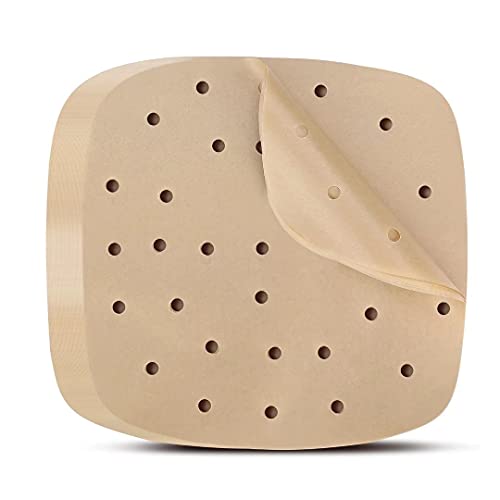
Pre-perforated air fryer liners win for everyday use. Products like the OLESBUR Air Fryer Liners Disposable and Katbite 200PCS Perforated Parchment Squares are engineered with dozens of holes that let hot air circulate underneath your food, so you get the crisp an air fryer is meant to deliver plus a no-scrub cleanup. Plain parchment is cheaper per square inch and fine for occasional use, but its solid surface blocks airflow and it can lift into the element if you preheat empty.
Key Differences
- Airflow: perforated liners have holes that keep bottoms crisp; solid parchment traps steam and can leave food soggy underneath.
- Safety: both are usually rated to 425°F, but a liner weighted down by food is far less likely to fly up than a loose parchment sheet in an empty basket.
- Fit: liners come pre-cut in 8-inch squares and rounds sized for 5-8QT baskets; parchment must be cut or folded to fit, and overhang can singe.
- Convenience: grab-and-drop liners take one second; parchment needs measuring, cutting, and sometimes weighting.
- Cost: a 200-count pack of liners runs a few cents each, while a parchment roll is cheaper still if you cut your own.
- Bleaching: unbleached options exist in both, but many liners like the OLESBUR set are explicitly unbleached and food-grade.
Purpose-Made Air Fryer Liners
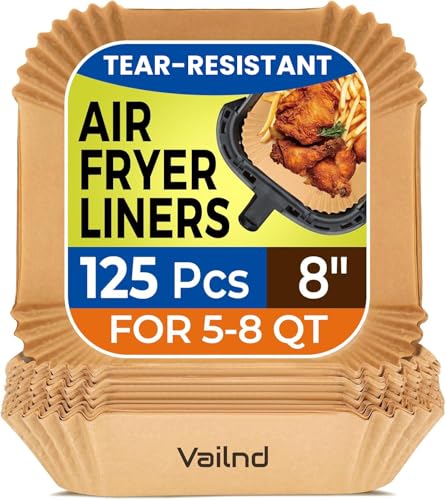
Disposable liners are built for exactly this job. The perforations on sets like the 125Pcs Square Air Fryer Liners and the Katbite perforated squares are the whole point: they let the fan pull air past the bottom of a chicken wing or fry so it browns instead of steaming. Because they arrive pre-cut in 8 to 9-inch squares and rounds, there is no measuring, and the raised or scalloped edges keep grease from pooling against the basket.
The trade-off is that you are buying a consumable. A 150 to 200-count pack lasts a heavy user a couple of months, and you toss one after every cook. For most people the time saved on scrubbing baked-on cheese and the reliably crisp results justify the small per-use cost.
Plain Parchment Paper
Regular parchment from a roll is the budget and flexibility champion. You cut exactly the size you need, it works in the air fryer, the oven, and on a baking sheet, and one roll costs a few dollars. For delicate items like a single fish fillet or a batch of cookies, being able to size the sheet precisely is genuinely useful.
The catch is airflow and safety. A solid sheet blocks the holes in your basket, so bottoms come out paler and softer, and an unweighted piece can lift in the airflow and touch the top heating element, which is a fire risk. Never preheat an air fryer with loose parchment inside and nothing on top of it.
Which Should You Buy?
- Fry several times a week: buy pre-perforated liners for the airflow and instant cleanup.
- Want maximum crisp on wings and fries: liners, every time, because the holes are the difference.
- Only air fry occasionally and already own parchment: plain parchment is fine, just cut it to fit and weight it with food.
- Cook delicate or oddly shaped items: parchment you cut yourself hugs the shape better.
- Prefer the greenest option: reusable silicone liners beat both, though they slightly dull crisp compared with perforated paper.
Frequently Asked Questions
Can you use regular parchment paper in an air fryer?
Yes, but only with food placed on top to weigh it down, and never during an empty preheat. Keep it below the basket rim so no edge can reach the heating element.
Do air fryer liners affect cooking time?
Perforated liners have almost no effect because air still moves through the holes. Solid parchment can add a minute or two and leave bottoms less crisp since it blocks airflow.
Are air fryer liners safe at high temperatures?
Most quality liners are rated to about 425°F, comfortably above typical air-fry temps of 350-400°F. Check the pack’s stated rating and never exceed it.
Which is cheaper over a year?
A parchment roll you cut yourself costs the least per use. Pre-cut liners cost a few cents each but save cutting and scrubbing time, which many cooks value more than the difference.
Final Verdict
For the crispiest results with the least effort, pre-perforated air fryer liners are the better everyday choice, and a 200-count unbleached pack is cheap insurance against scrubbing. Keep a roll of plain parchment on hand too for delicate or unusually shaped foods. Buy liners as your default, parchment as your backup, and you are covered for anything the basket throws at you.