
Key takeaways
- Judge the lock, not the label. Every adjustable bell claims a max weight. What separates them is whether the plates seat with zero play once locked. Shake a loaded bell hard before your first swing session; if you hear or feel movement, that movement will only get worse under repetition.
- Measure your handle window. Most adjustable designs use a narrower handle opening than a 35mm competition bell, which means two-handed swings feel cramped for anyone with large hands or thick gloves. If your program lives on two-handed swings and snatches, hold one before committing.
- Check the jump sizes against your weakest lift. A single-arm press progresses in small increments; a swing tolerates large ones. Look at the gaps between settings and ask whether they align with the movement you’ll do most. A leap from 25 to 35 pounds is significant on an overhead press.
- Account for the base plate. Adjustable kettlebells sit in a cradle that holds the unused plates. That cradle needs a flat, stable home near your training area, and it usually rules out training on soft grass or thick foam where the base can tip.
- Decide how much you’ll drop it. Adjustable bells are not built for being dumped from overhead onto concrete. If your training involves cleans you sometimes miss, or Turkish get-ups where control occasionally fails, budget for a rubber mat or accept the cosmetic damage.
What's inside
A kettlebell only has to survive one test to prove itself: the moment at the bottom of a swing when the handle yanks against your fingers and the load tries to keep traveling. Fixed cast iron passes that test by being a single lump of metal. Adjustable kettlebells have to pass it while holding six separate weight plates in place with a dial. That’s the whole engineering problem, and it’s why so many adjustable designs feel fine on a goblet squat and sketchy the second you go ballistic. I’ve spent enough garage-gym mornings listening for plate rattle to know that the mechanism matters more than the max load number on the box.
The BowFlex SelectTech 840 is the design that made the category worth taking seriously. One footprint roughly the size of a shoebox replaces a rack of six bells from 8 to 40 pounds, and the switch between them takes about two seconds with a wrist twist. Below you’ll find where it earns that space, where the handle geometry differs from a competition bell, and who should still spend the money on a single 35-pound chunk of iron instead. Grip comfort and load security are the two axes I graded on, because those are the two things that decide whether an adjustable bell becomes your daily driver or a closet ornament.
As an Amazon Associate we earn from qualifying purchases at no extra cost to you. Product prices and availability are accurate as of the date shown and are subject to change.

#2 Pick
#3 Pick
#4 Pick

#5 Pick

#6 Pick
#7 Pick

As an Amazon Associate we earn from qualifying purchases at no extra cost to you. Product prices and availability are accurate as of the date shown and are subject to change.

Quick Comparison
| Specification | BowFlex SelectTech 840 |
|---|---|
| Weight range | 8 lb to 40 lb |
| Number of settings | 6 (8, 12, 20, 25, 35, 40 lb) |
| Adjustment method | Rotating dial on the base |
| Handle style | Fixed molded handle, single-hand width |
| Replaces | Six individual kettlebells |
| Best suited for | Swings, goblet squats, presses, rows, carries |
| Grip rating | 4.5 / 5 |
| Load security rating | 4.5 / 5 |
| Space saved | Roughly a two-foot square of floor |
How to Choose
- Judge the lock, not the label. Every adjustable bell claims a max weight. What separates them is whether the plates seat with zero play once locked. Shake a loaded bell hard before your first swing session; if you hear or feel movement, that movement will only get worse under repetition.
- Measure your handle window. Most adjustable designs use a narrower handle opening than a 35mm competition bell, which means two-handed swings feel cramped for anyone with large hands or thick gloves. If your program lives on two-handed swings and snatches, hold one before committing.
- Check the jump sizes against your weakest lift. A single-arm press progresses in small increments; a swing tolerates large ones. Look at the gaps between settings and ask whether they align with the movement you’ll do most. A leap from 25 to 35 pounds is significant on an overhead press.
- Account for the base plate. Adjustable kettlebells sit in a cradle that holds the unused plates. That cradle needs a flat, stable home near your training area, and it usually rules out training on soft grass or thick foam where the base can tip.
- Decide how much you’ll drop it. Adjustable bells are not built for being dumped from overhead onto concrete. If your training involves cleans you sometimes miss, or Turkish get-ups where control occasionally fails, budget for a rubber mat or accept the cosmetic damage.
Top Picks Reviewed
BowFlex SelectTech 840 Adjustable Kettlebell
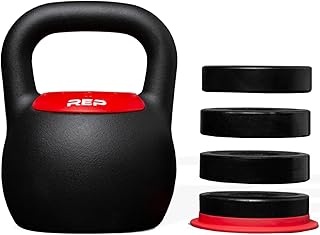
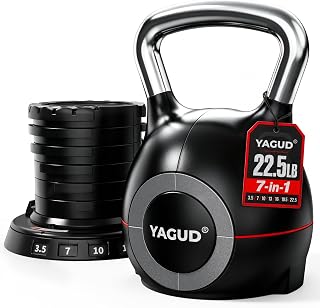
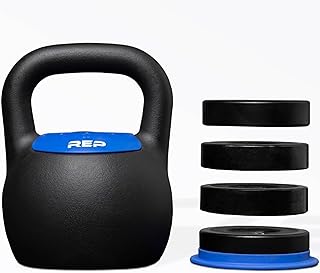
The 840 hides six bells inside one shell. You set it in its base, turn the dial on top to your target number, and lift out only the plates you asked for; the rest stay behind. In practice the adjustment is faster than walking to a rack, which turns weight-ladder work into something you’ll actually do rather than something you plan and skip. Descending sets — 40 for swings, 25 for presses, 12 for halos — flow without a break in tempo, and that alone changes how you write a session.
Grip is where it surprised me. The handle is a smooth molded arc with a subtle taper, wide enough for a single hand plus a loose thumb wrap and comfortable through high-rep swings without chalk. Sweat is the limiting factor rather than shape, so a towel nearby helps more than gloves. Two-handed work is the compromise: the opening accommodates both hands, but you’re stacking them tighter than on a 16kg competition bell, and taller lifters may notice their pinkies crowding the corners. Racked position sits cleanly against the forearm, which is the detail cheaper adjustable bells routinely fumble by leaving a bolt or a squared corner right where your wrist goes.
Load security holds up under aggressive use. Once the dial clicks into place the plates behave as one mass — no metallic chatter at the bottom of a swing, no shifting weight that throws the arc off-line. The bell’s center of gravity does sit slightly differently than solid iron because the mass is distributed across stacked plates rather than a single sphere, which is most noticeable during get-ups and windmills where you’re reading the bell’s balance overhead. Give it a week and your hands recalibrate. The honest ceiling is 40 pounds, so committed swing specialists and anyone deadlifting heavy single-arm will outgrow the top setting eventually. For everyone building strength conditioning, mobility flows, and accessory work in a small space, that ceiling arrives much later than you’d expect.
Frequently Asked Questions
Can you actually swing an adjustable kettlebell safely?
Yes, with the 840’s dial mechanism specifically — it locks plates without play, which is the prerequisite. The habit worth building is a quick shake test after every adjustment, the same way you’d tug a barbell collar. Half a second of verification eliminates the only real failure mode.
Is 40 pounds enough to keep making progress?
For two-handed swings and goblet squats, most trained lifters will find 40 pounds becomes a conditioning weight rather than a strength weight within a few months. For single-arm presses, rows, snatches, and get-ups, it stays challenging far longer. Density work — more reps, tighter rest, longer time under tension — extends the useful life of the top setting considerably.
How does the handle compare to a competition kettlebell?
It’s smoother and slightly narrower. Competition bells use a standardized 35mm handle sized for two-hand and insert work in sport contexts; the 840 prioritizes single-hand comfort and a clean rack position. If you’re training for kettlebell sport, use sport equipment. For general strength, the difference is a preference, not a limitation.
Does it need a special surface or storage spot?
It needs a level, firm surface for the base so plates seat and release properly. A rubber mat over concrete is ideal. The whole unit tucks into a corner or under a bench, which is the point — you’re trading a rack’s worth of floor for a footprint smaller than a milk crate.
Final Thoughts
The BowFlex SelectTech 840 solves a specific problem well: you want six kettlebells and you have room for one. Its grip is comfortable enough for high-volume swing work, its locking mechanism doesn’t rattle under load, and the dial is fast enough that varying weight mid-workout stops being friction. The tradeoffs are real and predictable — a 40-pound ceiling, a two-handed grip that’s snugger than competition iron, and a base plate that wants a stable home. None of those are dealbreakers for the person this bell is built for: someone training seriously in a compact space who’d rather progress across six loads than own one. If that’s you, this is the adjustable kettlebell to buy, and the space it gives back is a bonus you’ll appreciate every session.
FAQ
Can you actually swing an adjustable kettlebell safely?
Is 40 pounds enough to keep making progress?
How does the handle compare to a competition kettlebell?
Does it need a special surface or storage spot?
Best Kettlebell Weight for Men: How to Pick the Right Size
Best kettlebell weight for men is the decision that quietly settles whether...
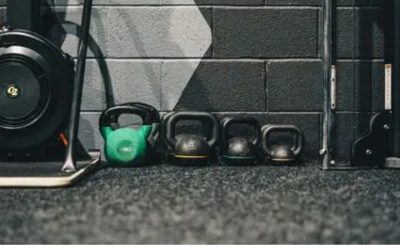
Best Kettlebell Ab Exercises: 6 Adjustable and Fixed Picks
Best kettlebell ab exercises rarely share a single weight. A loaded carry,...
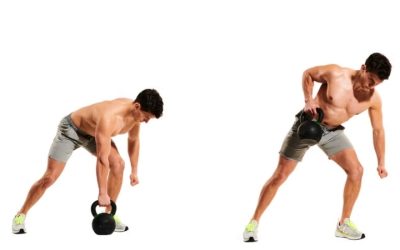
Best Kettlebell Core Exercises: 6 Picks for Floor Space
Best kettlebell core exercises tend to be floor-based or overhead, which makes...
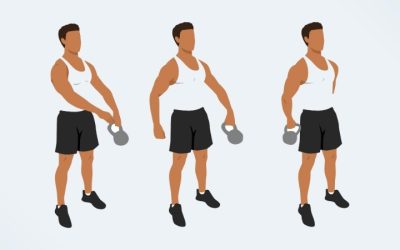
Best Kettlebell Exercise for Abs: 5 Bells for Long Holds
Best kettlebell exercise for abs options nearly all involve holding load away...
Best Kettlebell Ab Workout: 6 Bells Sized for Circuit Work
Best kettlebell ab workout equipment is chosen for sustained rounds, not for...
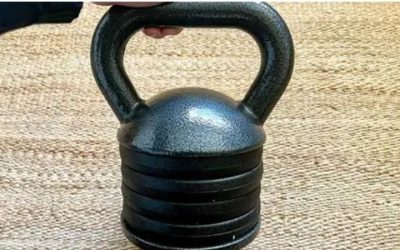
Best Kettlebell Weight: How to Size It Plus 6 Top Picks
Best kettlebell weight is not one number, because a swing, a press...
Best Kettlebell Routine: How to Pick the Right Bell Weight
Best kettlebell routine arguments usually skip the one decision that determines whether...
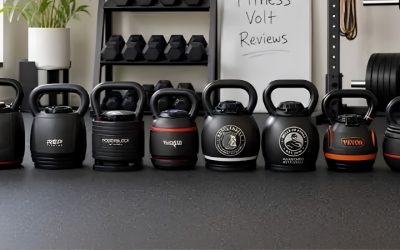
Best Kettlebell Routines: 6 Bells Matched to Each Format
Best kettlebell routines fail more often on equipment than on programming. A...
Best Kettlebell Training: 6 Bells to Build a Progression
Best kettlebell training runs into a hardware problem early: the traditional weight...
Best Workout Kettlebell: 6 Bells Matched to Your Training
Best workout kettlebell choices depend entirely on the session you plan to...
Write Your Review
No reviews yet. Be the first to share your experience!