Key takeaways
- You buy meat in bulk or freeze garden produce: Choose a chest freezer if you have floor space and can label and rotate packages. Its open cavity handles awkward shapes better than fixed shelves.
- You reach for frozen food every day: Choose an upright. Shelves or drawers reduce digging and help keep frequently used items at eye level.
- You have a small utility room: Measure the appliance and its access path first. An upright can fit a narrow wall, while a chest model may block a walkway even if its capacity is attractive.
- You live in a rental or may move: A compact freezer is easier to place, but measure doorways, stairs, and landings. A full-size freezer can be heavy and awkward to maneuver, even when empty.
- You want minimal maintenance: Look for an upright with automatic defrost. If low running costs and temperature stability matter more than convenience, a manual-defrost chest may be a better trade-off.
The best deep freezers for reliable long-term food storage are chest models if you prioritize efficiency and bulk capacity, and upright models if you need quick access, shelves, and a smaller footprint. Choose by the food you store and the space you can give the freezer—not just its advertised capacity.
Chest vs. upright: the decision at a glance
| Decision factor | Chest freezer | Upright freezer |
|---|---|---|
| Usable capacity | Often holds bulky packages efficiently, but food at the bottom can be hard to reach. | Shelves and door bins make contents visible, though shelving can limit space for large cuts or containers. |
| Temperature stability | Cold air tends to stay inside when the lid opens, which helps during brief access. | Cold air spills out more readily through the front door; frequent or prolonged openings matter more. |
| Energy use | Often uses less energy than a similar-capacity upright, but compare the EnergyGuide label for the specific model. | May use more energy at a comparable capacity; automatic defrost can also affect consumption. |
| Organization | Typically has removable baskets. Larger items can fit, but sorting below the baskets takes planning. | Vertical shelves, drawers, and door storage make everyday sorting easier. |
| Defrosting | Many models require manual defrosting and have a drain for meltwater. | Manual-defrost and frost-free models are available. Frost-free units save maintenance time but can cost more to run. |
| Footprint | Wide floor footprint with a lid that needs overhead clearance. | Narrower floor footprint, but needs room in front for the door to swing open. |
Choose by your storage situation
- You buy meat in bulk or freeze garden produce: Choose a chest freezer if you have floor space and can label and rotate packages. Its open cavity handles awkward shapes better than fixed shelves.
- You reach for frozen food every day: Choose an upright. Shelves or drawers reduce digging and help keep frequently used items at eye level.
- You have a small utility room: Measure the appliance and its access path first. An upright can fit a narrow wall, while a chest model may block a walkway even if its capacity is attractive.
- You live in a rental or may move: A compact freezer is easier to place, but measure doorways, stairs, and landings. A full-size freezer can be heavy and awkward to maneuver, even when empty.
- You want minimal maintenance: Look for an upright with automatic defrost. If low running costs and temperature stability matter more than convenience, a manual-defrost chest may be a better trade-off.
Capacity: compare usable space, not just the headline
Freezer capacity is usually stated in cubic feet, but the number does not tell you how easily food will fit. A chest freezer’s open interior can accommodate a large roast or a stack of meal-prep containers, while an upright’s shelves may need to be rearranged or removed. Conversely, a freezer with bins and shelves can make more of its space accessible in daily use.

Midea 3.5 Cu.ft Chest Freezer, Fridge Freezer Convertible with LED Light
Included for 'Best Deep Freezers for Reliable Long-Term Food Storage' because the listing specifies Fridge Freezer Convertible with LED Light, details this guide uses to compare options.
View on Amazon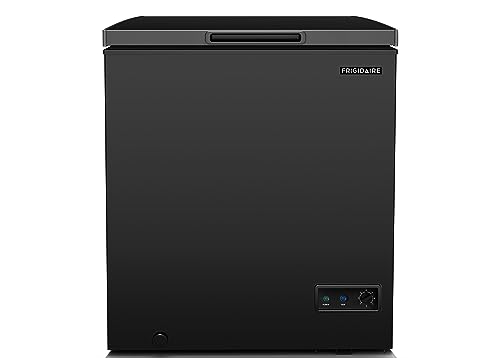
FRIGIDAIRE EFRF5003-BLACK Chest Deep Freezer-Garage-Ready, 5.0 Cu. Ft. Capacity, Black-Adjustable Thermostat-Removable Vinyl Coated Wire Basket-Easy Defrost Drain
Included for 'Best Deep Freezers for Reliable Long-Term Food Storage' because the listing specifies 5.0 Cu. Ft. Capacity, details this guide uses to compare options.
View on Amazon
Igloo 3.5 Cu Ft. Upright Deep Freezer Chest- Deep Freezer with Quick Freezing System & Adjustable Thermostat for Homes, Garages & Basements- Low Noise Freezer with Removable Basket & LED Lights- White
Included for 'Best Deep Freezers for Reliable Long-Term Food Storage' as a relevant option in this category; details come from the product listing.
View on Amazon
Kismile 3.2 Cubic Feet Chest Freezer, Small Deep Freezer for Home, Black
Included for 'Best Deep Freezers for Reliable Long-Term Food Storage' because the listing specifies Small Deep Freezer for Home and Black, details this guide uses to compare options.
View on AmazonAs a rough planning guide, a small 5–7-cubic-foot model suits supplemental storage for a modest household; 10–15 cubic feet is more practical for regular bulk buying; and 16 cubic feet or more is for substantial seasonal or household storage. These are starting points, not guarantees: packaging, household habits, and how often you restock all affect the capacity you need.
Temperature, efficiency, and long-term storage
For frozen food storage, aim to keep the appliance at 0°F (-18°C) or colder. Check that the temperature control lets you set a suitable temperature, and use an inexpensive independent freezer thermometer to verify it after the freezer has stabilized. A dial setting alone does not confirm the actual interior temperature.
Energy use varies by model, size, insulation, room temperature, and defrost system. Compare the estimated annual electricity use on the EnergyGuide label rather than assuming every chest freezer is more efficient than every upright. Leave the ventilation space specified by the manufacturer, keep the condenser area clear if the model requires it, and avoid placing the freezer beside a heat source. A warm garage can also make an appliance work harder; check the model’s stated operating-temperature range before buying for an unheated space.
Measure the room before ordering
Measure the freezer’s width, depth, and height, then add the manufacturer’s required ventilation clearance. Also account for how the lid or door opens and whether you can stand in front of it while loading. For example, a chest freezer that is 30 inches deep may need considerably more than 30 inches of usable floor depth once you allow room to stand and lift the lid. An upright may fit a 30-inch-wide alcove but still need a clear door-swing area.
Measure the narrowest doorway, hallway, stair turn, and landing along the delivery route. Compare those measurements with the freezer’s packaged dimensions, not only its unboxed size. Ask the seller or manufacturer about delivery requirements, and avoid moving a freezer alone: the appliance’s weight and shape can make it difficult to control on stairs. Follow the manufacturer’s guidance on transporting and allowing the unit to settle before plugging it in.
Organization and defrosting: the practical trade-offs
Chest baskets are helpful for dividing small items, but they do not solve the “food at the bottom” problem. Use labeled, stackable containers or sturdy bags by category, and put newer food behind or beneath older food so it gets used first. Keep an inventory on the lid or nearby; otherwise, items can disappear into the cold-storage equivalent of a junk drawer.
Upright shelves and drawers make categories easier to see, but fixed shelves can restrict tall packages. Check whether shelves adjust or remove, and whether door bins are deep enough for the foods you actually keep. Frost-free models periodically circulate air to limit frost buildup; manual-defrost models need to be emptied and defrosted when ice accumulation becomes significant. During defrosting, protect food in another freezer or an insulated cooler, and follow the appliance instructions for draining and cleaning.
Best deep freezers by type and budget
- Best for bulk storage: A manual-defrost chest freezer with removable baskets, a drain, and enough interior width for your largest packages.
- Best for daily access: A frost-free upright with adjustable shelves or pull-out drawers, especially if several household members use the freezer.
- Best for tight spaces: A compact upright if floor width is limited, or a small chest model if you have a clear corner and overhead lid clearance.
- Best value: A simple manual-defrost model sized to your actual needs. Extra features are less useful than stable temperature, a practical layout, and a location with good ventilation.
As a broad market guide, compact models often fall around $200–$400, mid-size household units around $300–$700, and larger or feature-rich models can run from roughly $600 to over $1,000. Prices vary with capacity, defrost type, and availability, so compare the EnergyGuide estimate and warranty along with the purchase price.
A quick buying checklist
- Measure the installation space, ventilation clearance, door swing or lid opening, and full delivery route.
- Choose capacity based on what you freeze and how often you shop—not household size alone.
- Confirm the freezer can maintain 0°F (-18°C) or colder and suits the temperature of its intended room.
- Compare annual energy estimates for similar-size models.
- Decide whether baskets or shelves better suit your food, and whether manual defrost is acceptable.
- Check the warranty, temperature alarm availability, and the manufacturer’s guidance for power interruptions.
For most households storing large quantities for months, a well-sized chest freezer is the efficient, flexible choice. If you need to find specific items quickly or have limited floor space, an upright’s organization may be worth the trade-offs in energy use and cold-air loss.