Key takeaways
- Pro: Highest capacity here, suitable for rooms approaching 600 square feet or dense rack loads.
- Pro: Priced under $500 despite the extra 2,000 BTU over most rivals.
- Con: More capacity means a larger, heavier chassis that needs floor space near a window or wall port.
A server room is the worst-case scenario for a portable air conditioner. The heat load never turns off, the door stays shut, and every rack you add dumps another few hundred watts into a space that was probably a supply closet six months ago. A single-hose unit makes things worse: it pulls conditioned air out of the room to cool its own condenser, which creates negative pressure and drags warm, dusty hallway air in through every gap. Dual-hose units solve that by pulling outside air in through one hose and pushing it back out through the other, so the room stays sealed and the cooling capacity you paid for actually reaches the equipment.
The picks below are all dual-hose or dual-hose-capable inverter units in the 8,000 to 16,000 BTU class, which covers the typical small business server room of 100 to 550 square feet holding one to four racks. We ranked them on sustained cooling in a closed room, noise (a 45 dB unit is quiet enough to sit next to a working desk), the ability to run 24/7 without babysitting a drain bucket, and whether the price makes sense against the cost of a hard-wired mini-split.
Our top picks
![Gasbye Dual Hose Portable Air Conditioner, [2026 Upgraded] Full DC Inverter Compressor, Energy-Saving 13.6 CEER, Low Noise (45dB), Cools Room up to 500 Sq.Ft., Backlit Remote Control, 14,000BTU, White](https://m.media-amazon.com/images/I/31v+CC4UhyL._SL500_.jpg)
![Gasbye Dual Hose Portable Air Conditioner, [2026 Upgraded] Full DC Inverter Compressor, Energy-Saving 13.0 CEER, Low Noise (45dB), Cools Room up to 550 Sq.Ft., Backlit Remote Control, 15,000BTU, White](https://m.media-amazon.com/images/I/31XNdjXs3GL._SL500_.jpg)
![Gasbye Dual Hose Portable Air Conditioner, [2026 Upgraded] Full DC Inverter Compressor, Energy-Saving 13.6 CEER, Low Noise (45dB), Cools Room up to 500 Sq.Ft., Backlit Remote Control, 14,000BTU, Black](https://m.media-amazon.com/images/I/41O9kgQPtHL._SL500_.jpg)


As an Amazon Associate we earn from qualifying purchases at no extra cost to you.
Quick Picks
| Product | Best for | Price |
|---|---|---|
| Temprium 16,000 BTU Inverter Dual Hose | Largest rooms and heaviest rack loads | $489.98 |
| Gasbye 14,000 BTU Dual Hose Inverter, 13.6 CEER (White) | Best overall efficiency for 24/7 duty | $479.99 |
| Gasbye 15,000 BTU Dual Hose Inverter, 13.0 CEER (White) | Rooms up to 550 sq ft with growth planned | $559.99 |
| Gasbye 14,000 BTU Dual Hose Inverter, 13.6 CEER (Black) | Same performance, darker finish for rack rooms | $499.99 |
| ZAFRO Smart Inverter 14,000 BTU (10,000 BTU SACC) | Budget smart control for mid-size rooms | $439.90 |
| Hisense 8,000 BTU SACC Dual Hose Inverter (Renewed) | Single-rack closets under 350 sq ft | $199.99 |
| ZAFRO Smart Inverter 14,000 BTU (10,000 BTU SACC), alternate listing | Backup pick when the first ZAFRO is out of stock | $439.90 |
| Midea 13,000 BTU Dual Hose Inverter | Quietest brand-name option for shared office space | $519.96 |
How We Picked
We started with a hard filter: dual-hose airflow and an inverter compressor. Fixed-speed compressors cycle on and off dozens of times a day, and every restart is a spike in noise and power draw. An inverter ramps down to maybe 30 to 40 percent of full output once the room hits setpoint, which is exactly what a steady-load server room needs. We then weighted capacity against realistic room sizes, favoring units rated for 350 to 550 square feet, because a server room at 75 degrees Fahrenheit with a 2 to 3 kW IT load behaves like a much larger residential room. Noise mattered because many small server rooms sit next to offices. Finally we looked at continuous drain support, since a portable unit that stops when its tank fills is a portable unit that lets your switches overheat at 2 a.m. We did not run lab tests; ratings below reflect manufacturer specifications and how those specs translate to a closed equipment room.
The 8 Best Picks
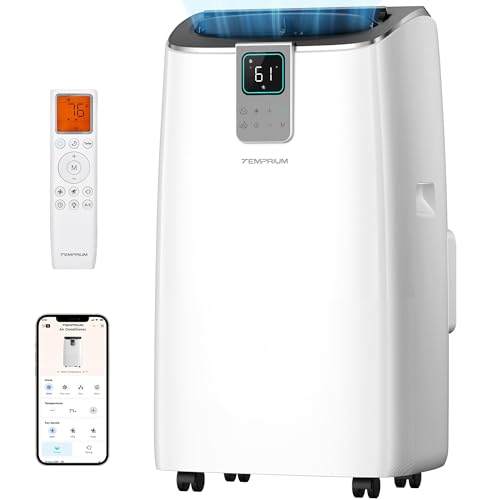
1. Temprium 16,000 BTU Inverter Dual Hose Portable Air Conditioner
This is the pick when you have three or four racks, a UPS, and no budget for a mini-split. At 16,000 BTU it has the most headroom in the group, which means it can hold setpoint during a heat wave without running flat out. The inverter compressor keeps the power draw proportional to load, and at $489.98 it costs about the same as the 14,000 BTU units.
- Pro: Highest capacity here, suitable for rooms approaching 600 square feet or dense rack loads.
- Pro: Priced under $500 despite the extra 2,000 BTU over most rivals.
- Con: More capacity means a larger, heavier chassis that needs floor space near a window or wall port.
Skip it if your room is under 200 square feet; an oversized unit short-cycles and dehumidifies poorly.
2. Gasbye 14,000 BTU Dual Hose Inverter, 13.6 CEER (White)
The 13.6 CEER rating is the highest in this roundup, and efficiency matters more in a server room than anywhere else because the unit runs every hour of the year. Rated for rooms up to 500 square feet with a 45 dB noise figure, it is the balanced choice for a two-rack room adjacent to workspace. At $479.99 it undercuts the identical black version by $20.
- Pro: Best efficiency in the group, which pays back over thousands of runtime hours.
- Pro: 45 dB is quiet enough that staff outside the door will not notice it.
- Con: White finish shows dust quickly in a room full of fans pulling air through filters.
Skip it if you expect to add racks within a year; step up to the 15,000 BTU sibling instead.
3. Gasbye 15,000 BTU Dual Hose Inverter, 13.0 CEER (White)
Same platform as the 14,000 BTU model, with an extra 1,000 BTU and a 550 square foot rating. The tradeoff is a slightly lower 13.0 CEER and a $559.99 price, an $80 premium for roughly 7 percent more cooling. That is worth it if your room is between 450 and 550 square feet or if your IT load is expected to grow.
- Pro: Largest room rating in the Gasbye line while keeping the same 45 dB noise level.
- Pro: Full DC inverter compressor modulates smoothly for a steady 24/7 load.
- Con: Costs the most in the group while the efficiency figure drops slightly.
Skip it if the room is already well under 450 square feet; the 14,000 BTU version does the job for less.
4. Gasbye 14,000 BTU Dual Hose Inverter, 13.6 CEER (Black)
Functionally the same unit as pick number two: 14,000 BTU, 13.6 CEER, 45 dB, 500 square foot rating. The difference is the black finish and a $499.99 price. In a server room full of black racks and cable management, it blends in and hides the dust that gathers on a white cabinet.
- Pro: Identical top-tier efficiency and quiet operation as the white model.
- Pro: Black finish suits an equipment room and hides grime between cleanings.
- Con: You pay $20 more for the color alone.
Skip it if appearance does not matter; buy the white version and save the $20 for a spare filter.
5. ZAFRO Smart Inverter Portable Air Conditioner, 14,000 BTU (10,000 BTU SACC)
The ZAFRO is the value inverter pick at $439.90. Note the two numbers: 14,000 BTU is the older ASHRAE figure, and 10,000 BTU SACC is the standardized rating that accounts for real-world hose heat loss. Plan around the SACC number, which puts it in the 300 to 450 square foot range for a lightly loaded room. Smart control lets you monitor it from your phone, useful for a room you do not visit daily.
- Pro: Lowest price among the new 14,000 BTU class units.
- Pro: App control gives remote alerts and setpoint changes from outside the room.
- Con: The 10,000 BTU SACC rating is meaningfully below the headline number.
Skip it if your room runs above 2 kW of IT load; you want the Temprium or a 15,000 BTU unit.
6. Hisense 8,000 BTU SACC Dual Hose Inverter, Wi-Fi (Renewed)
For a one-rack network closet under 350 square feet, this renewed Hisense at $199.99 is the smart money. Its 8,000 BTU DOE/SACC rating (10,000 ASHRAE) is honest, the 42 dB noise level is the lowest in the group, and dual-hose inverter operation plus Wi-Fi app control are rare at this price. Renewed means it has been inspected and restored, so check the warranty terms in the listing.
- Pro: Quietest unit here at 42 dB, with app control through Google and Alexa.
- Pro: Less than half the price of anything else on this list.
- Con: Renewed condition and 8,000 BTU capacity limit it to small closets.
Skip it if the room is over 350 square feet or holds more than one loaded rack.
7. ZAFRO Smart Inverter Portable Air Conditioner, 14,000 BTU (10,000 BTU SACC), alternate listing
This is the same ZAFRO model under a second listing at the same $439.90 price. We include it because stock on budget inverter units comes and goes, and having a second source for an identical unit means you can order two matched units for redundancy or replace a failed one without changing hoses and window kits.
- Pro: Identical specs and price, so buying two gives you an N+1 setup with interchangeable parts.
- Pro: Same smart app control for remote monitoring.
- Con: Offers nothing different from pick five; it exists as a stock backup.
Skip it if the first ZAFRO listing is available and you only need one unit.
8. Midea 13,000 BTU Dual Hose Portable Air Conditioner, Inverter
Midea is the most established brand in this roundup, and that matters for parts, filters, and support over a five-year service life. At 13,000 BTU and $519.96 it is not the cheapest per BTU, but the inverter platform and dual-hose design make it a strong fit for a 300 to 450 square foot room that shares a wall with occupied offices.
- Pro: Established brand with broad parts and accessory availability.
- Pro: Dual-hose inverter design suited to continuous, closed-room operation.
- Con: Highest price per BTU in the group.
Skip it if budget is the deciding factor; the Gasbye 14,000 BTU delivers more cooling for less.
Buying Guide
Size to the heat load, not the floor area
Residential sizing charts assume 20 BTU per square foot. A server room breaks that rule because the equipment itself is the heat source. Add up the actual power draw of every device (a loaded 1U server pulls 150 to 400 watts, a 48-port PoE switch 100 to 700 watts, a UPS loses 5 to 10 percent as heat) and multiply the total wattage by 3.41 to convert to BTU per hour. A 2,000-watt rack alone needs about 6,800 BTU before you account for the room, lighting, or a sunny exterior wall. Use the SACC or DOE number when comparing, not the ASHRAE headline.
Plan for the hoses and the water
Dual-hose units need two 5 to 6 inch openings to the outside or a return plenum. Keep hose runs under about 5 feet and as straight as possible; every foot of hose and every bend costs cooling. For 24/7 operation you need continuous drain, either gravity through a hose to a floor drain or a small condensate pump. Set the unit to fan-only during cold weather only if your room still needs airflow, and expect to clean the intake filter every two to four weeks in a dusty rack room.
Match noise and power to the building
A 45 dB unit is about the level of a quiet office; 42 dB is closer to a library. If the room is adjacent to desks, that 3 dB gap is noticeable. On the electrical side, a 14,000 to 16,000 BTU unit typically draws 1,200 to 1,500 watts at full output and needs its own 15 or 20 amp circuit, never shared with the rack. Inverter models drop to a few hundred watts at steady state, which is why they belong in a room that never turns off.
Our Verdict
For most small server rooms in 2026, the Gasbye 14,000 BTU Dual Hose Inverter in white is the pick: top-of-group 13.6 CEER efficiency, a 500 square foot rating, 45 dB noise, and a $479.99 price. If you run three or more racks or plan to grow, spend the same money on the Temprium 16,000 BTU for the extra headroom. For a single-rack closet, the renewed Hisense 8,000 BTU at $199.99 is hard to argue with. Whichever you choose, wire in continuous drain and a temperature alert before you trust it overnight.
FAQ
Why is dual hose so important for a server room specifically?
A single-hose unit exhausts room air outside, so the room goes negative and pulls in unconditioned air from adjacent spaces along with dust. In a sealed equipment room that can cut effective cooling by 20 to 30 percent. Dual hose keeps intake and exhaust separate, so the room stays sealed and the rated BTU actually applies.
How many BTU do I need per rack?
Multiply the rack’s real power draw in watts by 3.41. A lightly loaded rack at 1,000 watts needs about 3,400 BTU; a dense rack at 3,000 watts needs about 10,200 BTU. Add 10 to 20 percent for the room envelope, then round up to the next available SACC rating.
Can a portable unit run 24 hours a day?
Yes, if it has an inverter compressor and continuous drain. Fixed-speed units cycle hard and wear faster; inverter units throttle down and run steadily. Set up a gravity drain or condensate pump so the tank never fills and shuts the unit off, and clean the filter every two to four weeks.
Is a renewed unit safe for critical equipment?
A renewed unit has been inspected and restored to working condition, and for a small closet it is a reasonable way to save more than half the price. Pair it with an inexpensive Wi-Fi temperature sensor that alerts your phone; that safeguard is worth having with any portable unit, new or renewed.