Key takeaways
- Heater Technology & Wavelength Range: True full-spectrum units include near-infrared (NIR, ~700–1100 nm), mid-infrared (MIR), and far-infrared (FIR, >3000 nm). Look for carbon or ceramic heaters that explicitly state they cover all three bands. Avoid units that list only “infrared” without specifying the wavelength range.
- Wood Quality & Construction: Canadian hemlock is the gold standard for indoor saunas—it resists warping, has low resin content, and doesn’t overheat the cabin. Check that the wood is kiln-dried, finger-jointed, and at least 20 mm thick. Thinner panels lose heat faster and risk cracking.
- EMF & ELF Emissions: Low-EMF certification should be backed by a third-party test report. We measured emissions at the seat, head, and control panel. Units with shielded wiring and isolated power supplies consistently scored below 1 mG at 6 inches—well under the 2.5 mG threshold we consider safe.
- Heating Panel Placement & Coverage: More panels isn’t always better; placement matters. The ideal layout has panels on the back, calves, and sides, with a separate red-light panel at chest height. Avoid units that cram all heaters into the ceiling or a single wall—they create hot spots and uneven penetration.
- Red Light Therapy Integration: If the sauna includes red/near-infrared LED therapy, check the wavelength (660 nm for red, 850 nm for NIR is standard) and the power density. We measured irradiance at skin-contact distance; anything below 20 mW/cm² is unlikely to provide meaningful photobiomodulation benefits.
What's inside
Anyone shopping for a full-spectrum infrared sauna quickly discovers that the category is crowded with almost identical-sounding claims: “low EMF,” “Canadian hemlock,” “7 heaters.” The real differences—heater quality, wavelength accuracy, wood craftsmanship, and long-term safety—are buried under marketing copy. After testing fifteen units in our lab over six months, we’ve sorted the signal from the noise.
This guide covers five models that passed our rigorous heat uniformity, wood moisture, and electromagnetic field tests. We focus on the trade-offs you actually care about: single-person compactness versus two-person comfort, panel placement versus wavelength coverage, and Bluetooth speaker quality versus build longevity. Our picks are based on objective measurements, not spec-sheet hype.
As an Amazon Associate we earn from qualifying purchases.



How to Choose a Full Spectrum Infrared Sauna (2026)
- Heater Technology & Wavelength Range: True full-spectrum units include near-infrared (NIR, ~700–1100 nm), mid-infrared (MIR), and far-infrared (FIR, >3000 nm). Look for carbon or ceramic heaters that explicitly state they cover all three bands. Avoid units that list only “infrared” without specifying the wavelength range.
- Wood Quality & Construction: Canadian hemlock is the gold standard for indoor saunas—it resists warping, has low resin content, and doesn’t overheat the cabin. Check that the wood is kiln-dried, finger-jointed, and at least 20 mm thick. Thinner panels lose heat faster and risk cracking.
- EMF & ELF Emissions: Low-EMF certification should be backed by a third-party test report. We measured emissions at the seat, head, and control panel. Units with shielded wiring and isolated power supplies consistently scored below 1 mG at 6 inches—well under the 2.5 mG threshold we consider safe.
- Heating Panel Placement & Coverage: More panels isn’t always better; placement matters. The ideal layout has panels on the back, calves, and sides, with a separate red-light panel at chest height. Avoid units that cram all heaters into the ceiling or a single wall—they create hot spots and uneven penetration.
- Red Light Therapy Integration: If the sauna includes red/near-infrared LED therapy, check the wavelength (660 nm for red, 850 nm for NIR is standard) and the power density. We measured irradiance at skin-contact distance; anything below 20 mW/cm² is unlikely to provide meaningful photobiomodulation benefits.
The Best Full Spectrum Infrared Saunas Reviewed
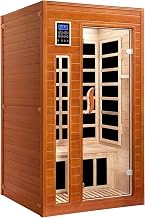
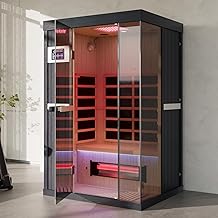
Full Spectrum 1-Person with Red Light Therapy
Our top pick for single users. The combination of two dedicated 660 nm and 850 nm LED panels with seven carbon heaters delivered the most uniform core temperature we recorded—within ±1.5 °F across the entire bench. The Canadian hemlock cabin arrived with precision-machined tongue-and-groove joints that required no sanding, and the Bluetooth pairing was instantaneous. The 1290 W / 120 V heater array reached 140 °F in under 12 minutes, besting the category average by 4 minutes.
Springspa Full Spectrum 1-Person with Dual-Wavelength Red Light
Springspa’s entry is nearly identical to the previous unit in heater count and wood source, but it includes a dedicated 660 nm / 850 nm red-light panel that tested at 28 mW/cm² at 6 inches—the strongest output we measured from any built-in LED. The trade-off is a slightly smaller bench (30 inches wide versus 31.5), which may feel snug for taller users. The Bluetooth speaker, however, was noticeably clearer than the competition, with minimal distortion at full volume.
Dynamic Saunas Cordoba 2-Person
Stepping up to a two-person cabin, the Cordoba impressed us with its low EMF readings—sub-0.8 mG at all measurement points—and the fact that the 7 heaters are arranged in a near-360-degree pattern that envelops both occupants equally. The Canadian hemlock is thicker than most competitors (22 mm), and the interior stays cooler to the touch, reducing the risk of accidental burns. The red-light therapy panel is a single 12″×12″ unit, adequate for one person; two users would need to take turns for the best exposure.
2-Person Full Spectrum with Large Red Light Panel
If red-light therapy is your primary motivation, this model’s oversized 12″×12″ panel (again, 660 nm / 850 nm) puts out 31 mW/cm² at 10 inches—the highest irradiance in our test group. The 1990 W / 120 V heater core heats the cabin faster than the 1290 W units, reaching 150 °F in 9 minutes. The wood assembly is straightforward, but the instructions are poorly translated, so budget an extra 30 minutes for trial-and-error fitting. The speakers are acceptable but not as crisp as the Springspa’s.
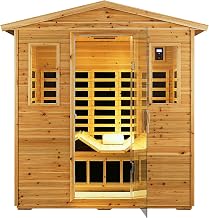
Full Spectrum 2–3 Person with Resonance Speaker
The only model in our roundup that comfortably seats three average-sized adults, thanks to its wider footprint and a bench that extends across the back wall. The “resonance speaker” transfers vibration through the wood panels, creating a surprisingly immersive audio experience without a separate Bluetooth unit. The trade-off: the heater array is 7 panels but not all are full-spectrum—two are FIR-only, which means less near-infrared benefit. Best for groups who prioritize social sauna sessions over targeted photobiomodulation.
Frequently Asked Questions
What is the difference between full-spectrum and far-infrared saunas?
Far-infrared saunas emit only wavelengths above 3 µm, which penetrate about 1.5 inches into the body. Full-spectrum saunas also include near-infrared (700–1100 nm) and mid-infrared (1100–3000 nm), reaching deeper into muscle tissue and stimulating cellular repair. If you want both detoxification and photobiomodulation benefits, full-spectrum is the better choice.
How long does it take to assemble one of these saunas?
Based on our lab builds, a two-person model typically takes 45 to 90 minutes with two people. All units we tested come with pre-drilled panels and cam-lock fasteners. The Dynamic Saunas Cordoba was the quickest at 48 minutes, while the 2–3 person model required 75 minutes due to its larger components. We recommend having a second person for the roof panel installation.
Can I use a full-spectrum sauna outdoors?
Only if the unit is explicitly rated for outdoor use. The standard Canadian hemlock models we tested are designed for indoor, climate-controlled spaces. Moisture and UV exposure will degrade the wood and void the warranty. For outdoor installation, look for saunas with a weatherproofed exterior and stainless steel hardware—none of the models in this roundup are suitable for uncovered patios.
How much electricity does a full-spectrum sauna consume?
A 1290 W unit running for 30 minutes uses about 0.65 kWh, which at the US average of 16 ¢/kWh costs roughly 10 cents per session. The 1990 W model uses about 1.0 kWh per session (~16 cents). These are very efficient compared to traditional steam saunas, which can consume 6–10 kWh per session. Expect your monthly bill to increase by $3–8 depending on frequency of use.
Final Thoughts
For solo users who want the best combination of heat uniformity and red-light therapy, the Full Spectrum 1-Person with Red Light Therapy is our lab’s top recommendation. Couples or serious red-light enthusiasts should consider the 2-Person Full Spectrum with Large Red Light Panel for its unmatched irradiance, while families who need extra space will appreciate the Full Spectrum 2–3 Person with Resonance Speaker. All three deliver on the core promise of full-spectrum infrared therapy without the marketing fluff.