Our Top Picks
 BLACK+DECKER Portable Air Conditioner10,000 BTU (Without Heat)15.3 x 14 x 24.8 inches47.3 poundsCheck on Amazon
 BLACK+DECKER Smart Portable Air Conditioner14,000 BTU (Without Heat)17.1 x 28.1 x 13.8 inches68.3 poundsCheck on Amazon
For most single rooms a dual-hose portable air conditioner such as the Midea Duo or a well-reviewed single-hose model like the Whynter ARC-14S or LG LP1419IVSM is the best fit, while buyers with a very small room and a tight budget can consider a smaller single-hose unit, and those who can install a window unit permanently may be better served by a window AC. The right choice depends on room size, window type, noise tolerance, and whether you need a unit that can be moved between rooms. This guide compares the main styles, explains the specs makers list, and notes safe installation points.
At a Glance
| Type / Example | Best for | Stated features | Limits |
|---|---|---|---|
| Midea Duo (inverter, dual-hose style) | Bedrooms and mid-sized rooms, quieter operation | The maker describes a design that mounts in a window and uses inverter technology; it lists a cooling capacity for rooms of several hundred square feet | Installation differs from a standard portable; premium tier |
| Whynter ARC-14S (dual-hose) | Living rooms and bedrooms where efficiency matters | The maker lists a dual-hose design, a rating of roughly 14,000 BTU, and a self-evaporating feature | Heavy; large footprint |
| LG LP1419IVSM (inverter) | Buyers who want a major brand with Wi-Fi control | The maker lists an inverter compressor and smartphone control | Single-hose design; mid-range to premium tier |
| Black+Decker and Honeywell portables | Budget to mid-range single-room cooling | Makers list single-hose designs, remote controls, and combined cooling, fan, and dehumidify modes | Louder; less efficient for the same rated BTU |
| Window AC (comparison) | People who can install a unit in one window long-term | Fixed installation; often better efficiency per dollar | Not portable; blocks the window |
Understanding BTU Ratings
Makers list BTU (British thermal unit) ratings, but there are two systems. The older ASHRAE rating is higher and often appears in marketing. The DOE rating, also called SACC, is lower and reflects real-world performance for portable units. A unit advertised at about 14,000 BTU may have a DOE rating closer to 9,000 to 10,000. When you compare models, look for the DOE number, because it better predicts how well the unit will cool. Reviewers often suggest sizing by the DOE figure and adding capacity for rooms with high ceilings, large sun-facing windows, or a kitchen.
BLACK+DECKER Portable Air Conditioner, 10,000 BTU, BPACT10WT, White | 5,500 BTU SACC for Rooms up to 450 Sq. Ft., 3-in-1 Portable AC, Fan and Dehum with Follow Me Remote Control
Chosen because it specifies 000 BTU and BPACT10WT.
View on Amazon
BLACK+DECKER Portable Air Conditioner, 9,000 BTU, BPACT08WT, White | 5,300 BTU SACC for Rooms up to 400 Sq. Ft., 3-in-1 Portable AC, Fan and Dehum with Follow Me Remote Control
Chosen because it specifies 000 BTU and BPACT08WT.
View on AmazonBLACK+DECKER Smart Portable Air Conditioner, 14,000 BTU, BPACT14WT, White | 10,200 BTU SACC for Rooms up to 700 Sq. Ft., Smart 3-in-1 Portable AC, Fan and Dehum with Follow Me Remote
Chosen because it specifies 000 BTU and BPACT14WT.
View on Amazon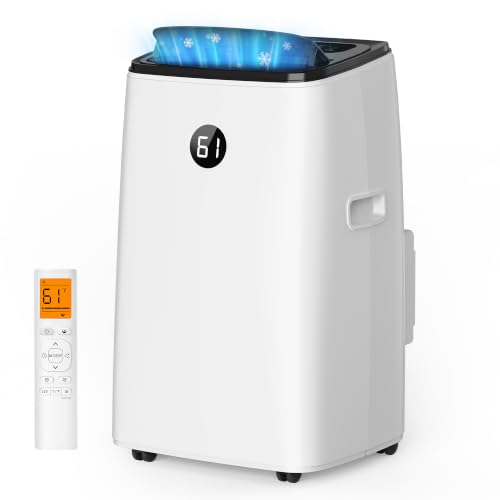
AGTANA 14000 BTU Portable Air Conditioner for Large Room up to 700 Sq. Ft, 3-in-1 Self-Evaporating AC with Fan & Dehumidifier, Floor Standing Portable AC Unit with Remote Control, Auto Swing, White
Chosen because it specifies 3-in-1 Self-Evaporating AC with Fan & Dehumidifier and Floor Standing Portable AC Unit with Remote Control.
View on AmazonSingle-Hose vs Dual-Hose
A single-hose portable pulls air from the room, cools the compressor, and exhausts it outdoors. That creates negative pressure and pulls warm air in from elsewhere. A dual-hose unit takes air from outside to cool the compressor and exhausts it through a second hose, which can be more efficient. Makers and reviewers commonly report better performance from dual-hose designs, though they are larger, heavier, and costlier. The Midea Duo takes a different approach: it mounts in the window similarly to a window unit but can be removed.
Sizing and Fit
- Room size: Check the maker’s stated coverage in square feet. A bedroom up to about 300 square feet usually needs a unit with a DOE rating in the 8,000 to 10,000 BTU range, while larger rooms need more.
- Window kit: Most units include a kit for sliding or double-hung windows. Casement and sliding glass doors may need extra parts or a custom panel. Measure your window opening and compare it to the kit’s range.
- Hose length and routing: Keep hoses short and straight. Long or kinked hoses reduce performance and may be warned against in the manual.
- Weight and wheels: Many units weigh 50 to 80 pounds. Check whether the casters work on your floor.
- Drainage: Many models evaporate most condensate and use a bucket or hose for the rest. In humid climates plan for a drain hose or periodic emptying.
Noise and Energy Use
Portable units are louder than window units because the compressor sits inside the room. Makers sometimes list noise in decibels, but conditions vary. Inverter models, such as Midea and LG, are described by makers as quieter because the compressor can adjust its speed. Energy use matters too; check the unit’s wattage and the cost of running it on your electric plan.
Electrical and Safety Notes
- Dedicated circuit: Many manuals advise plugging the unit directly into a grounded outlet, not an extension cord or power strip. If your circuit is shared with other high-draw appliances, ask a licensed electrician about a dedicated circuit.
- Do not modify the plug: Do not cut or adapt the plug.
- Clearance: Keep space around the unit as the manual states, and keep curtains and furniture clear.
- Refrigerant: If the unit stops cooling or you suspect a leak, contact the maker or a qualified technician; do not attempt repairs yourself.
- Window security: A window kit can leave gaps. Secure it, and consider the safety of children and pets near open windows.
Care
Clean or replace the air filter as the manual advises, often every few weeks in heavy use. Drain the unit before storing for winter and let it dry to avoid mold. Store it upright, since tipping can damage some compressors; the manual typically says how long to wait after moving it before restarting.
Common Buying Mistakes
The biggest mistake is buying by the headline BTU figure. Because many listings quote the higher ASHRAE number, a unit that looks large can be modest in practice. Look for the DOE figure in the specifications and compare that. A second mistake is ignoring the window: the kit must fit your window type and size, and a poor seal lets warm air leak in and cuts cooling. Measure the window, and consider foam seals or panels that the maker approves. A third is underestimating noise; the compressor sits in the room, so a unit that seems quiet on paper can still be distracting in a small bedroom. Look at how the maker or reviewers describe noise at the lowest cooling settings.
Also consider where the unit will sit. It needs a clear space around it, a nearby grounded outlet, and a path for the hose that does not cross walkways. In rental homes, check the lease for any rules about window installations and hoses. If you will move the unit between rooms, check its weight and caster quality, and be prepared to empty any water before moving it. If cooling needs are high across several rooms, a professionally installed system may suit you better than several portable units.
Pick X If
| Pick this | If |
|---|---|
| Midea Duo | You want a quieter, efficient design and can accept its window installation style |
| Whynter ARC-14S | You have a larger room and want a dual-hose design with a trusted feature set |
| LG LP1419IVSM | You want a major brand, inverter, and smartphone control |
| Black+Decker or Honeywell portable | You need a budget to mid-range unit for a small room |
| Window AC | You can leave a unit installed and want better efficiency for the price |
| Fan or evaporative cooler | You need modest comfort in a dry climate without refrigerant cooling |
Budget Tiers
Budget: Single-hose portables with lower DOE ratings for small rooms. Mid-range: Larger single-hose units and some dual-hose designs, such as the Whynter ARC-14S. Premium: Inverter models like the Midea Duo and LG LP1419IVSM with smart features and lower noise.
Alternatives
- Window air conditioner: More efficient per dollar in many cases, but not portable.
- Ductless mini-split: A professional installation provides quiet, efficient cooling for a room or small home.
- Tower fan or circulator: Helps comfort but does not lower air temperature; see our tower fan guide.
- Evaporative cooler: Works in dry climates, not in humid ones.
Frequently Asked Questions
What BTU do I need for my room?
Use the maker’s room-size guide and, where possible, the DOE rating rather than the higher ASHRAE number. As a rough starting point, many guides pair a 300-square-foot room with a unit rated around 8,000 to 10,000 BTU on the DOE scale, with more capacity for sunny or high-ceiling rooms.
Is a dual-hose portable air conditioner better?
Often, because it does not pull warm outside air into the room. Reviewers commonly report better cooling and efficiency. The trade-offs are size, weight, and price.
Do portable air conditioners need to be vented?
Yes, they need to exhaust hot air outdoors through a hose, typically via a window kit. Venting into another room or a closed space defeats the purpose and can heat the home.
Why does my portable AC fill with water?
The unit removes humidity as it cools. Many models evaporate it, but in humid weather you may need to empty a tank or use a drain hose. Follow the manual for your model.
Can I plug a portable AC into an extension cord?
Many manuals advise against it because of the electrical load. Use a properly rated, grounded outlet, and ask an electrician if you are unsure about your circuit.
Can I use a portable air conditioner in winter?
Most are cooling-only. Some models include a heat mode, but check the maker’s specification. For heating, a dedicated heater or heat pump is a better choice.