Key takeaways
- Pro: Super-thin design clears furniture with minimal clearance.
- Pro: Quiet enough for nighttime or work-from-home operation.
- Con: Modest suction struggles with carpet deeply embedded in pet hair.
What's inside
A robot vacuum is one of those purchases that either becomes a daily workhorse or gathers dust in a closet within weeks. The difference usually comes down to how well the machine handles your specific floors: a home full of low-pile carpet and pet hair demands very different specs than a sparse apartment with tile throughout. Budget models often lack the navigation intelligence to avoid obstacles or the suction to pull embedded hair from carpet fibers, while premium units can be overkill if your space is small and uncluttered.
This roundup compares published specifications and owner-reported experiences across eight robot cleaners spanning under $100 to roughly $650. The best robot cleaner for your situation depends on whether you need strong suction, a functional mop, self-emptying convenience, or simply a thin profile that fits under furniture. Below we break down what separates a reliable pick from a disappointing one.
As an Amazon Associate we earn from qualifying purchases at no extra cost to you. Product prices and availability are accurate as of the date shown and are subject to change.




Quick Picks
| Product | Best for | Price |
|---|---|---|
| eufy 11S MAX | Thin-profile budget cleaning | $139.99 |
| Tikom G8000 Max | Value vacuum-and-mop combo | $129.99 |
| roborock Qrevo S Pro | High-power suction and mopping | $549.99 |
| iRobot Roomba 105 Combo | Hands-off self-empty convenience | $269 |
| eufy E25 | Best roller-mop performance | $649.99 |
| Tikom Self-Emptying | Budget self-empty station | $249.99 |
| roborock Q7 M5+ | Longest self-empty interval | $299.99 |
| ILIFE V5s Max | Absolute lowest price entry | $89.99 |
How We Picked
Four criteria guided this selection. First, suction power relative to price — a machine rated at 10,000Pa or above can pull hair from carpet, while sub-4,000Pa models mostly handle surface dust. Second, navigation method: LiDAR or app-based mapping produces consistent coverage, whereas random-bounce patterns leave gaps. Third, maintenance burden: self-emptying docks and washable mop pads reduce weekly chores dramatically. Fourth, verified owner feedback on real-world reliability over several months of use, since spec sheets can overstate performance in ways that daily operation reveals.
The 8 Best Robot Cleaner in 2026
eufy 11S MAX
This ultra-thin robot is the right call if you have low-clearance furniture and mostly hard floors with light debris. At $139.99 it undercuts most competitors while maintaining a slim profile that slips under sofas and bed frames where bulkier units get stuck. Owner reports praise its quiet operation and reliable self-return to the charging dock.
- Pro: Super-thin design clears furniture with minimal clearance.
- Pro: Quiet enough for nighttime or work-from-home operation.
- Con: Modest suction struggles with carpet deeply embedded in pet hair.
Skip it if your floors are predominantly thick carpet or if you need a mop function.
Tikom G8000 Max
Priced at $129.99, this Tikom combo packs 5,000Pa suction, a 150-minute maximum runtime, app and remote control, plus a self-charging dock. It is the strongest value proposition in the budget tier for homes mixing hard floors and carpet, and the pet-hair focus matches owner feedback describing clean brush rolls after multiple runs.
- Pro: Longest runtime in the under-$150 bracket at 150 minutes.
- Pro: Dual control via app and included remote.
- Con: Navigation is less refined than LiDAR-based models in complex room layouts.
Skip it if your priority is a truly capable mop; its wiping pad is basic.
roborock Qrevo S Pro
The Qrevo S Pro represents roborock’s 2026 new entry with 18,500Pa suction and a combined vacuum-mop system. It targets buyers who want aggressive carpet cleaning plus wet mopping in one pass without paying flagship prices. Owners highlight the mapping accuracy and the strong suction that lifts debris from high-pile carpet.
- Pro: 18,500Pa suction places it among the most powerful in this list.
- Pro: Precise room mapping enables zone cleaning and no-go areas.
- Con: At $549.99 it is a significant step above mid-range options.
Skip it if your home is small and carpet-light; cheaper models will serve adequately.
iRobot Roomba 105 Combo
At $269 this Roomba bundles an AutoEmpty Dock that holds debris for up to 75 days, LiDAR navigation, and carpet-aware mopping that skips rugs during wet passes. It is ideal for people who want set-and-forget automation without buying into the most expensive tier. The power-lifting suction mechanism is a Roomba signature for carpet.
- Pro: Self-empties for up to 75 days between manual maintenance.
- Pro: Automatically avoids mopping carpet, protecting area rugs.
- Con: Mopping function is adequate but less thorough than dedicated roller-mop systems.
Skip it if you already own a large robot dock and want maximum raw suction.
eufy E25
The most expensive pick here at $649.99, the eufy E25 delivers 20,000Pa suction and a HydroJet Roller Mop that continuously washes its own pad during cleaning. This is the best robot cleaner for households that value genuine mop performance alongside powerful vacuuming, particularly homes with tile or sealed hardwood that see daily spills and footprints.
- Pro: HydroJet roller mop keeps the cleaning surface fresh mid-run.
- Pro: 20,000Pa suction is the highest in this roundup.
- Con: Premium pricing means it is hard to justify for smaller or carpet-dominant spaces.
Skip it if your floors are mostly carpet; the mopping system adds cost you will rarely use.
Tikom Self-Emptying Robot Vacuum and Mop
For $249.99, this Tikom model pairs vacuum-and-mop functionality with a self-emptying base, a feature that used to belong to the $400-plus tier. Owner feedback highlights how the dock saves them from touching debris weekly. It suits renters and homeowners who want convenience without committing to flagship pricing.
- Pro: Self-emptying base at a mid-range price point.
- Pro: Combo vacuum and mop covers both floor types.
- Con: Suction specs are not published as aggressively as roborock or eufy competitors.
Skip it if deep carpet cleaning is essential and you need the highest available suction.
roborock Q7 M5+
The Q7 M5+ at $299.99 offers 10,000Pa suction and claims seven to nine weeks between dock bag changes. It is the sweet-spot robot for owners who want reliable LiDAR mapping, strong vacuuming, and the self-emptying convenience of a roborock dock without jumping to the Qrevo tier.
- Pro: Up to 7-9 weeks before the dock bag needs replacement.
- Pro: Proven roborock LiDAR navigation with app control.
- Con: Mopping capability is functional but basic compared to roller-mop systems.
Skip it if wet mopping is a priority rather than a nice-to-have feature.
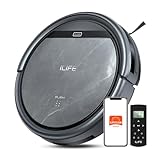
ILIFE V5s Max
At $89.99 the ILIFE V5s Max is the cheapest viable robot on this list, delivering 4,000Pa suction in a slim body. It targets first-time robot buyers or those who want a second unit for a bedroom or office without spending much. Owners appreciate the low price and basic reliability, though expectations should match the hardware.
- Pro: Lowest entry price in this roundup at under $90.
- Pro: Compact size fits under most standard furniture.
- Con: 4,000Pa suction is only adequate for surface dust on hard floors.
Skip it if you have pets shedding onto carpet or need any kind of mopping.
Buying Guide
Suction Power and What It Actually Means
Pascal ratings on spec sheets indicate static pressure the motor can generate, not real-world pickup on your specific flooring. In practice, anything under 5,000Pa will handle hard floors and light debris but will leave pet hair trapped in carpet. The 10,000Pa-to-20,000Pa range found in mid-to-premium models represents the threshold where you see visible hair removal from medium-pile carpet. Match the number to your flooring type rather than chasing the highest figure blindly.
Navigation: LiDAR vs. Random vs. Visual
Random-bounce patterns are the oldest approach and leave uneven coverage, especially in rooms with multiple obstacles. LiDAR (laser-based) navigation, used by roborock and iRobot models here, builds a precise map, enables room-by-room cleaning, and reduces missed patches. For homes with complex layouts or multiple floors, LiDAR is the practical minimum if you want consistent results without manually guiding the robot.
Self-Emptying Docks and Maintenance Load
A self-emptying dock transfers debris from the robot into a sealed bag, typically lasting one to three months before replacement. This eliminates the single most unpleasant maintenance task. If you run your robot daily, the time savings compound quickly. Factor in the ongoing cost of replacement bags, which range from $2 to $15 per unit depending on brand, when comparing sticker prices.
Our Verdict
Top pick: the roborock Qrevo S Pro at $549.99 offers the best balance of raw suction, navigation accuracy, and mopping capability in this group. Budget pick: the Tikom G8000 Max at $129.99 delivers the most features per dollar for mixed hard-floor and carpet homes. Special condition: if your household is mostly sealed hard floors and you want genuinely clean-looking surfaces after each pass, the eufy E25 with its HydroJet Roller Mop outperforms everything else in wet-cleaning quality.
FAQ
Is 20,000Pa suction overkill for most homes?
For a typical apartment with thin rugs and hard floors, anything above 5,000Pa is sufficient. The ultra-high suction figures matter most in homes with dense pet hair, shaggy carpet, or high-traffic zones where debris embeds quickly. Paying a premium for 20,000Pa only makes sense if your flooring demands it.
Do robot mops replace traditional mopping?
A roller-mop system like the eufy E25 HydroJet comes close for light maintenance mopping but will not tackle dried spills or heavy grime the way a manual mop does. Basic wiping pads on budget models are mostly decorative. Expect a robot mop to keep hard floors looking fresh between deeper cleanings.
How long do robot vacuums typically last?
Owner reports suggest three to five years of daily use before brush wear, battery degradation, or navigation sensor issues require replacement. Units with replaceable filters, washable mop pads, and widely available parts (such as roborock and iRobot models) tend to reach the upper end of that range.
Can a robot vacuum work on high-pile carpet?
Most robot vacuums can traverse low to medium-pile carpet effectively, but high-pile or shaggy rugs often cause tangles and reduce suction seal. If your home has dense carpet, prioritize a model with a dedicated power-lifting suction mechanism like the Roomba 105 or at least 10,000Pa or more, and avoid ultra-thin budget units.