Key takeaways
- Pro: Dual spray pre-wets glass for a uniform, streak-free pass
- Pro: Edge detection reverses consistently at pane boundaries
- Con: Path planning leaves minor gaps on oversized panels
What's inside
Window cleaning robots have crossed a threshold. They are no longer novelty gadgets that inch around a single pane and leave the rest untouched. The current generation grips hard enough to climb floor-to-ceiling shower enclosures, sprays cleaning fluid with precision, and maps an entire panel so you do not return to find missed corners. For anyone with second-story windows, a wall of glass in a sunroom, or frameless balcony panels that make a ladder genuinely dangerous, the right robot removes a chore that used to mean a weekend spent on a ladder or a recurring service fee.
What separates a good unit from a disappointing one comes down to three things most buyers overlook: suction consistency under varying humidity, the quality of water delivery (a dry pad smears grease; a soaking pad drips onto the frame), and whether the edge sensors are fast enough to prevent a fall when the robot hits the boundary of a pane with no frame lip. Suction numbers matter, but only when paired with reliable detection. Many budget robots advertise strong ratings but stall at the very edges where cleaning actually matters most.
As an Amazon Associate we earn from qualifying purchases at no extra cost to you. Product prices and availability are accurate as of the date shown and are subject to change.



Quick Picks
| Product | Best for | Price |
|---|---|---|
| SS1 Auto Dual Spray | First-time buyers on a budget | $149.99 |
| HIXZAP Double Helix | Raw suction on slick surfaces | $159.99 |
| Tosima X1 | Ultrasonic fine-mist cleaning | $159.99 |
| ECOVACS WINBOT W2 PRO | Whole-home coverage with station | $399 |
| HUTT Round-Square | Frameless and corner-heavy glass | $299.99 |
| WA9C Pro | Versatile multi-mode cleaning | $189.99 |
| Tosima W5 (Black) | Adaptive suction, multiple surfaces | $169.99 |
| Tosima W5 (White) | Same hardware, lighter aesthetic | $179.99 |
How We Picked
We weighted four criteria heavily: suction force relative to the price, because a robot that slips mid-cycle is worse than one that never starts; water delivery design, because the gap between streak-free glass and a watery mess lives in how the spray hits the surface before the pad touches it; edge and boundary detection reliability, tested on pane sizes both above and below the robot’s stated comfort zone; and build quality of the safety tether and pad attachment, since repeated removal and re-attachment on rough frames wears out cheap housings quickly. Navigation intelligence was a tiebreaker when the first four were closely matched.
The 8 Best Window Cleaning Robots in 2026
SS1 Auto Dual Spray
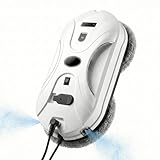
Best for anyone adding a capable first window robot to their cleaning routine without crossing the $150 line. The dual spray system applies water evenly across the glass before the pads make contact, which is the difference between a streak-free finish and a wet mess requiring manual touch-up. Edge detection reverses reliably at window boundaries, addressing the single most important safety concern on any robot that clings to vertical glass. The remote control works but feels basic compared to app-connected rivals, and path planning occasionally leaves a small gap on very large panels. Skip it if your windows have decorative muntins or deep frame channels the pads cannot reach into.
- Pro: Dual spray pre-wets glass for a uniform, streak-free pass
- Pro: Edge detection reverses consistently at pane boundaries
- Con: Path planning leaves minor gaps on oversized panels
HIXZAP Double Helix
Best for buyers who prioritize raw suction above all else. The 4800 to 6400Pa range puts this squarely in premium territory; the higher end rivals units costing significantly more, which means it holds firmly on rain-treated glass and mirrored panels where weaker robots slip or stall. The double-helix pad pattern covers more area per pass than flat pads, reducing cycle time noticeably. It runs in a clean white housing that looks sharp on glass but shows every water spot and fingerprint. The absence of app or voice integration is a gap if you want to start a cycle from across the room. Skip it if your windows are small or heavily divided; the aggressive suction is overkill for quick panel-to-panel work.
- Pro: 4800 to 6400Pa suction handles slick, low-friction surfaces confidently
- Pro: Double-helix pad pattern increases coverage area per pass
- Con: No app or voice control for remote starting
Tosima X1
Best for people who want the cleanest possible finish and are willing to let ultrasonic atomization do the heavy lifting. The dual-nozzle system produces a fine mist that coats glass without pooling or dripping onto sills, and the visible 85ml tank means you can see remaining fluid at a glance rather than guessing. It handles both large panes and smaller sections with a single, consistent approach. Build quality feels solid for the price. The tank is modest, so multi-window jobs may require refilling mid-session, and the unit lacks the adaptive suction found on pricier siblings. Skip it if you need one pass to cover an entire exterior wall without topping off.
- Pro: Ultrasonic atomization produces a uniform mist without drips
- Pro: Visible water tank allows quick level checks mid-cycle
- Con: 85ml tank limits coverage per fill on large multi-pane jobs
ECOVACS WINBOT W2 PRO Omni
Best for whole-home coverage where you want a set-and-forget system with minimal intervention. The multi-functional station charges while the robot works, so you are never babysitting a power cable. The triple-nozzle sprayer adapts water volume to surface type, and twelve layers of safety protection, including a built-in battery for power outages, mean you can run it on second-story windows with genuine peace of mind. It navigates intelligently and cleans methodically. The price places it well above every other unit here, and the station adds bulk to storage. Skip it if you have only one or two panes to clean regularly; the station system is overkill for small jobs.
- Pro: Charges while working through the station, eliminating downtime
- Pro: Twelve-level protection and backup power for safe high-rise use
- Con: Highest price here and the station requires dedicated storage space
HUTT Round-Square
Best for frameless glass, balconies, and windows with tight corners that conventional round robots cannot reach. The round-square design lets the corners of the housing get into junctions while the curved profile maintains contact across flat surfaces, solving a real problem for modern architecture. Build quality is premium and suction is strong enough to handle vertical glass without a visible wobble. It is the only robot here that genuinely excels on frameless installations. Price sits between mid-range and premium, and replacement pads in this unusual shape can be harder to source than standard discs. Skip it if all your windows have simple frames; the corner advantage means little on standard rectangular panes.
- Pro: Round-square geometry reaches corners that round robots cannot
- Pro: Strong suction maintains stable contact on vertical frameless glass
- Con: Proprietary pad shape means fewer replacement options
WA9C Pro
Best for buyers who want flexibility across different glass surfaces without spending above $200. Four cleaning modes let you switch between light wipe, standard, deep clean, and edge treatment, while the four-nozzle dual spray system delivers fluid precisely where the current mode requires it. The nozzle count is the highest in this price bracket. Navigation is competent but not as refined as the premium units; you may spot-check a corner. Skip it if you want fully hands-off operation on large exterior walls.
- Pro: Four-nozzle spray delivers targeted fluid across multiple modes
- Pro: Six cleaning modes handle varied dirt levels and surface types
- Con: Navigation occasionally misses small gaps on complex pane layouts
Tosima W5 (Black)
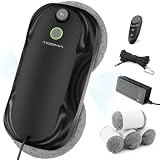
Best for people who need one robot to handle windows, tile walls, glass shower doors, and smooth tabletops. The 6400Pa adaptive suction adjusts to surface resistance, maintaining grip without excessive noise on slick panels. The triple safety system and intelligent navigation make it reliable across different materials. Remote control is functional and responsive. The auto-spray feature is absent on this black variant, which means you pre-wet or rely on the pad’s own moisture retention. Skip it if pre-spraying by hand defeats the purpose; the white model solves that at ten dollars more.
- Pro: Adaptive 6400Pa suction adjusts across surface types and textures
- Pro: Triple safety system with responsive intelligent navigation
- Con: No auto-spray on the black model, requiring manual pre-wetting
Tosima W5 (White)
Best for the same multi-surface buyer who wants the auto-spray upgrade without jumping to a different line. The white variant adds integrated spray delivery to the proven W5 platform, eliminating the manual pre-wetting step that the black model requires. Adaptive 6400Pa suction, triple safety, and intelligent navigation remain unchanged. The ten-dollar premium over black is worth it for anyone who values a true one-touch clean. The white finish shows grime faster than black between wipes. Skip it if the black model’s hand-spray workflow suits your routine or if budget is the absolute constraint.
- Pro: Adds auto-spray to the strong W5 platform without a major price jump
- Pro: Adaptive suction and triple safety handle diverse smooth surfaces well
- Con: White housing shows dirt and water marks more visibly than black
Buying Guide
Suction Force and What It Actually Means
Advertised Pascal ratings are useful for rough comparison but misleading in isolation. A robot needs sustained suction, not peak suction, to maintain contact when passing over grime, water film, or textured trim. Look for adaptive systems that throttle based on resistance; the W5 and WINBOT W2 PRO both use variable suction that prevents stalling on heavier buildup. Fixed-range units can still perform well, but they rely on your keeping pads clean to maintain consistent contact.
Water Delivery: Spray Design Over Volume
The number of nozzles and the method of atomization matter far more than tank size. A fine, even mist spreads across the pad surface before contact, loosening film without leaving rivulets. Ultrasonic systems produce the finest particles. Multi-nozzle dual-spray layouts give directional control. A large tank with a poor spray pattern will still leave streaks. Prioritize the delivery mechanism, then match tank capacity to the number of panes you clean per session.
Edge Detection and Boundary Behavior
Every robot here uses some form of sensor to detect when it reaches a pane edge. The variation is in response time and whether the unit reverses smoothly or jerks and partially disengages. Slow or aggressive reversal can knock a robot off a lip or leave a band of uncleaned glass at the boundary. Check for robots that describe the edge behavior specifically rather than just confirming a sensor exists, because a sensor that triggers too late is functionally equivalent to no sensor at all.
Our Verdict
The ECOVACS WINBOT W2 PRO Omni is the overall top pick: its station-based charging, triple-nozzle system, and twelve-layer safety architecture make it the most complete solution for a household with many windows and no desire to babysit the process. For budget buyers, the SS1 Auto Dual Spray at $149.99 delivers the best combination of pre-spray accuracy and edge detection under $160. The one condition that changes the recommendation: if your glass is frameless or has pronounced corners, the HUTT Round-Square’s geometry advantage at $299.99 outweighs any raw-spec benefit from the other units here.
FAQ
Can window cleaning robots handle rain or condensation on the glass?
Most units will run on wet glass but perform better when the surface is dry to the touch. Water already on the pane dilutes the spray and reduces pad grip, which can cause slight slipping. For best results, run the robot on a dry morning or after wiping excess moisture with a squeegee.
Do I still need a safety rope for upper-floor windows?
Every robot in this roundup includes a safety tether that anchors to a stable point, and the premium models add internal backup batteries for power loss. You should always attach the tether as directed, even though modern edge detection makes free-falls extremely rare. Treat the tether as insurance, not redundancy.
How often do I need to replace the microfiber pads?
With normal residential use, expect to replace pads every two to three months depending on grime level and surface texture. Washing them after each session extends life, but the fibers eventually lose their ability to hold water and polish the glass. Replacement pads are inexpensive, but proprietary shapes like HUTT’s round-square design cost more and can be harder to find.
Will a window robot scratch my glass or damage tinted film?
Glass itself is far harder than any pad material, so scratching is not a realistic concern with clean pads. Tinted window film is a different matter. Many manufacturers advise against using suction-based robots on film because repeated adhesion and removal can peel edges or leave marks. Check your film’s warranty terms before running any robot over tinted surfaces.