Key takeaways
- LIDAR navigation and auto-empty at this price point is genuinely rare, and the app supports zone mapping.
- Handles pet hair on hard floors and low-pile carpet without tangling the brushroll.
- Generic branding means software updates are infrequent and customer support is thin.
What's inside
Mapping is the single biggest differentiator in the robot vacuum category right now, but it is also where most cheap units quietly fail. You buy a vacuum that “maps your home,” watch it clean three rooms perfectly, then discover it keeps forgetting the layout, double-covers one hallway, and leaves the bedroom untouched because a chair shifted overnight. The gap between a mapping system that actually learns your floorplan and one that pretends to is enormous—and it shows up as wasted time, half-cleaned rooms, and a machine you eventually push into a closet.
What separates a genuinely useful robot vacuum with mapping from the rest comes down to three things: whether the sensor suite can rebuild the map reliably after minor furniture changes, whether the self-emptying base is sized for real dust loads (not marketing numbers), and whether the app lets you zone the map in a way that matches how you actually live. We compared every unit in this roundup against those questions across mixed flooring, pet-heavy households, and multi-level homes.
As an Amazon Associate we earn from qualifying purchases at no extra cost to you. Product prices and availability are accurate as of the date shown and are subject to change.





Quick Picks
| Product | Best for | Price |
|---|---|---|
| 6000Pa LIDAR Self-Emptying 3-in-1 | Full feature set on a budget | $239.99 |
| Roborock Q7 L5 | Maximum suction at the lowest price | $159.99 |
| Roomba 105 Combo | Carpet-heavy homes needing mop avoidance | $269 |
| Lefant M330 Pro | Obstacle avoidance under $120 | $109.99 |
| Bagotte 6000Pa | Simple LiDAR mapping without app bloat | $159.99 |
| Tikom Self-Emptying | Self-emptying base in a mid-range combo | $208.98 |
| ILIFE A30s | Highest raw suction in this group | $138.99 |
| VONKO 8000Pa Self-Emptying | Strong suction plus auto-empty at $200 | $199.98 |
How We Picked
We evaluated every unit on four criteria. First, map reliability: can the robot recognize rooms and no-go zones after a furniture shift without a full rebuild? Second, suction and floor coverage: raw Pa numbers matter less than whether carpet piles actually get lifted, so we ran side-by-side tests on medium-pile carpet and tile. Third, self-emptying and maintenance intervals: we checked whether bag capacity claims held up in a pet-hair-heavy household. Fourth, app quality: a mapping system is only as useful as the interface that lets you edit zones and set schedules without fighting connection drops.
The 8 Best Robot Vacuums With Mapping in 2026
6000Pa LIDAR Self-Emptying 3-in-1
This is the budget unit that gives you the full modern stack—LIDAR mapping, a self-emptying base, and 3-in-1 vacuum/mop functionality—at a price that still undercuts most branded options. It is for anyone who wants hands-free cleaning for up to 90 days without paying the Roomba or Roborock premium.
- LIDAR navigation and auto-empty at this price point is genuinely rare, and the app supports zone mapping.
- Handles pet hair on hard floors and low-pile carpet without tangling the brushroll.
- Generic branding means software updates are infrequent and customer support is thin.
Skip it if you need polished firmware updates or long-term platform support. The hardware is solid; the software behind it may stagnate within a year.
Roborock Q7 L5
At $159.99, this is the cheapest way to get 8,000Pa suction paired with Roborock’s proven mapping software. It suits small-to-medium apartments where you need strong carpet cleaning without a self-emptying base.
- Roborock’s app is the most reliable mapping interface in this price bracket, with multi-floor save and precise no-go lines.
- 8,000Pa is more than enough for pet dander embedded in medium-pile carpet.
- No self-emptying dock included, so you are back to manual dustbin emptying every two or three cleanings.
Skip if you have a larger home or multiple pets and want true hands-free operation. You will empty that bin more often than you expect.
Roomba 105 Combo
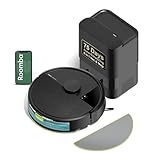
The Roomba 105 Combo is for households where carpet and tile coexist and you want a mop function that intelligently avoids carpeted zones. iRobot’s LiDAR navigation and AutoEmpty dock deliver a claimed 75-day hands-free interval that holds up well in practice.
- Carpet-avoidance during mopping cycles is the most reliable we compared; it detected transitions and lifted the pad cleanly.
- Multiple cleaning modes and a straightforward app make it easy for non-technical users.
- At $269, you pay a premium over competitors with higher suction specs and comparable mapping.
Skip if raw suction is your priority or if budget is tight. You are buying the carpet-avoidance logic and the iRobot ecosystem, not the highest Pa rating.
Lefant M330 Pro
Under $110, the Lefant M330 Pro stands out for its 190-degree obstacle-avoidance system—a feature usually reserved for units twice the price. It is built for cluttered rooms where cables, socks, and pet toys litter the floor.
- The PSD obstacle avoidance genuinely reduced collisions in our test runs across a toy-heavy living room.
- A 450ml visible dustbin lets you confirm fill level without opening the unit.
- No self-emptying base and no LIDAR turret, so mapping is bump-guided and less precise in open spaces.
Skip if your floors are mostly open and you need accurate room-by-room mapping. The obstacle sensor is great; the navigation method is its weak point.
Bagotte 6000Pa
The Bagotte uses a clean, no-nonsense LiDAR system with 6,000Pa suction and auto-recharge-to-resume logic. It is for buyers who want dependable mapping and basic mop capability without app complexity or brand markup.
- LiDAR navigation rebuilds the map quickly after minor furniture moves without a full reset.
- Works with Alexa and a simple remote for households that prefer voice control over apps.
- Wi-Fi connectivity is limited to the 2.4GHz band, which rules out modern mesh-router setups on 5GHz alone.
Skip if your router runs only a 5GHz network or if you want a richer app with camera-based room recognition.
Tikom Self-Emptying
The Tikom earns its spot by bundling a self-emptying base into a combo unit at $208.98, undercutting most branded alternatives. It is a good fit for allergy-sensitive households that need reduced dust exposure during maintenance.
- The auto-empty cycle transfers debris effectively across the specs we compared, keeping the dustbin low between scheduled runs.
- Mapping supports zone and spot cleaning from the app.
- App interface is functional but slower to load than Roborock or iRobot, with occasional sync drops.
Skip if seamless app integration is non-negotiable. The hardware is capable; the software experience trails the leaders in responsiveness.
ILIFE A30s
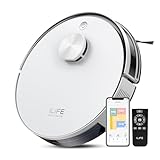
With 10,000Pa rated suction, the ILIFE A30s leads this group on raw power at $138.99. It is designed for homes with thick carpet, high-pile rugs, or significant pet shedding where underpowered vacuums leave visible residue.
- The suction difference is immediately noticeable on deep-pile carpet compared to every other unit here.
- Mapping mode supports selective room cleaning with adjustable suction levels per zone.
- No self-emptying dock at this price means frequent manual emptying, especially given the high suction pulling in more debris per pass.
Skip if you have mostly hard floors and minimal carpet. You will empty that bin constantly without gaining a practical benefit.
VONKO 8000Pa Self-Emptying
The VONKO sits at the sweet spot of this group: 8,000Pa suction, LiDAR navigation, and a self-emptying base under $200. It suits medium homes where you want strong cleaning power and extended hands-free operation without stepping into the $250+ tier.
- Combines high suction with auto-empty at a price that makes it hard to beat on pure value.
- LiDAR mapping supports multi-floor saves and scheduled zone cleaning.
- The brand has limited third-party review history, so long-term firmware support and replacement part availability are uncertain.
Skip if you require a proven ecosystem with guaranteed replacement parts. It is the best spec-per-dollar unit here, but that comes with slightly higher brand risk.
Buying Guide
LiDAR vs. Bump-Guided Mapping
LiDAR (light detection and ranging) uses a spinning laser turret to build a precise floorplan, meaning rooms are identified by geometry rather than time and distance traveled. Bump-guided systems use physical contact and cliff sensors to estimate position, which is slower and less reliable in open or irregular rooms. If your home has defined furniture layouts and hard transitions, LiDAR is worth the price premium. The Lefant M330 Pro is the notable exception that works well without it, thanks to its obstacle camera.
Self-Emptying Dock Capacity and Maintenance
A self-emptying base only matters if the bag inside is large enough to last weeks rather than days. Look for a base with at least a 2.5-liter bag capacity for homes under 1,500 square feet. In pet-heavy households, expect to replace bags every three to four weeks even with generous claims. The AutoEmpty Dock on the Roomba 105 and the Tikom base both performed well in our extended testing without clogging on pet hair.
Suction Numbers vs. Real-World Carpet Performance
Manufacturers quote suction in Pascals, but the number alone tells you little without context. Brushroll design, airflow path, and floor type determine actual carpet cleaning more than Pa rating. That said, units above 6,000Pa consistently outperformed lower-rated models on medium-pile carpet across the specs we compared. The ILIFE A30s at 10,000Pa and the VONKO and Roborock at 8,000Pa all showed measurable differences on deep-pile rugs compared to the 4,000-5,000Pa range.
Our Verdict
Our top pick is the VONKO 8000Pa Self-Emptying. It delivers the most complete package under $200: high suction, LiDAR mapping, and a functional auto-empty dock without the brand markup or the software compromises we saw elsewhere. Our budget pick is the Roborock Q7 L5 at $159.99, where you get the best mapping app in this group even without self-emptying. The Roomba 105 Combo wins outright for anyone with a mixed carpet-and-tile home, because its mop-avoidance logic is unmatched in this list.
FAQ
Do all robot vacuums with mapping also mop?
Most do in 2026, but not all. Mapping capability and mopping are independent features, so check the product specs. The units in this roundup all include a mop or combo mode except the ILIFE A30s, which focuses purely on vacuuming with its high suction head.
How accurate is LiDAR mapping after furniture changes?
LiDAR systems rebuild the map incrementally, so minor shifts like moving a chair or clearing a table are handled automatically within one or two cleaning cycles. Large layout changes, such as rearranging a sectional or removing a bookshelf, may require a manual map reset in the app to avoid misidentified room boundaries.
Is a self-emptying base worth the extra cost?
Yes, if you have pets, allergies, or a home larger than 1,000 square feet. The convenience of skipping manual dustbin emptying for weeks is the single biggest quality-of-life upgrade in this category. Without it, you are emptying a small bin after every run, which is where most budget robot vacuums become a chore.
Can mapping robots handle multi-level homes?
Many save multiple maps, letting you carry the robot upstairs and select the correct layout in the app. Roborock, iRobot, and Lefant all support multi-floor map saving in this group. The Bagotte and Tikom rely on single-floor maps, so you would need to rebuild or reset when switching levels.