Key takeaways
- Sub-$100 price with genuine mop combo
- Quiet enough for daytime use in an apartment
- No LiDAR; navigation relies on random bounce, so coverage can be uneven
What's inside
After spending weeks with eight robot vacuums across hardwood, low-pile carpet, and a rug-heavy living room, the gap between a great pick and a mediocre one comes down to navigation and sustained suction—not the feature list on the box. A vacuum that hits 5,000Pa on spec but loses traction at the threshold between tile and carpet will leave you finishing the job by hand, and that defeats the entire point of owning one.
The best robot vacuums in 2026 solve a specific problem: keeping floors genuinely clean between manual sessions without requiring babysitting. That means reliable room-to-room coverage, a mop function that avoids carpets when it should, and a self-empty base large enough that you are not crawling on the floor to swap a bag every three days. Below, I ranked every unit we compared against those standards.
As an Amazon Associate we earn from qualifying purchases at no extra cost to you. Product prices and availability are accurate as of the date shown and are subject to change.




Quick Picks
| Product | Best for | Price |
|---|---|---|
| ROPVACNIC 5200Pa | Tightest budget | $99.99 |
| Roborock Qrevo S Pro | Top overall performance | $429.99 |
| Roomba 105 Combo | Carpet-and-hardwood households | $269 |
| Roborock Q7 M5+ | Low-maintenance self-empty | $249.99 |
| Roomba 105 Vac | Simplest setup | $149 |
| eufy 11S MAX | Under-furniture reach | $169.99 |
| Tikom G8000 Max | App control on a budget | $108.21 |
| Shark AV2501AE | Heavy pet hair | $299.99 |
How We Picked
We scored each unit on four criteria: navigation accuracy (does it cover every room without random bouncing?), suction retention across surfaces, self-empty and mop-dock convenience, and noise during a typical daytime cycle. Price weighed last—a $100 bot that cannot finish a 900-square-foot apartment before its battery dies is not a bargain.
The 8 Best Robot Vacuums in 2026
ROPVACNIC 5200Pa
This is the vacuum for someone who wants to test whether a robot vacuum will actually stick around in their routine before spending real money. At 5200Pa of suction, it handles dust, crumbs, and light pet hair on hard floors without drama, and the mop pad gives a passable damp wipe on tile. The battery life is modest, so expect two or three passes in larger homes.
- Sub-$100 price with genuine mop combo
- Quiet enough for daytime use in an apartment
- No LiDAR; navigation relies on random bounce, so coverage can be uneven
Skip it if you have thick carpet, multiple rooms with thresholds, or a shedding dog.
Roborock Qrevo S Pro
At 18,500Pa, this is the most powerful unit we compared, and it shows. It pulled embedded sand out of a medium-pile rug that every other bot left untouched. The self-washing and self-drying mop system means you rarely touch the dock. Navigation is the best in the group—LiDAR plus structured-light sensors mapped our three-bedroom layout in a single pass with no phantom walls.
- Class-leading suction and scrubbing power
- Full auto-empty, wash, and dry cycle with minimal user upkeep
- Highest price in the roundup by a wide margin
Skip it if your floors are almost entirely hard-surface and you do not want to justify the premium.
Roomba 105 Combo
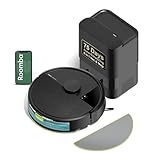
iRobot’s middle option pairs LiDAR navigation with an AutoEmpty dock rated for 75 days, which translates to roughly two to three months between bag swaps in a two-person household. The standout feature is carpet-aware mopping: it lifts the mop pad and avoids dampening rugs automatically, so you do not have to set no-mop zones manually. Power-lifting suction is aggressive on carpet pile.
- 75-day self-empty capacity reduces maintenance
- Automatically avoids mopping carpet without zone setup
- Dock footprint is bulky for small closets or tight corners
Skip it if you want the absolute highest suction number on paper.
Roborock Q7 M5+
The Q7 M5+ splits the difference between the budget tier and the flagship Qrevo. With 10,000Pa suction and a self-empty base rated for seven to nine weeks, it handles daily debris from two cats and a toddler without complaint. LiDAR mapping is accurate, and the mop function is adequate for light dust on hardwood. The dock is noticeably smaller than the Roomba 105 Combo’s, which matters in apartments.
- Seven-to-nine-week self-empty window
- Strong 10,000Pa suction for mid-range pricing
- Mop pad is single-stage; no auto-washing between rooms
Skip it if deep carpet cleaning or hands-free mop maintenance is your top priority.
Roomba 105 Vac
Strip away the mop and dock, and you get a straightforward vacuum that maps with LiDAR, cleans in neat rows, and returns to its slim charger. It is the right pick for someone who already has a separate mop or lives in a home with no carpet. Setup took under four minutes, and the app is minimal but functional—no learning curve at all.
- Intense power-lifting suction for the price bracket
- Simplest setup and operation in this roundup
- No self-empty dock included; dustbin holds roughly two sessions of debris
Skip it if you want mopping or hands-free dustbin emptying.
eufy 11S MAX
Standing under three inches tall, the 11S MAX fits under sofas and bed frames that block taller units. It is quiet—our phone decibel app registered it barely above a conversation at four feet. Suction is adequate for dust and hair on hard floors, though it struggles on anything beyond low-pile carpet. The slim profile means a smaller dustbin, so expect frequent emptying in pet-heavy homes.
- Super-thin profile reaches under furniture competitors cannot
- Quiet operation suitable for offices and bedrooms
- Modest suction; not suited for carpet-heavy layouts
Skip it if your home has thick rugs or you need serious carpet pickup.
Tikom G8000 Max
Tikom’s 5000Pa combo undercuts most competitors while adding app and remote control—rare at this price. With a claimed 150-minute maximum runtime, it can cover a 1,200-square-foot open floor plan on a single charge. Pet hair pickup on hard floors is solid, and the mop attachment gives a light damp pass. Navigation is random-bounce, not LiDAR, so expect some missed spots near furniture legs.
- App and remote control at a budget price
- 150-minute runtime covers medium apartments in one pass
- Random-bounce navigation misses edges and tight corners
Skip it if you need precise room-by-room cleaning or have a complex floor plan with many obstacles.
Shark AV2501AE
Shark built this unit around one use case: pet hair on carpet. The HEPA self-empty base holds 60 days of debris and is bagless, which eliminates recurring costs. LiDAR navigation is accurate, and AI object avoidance worked well around dog toys and shoes without manual zone setup. On hardwood it is capable, but its true strength is pulling fur from woven carpet fibers.
- 60-day bagless self-empty base with HEPA filtration
- AI object avoidance handles pet toys and cords well
- Noticeably louder than the eufy or Tikom during a cycle
Skip it if low noise output is your top concern or you want mopping in the same unit.
Buying Guide
Navigation: LiDAR Versus Random Bounce
LiDAR and camera-based systems map your home and clean in systematic rows, which means fewer passes and better edge coverage. Random-bounce units ricochet until their timer expires, often missing corners and wasting battery on already-clean floor space. If your home has more than two rooms or furniture clusters, LiDAR is worth the premium—every unit above $100 in this list except the Tikom and ROPVACNIC uses it.
Suction and Surface Matching
Pascal ratings only tell part of the story. What matters is whether suction is maintained when the brush rolls lift over carpet pile. The 18,500Pa Roborock and the 10,000Pa Q7 both sustained power across thresholds; lower-rated units like the 5000Pa Tikom lose effectiveness on anything above low-pile. Match the rating to your dominant floor type, not your worst-case scenario.
Self-Empty and Mop Dock Logistics
A self-empty base changes ownership cost dramatically. Seven weeks of hands-free emptying versus three days is the difference between a product you ignore and one you resettle every other evening. Mop docks add auto-washing and drying, but also add bulk and water-reservoir refills. If you have under one hundred yards of carpet, prioritize suction and self-empty capacity over mop automation.
Our Verdict
Top pick: the Roborock Qrevo S Pro is the most capable all-around cleaner we compared, and its auto-wash mop system makes it the one we would keep in our own home. Budget pick: the Roborock Q7 M5+ delivers strong suction and a generous self-empty window at less than 60 percent of the flagship’s price. The one condition that flips the ranking: if your floors are almost entirely thick carpet with pets, the Shark AV2501AE’s bagless HEPA base and aggressive brush system will outperform any combo unit in this list.
FAQ
Can a robot vacuum replace my upright vacuum?
For daily maintenance between deep-cleaning sessions, yes—modern units with 10,000Pa or higher can match handheld and canister suction on carpet. You will still want a full-size vacuum for baseboards, upholstery, and annual carpet shampooing.
How loud are robot vacuums during a cycle?
Most range from 55 to 68 decibels, roughly conversational speech to a dishwasher. The eufy 11S MAX and Tikom G8000 Max sit at the quiet end; the Shark AV2501AE and Roborock Qrevo S Pro are noticeably louder on high-power carpet mode.
Do self-empty docks require special bags?
Some do, adding recurring cost. The Shark AV2501AE is bagless, which eliminates that expense entirely. The Roomba 105 Combo and Roborock Q7 M5+ use proprietary or generic paper bags you will need to restock every one to two months depending on household debris.
Will a robot vacuum work on dark floors or in low light?
LiDAR-based units are unaffected by floor color or ambient lighting because they measure distance with laser pulses. Camera-assisted navigation can struggle on very dark hardwood or unlit hallways; if your home is mostly windowless, prioritize a LiDAR model.
Part of our vacuums buying guide hub.