Key takeaways
- Match washer auto-dose concentration to the exact detergent label, distinguish it from dose amount, and keep a refill record that avoids double dosing.
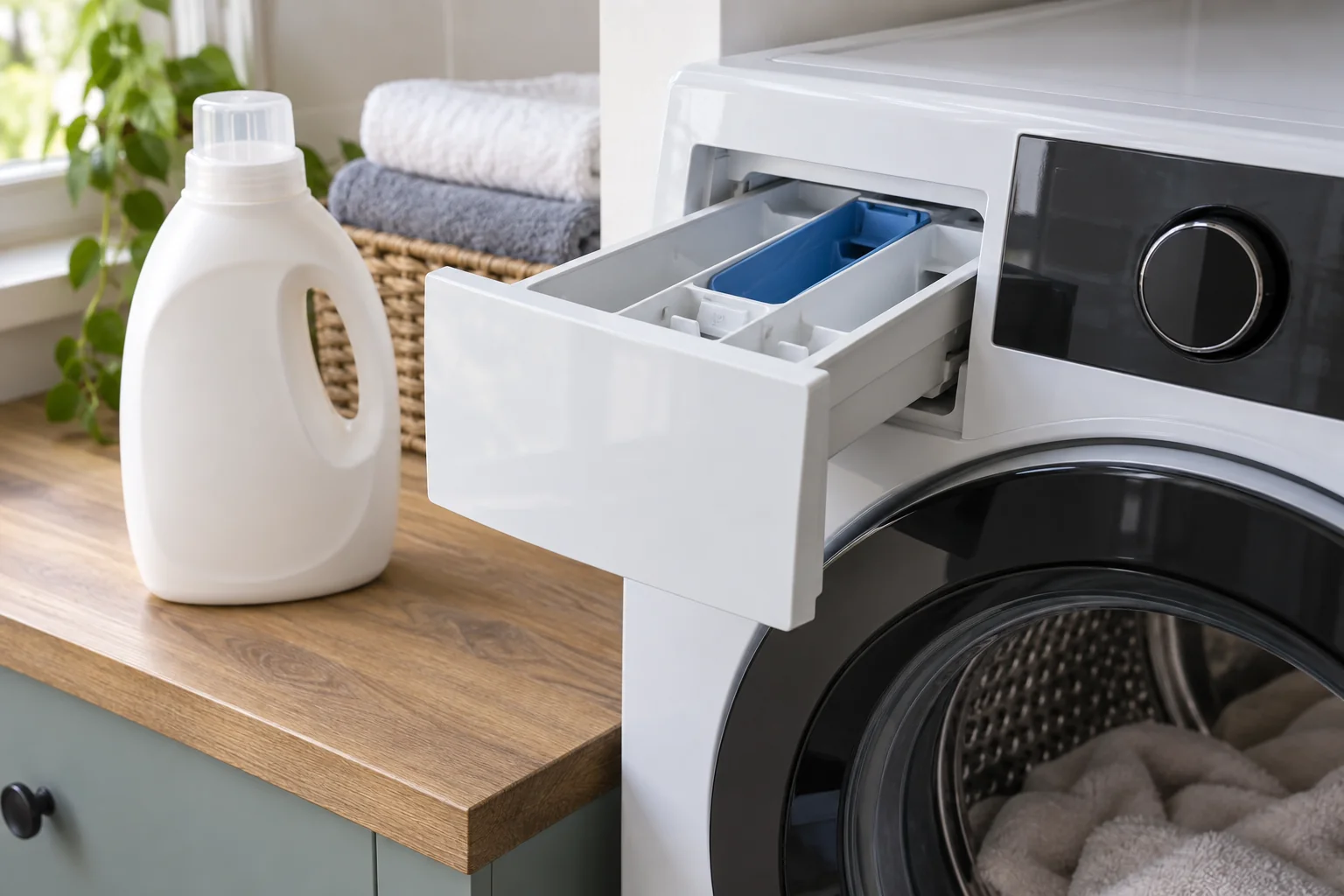
A washer’s auto-dose concentration setting should describe the detergent in its reservoir. It is different from a setting that increases or decreases the dose for a wash. Before changing either control, identify your model’s terms, read the exact detergent label and check which reservoir is active for the selected cycle.
Concentration and amount are different inputs
Concentration describes the formulation relative to the reference used by its labeling or the washer’s instructions. Dose describes how much the machine supplies. A stronger product and a larger dose are not interchangeable ways of requesting a more thorough wash. The machine needs correct product information before its other settings can be interpreted.
Samsung’s US auto-dispenser guidance illustrates this distinction on supported models: it describes separate dose options and concentration choices such as 1x, 2x and 3x. It distinguishes detergent from softener settings and notes that cycle availability varies. Use your exact model’s instructions; this is not a universal menu sequence for every Samsung washer or another brand.
Other machines may ask for a milliliter amount under defined conditions instead of an x-number. Do not convert between those systems by intuition. Identify the reference load, water conditions or other factors the setup actually requests.
Read the bottle before changing the screen
Record the full product name and formulation, not just the brand. Check that its type is allowed in the automatic reservoir. A front label may advertise a number of loads or use words such as “ultra”; those statements do not necessarily supply the concentration value your washer expects.
If the label gives only per-load milliliters, consult the washer’s setup guidance and detergent maker rather than assigning an x-number yourself. Photograph the dosing panel and any concentration statement. Do not infer concentration from bottle size, cap size, price or how thick the liquid looks.
Keep detergent and fabric softener information separate. Even where their controls look similar, the products and settings serve different purposes. Confirm the actual reservoir labels before refilling, particularly when another household member normally handles the laundry.
Build a refill record
| Question | What to write down | When unresolved |
|---|---|---|
| Which washer? | Model and manual section | Find the correct instructions |
| Which reservoir? | Detergent, softener or another approved role | Do not fill an unidentified compartment |
| Which product? | Full name, type and formulation | Keep the labeled bottle |
| What does setup ask? | Concentration, baseline dose or another value | Ask about the expected input |
| What does the label provide? | Exact statement and relevant conditions | Do not invent a conversion |
| What is selected? | Product setting, dose adjustment and cycle | Check before the next load |
Worked example: a new bottle needs a new check
Imagine a washer whose applicable manual offers 1x, 2x and 3x choices. Its currently approved detergent is explicitly labeled 2x, and the reservoir record says 2x. A replacement bottle from the same brand has a different formulation and no x-number on its label. The old setting is no longer verified just because the logo matches.
The owner saves the new label photo and asks how that formulation maps to this washer’s setup. Until resolved, they use only a dispensing method and product combination that the manual permits. They do not pour the new liquid over an unidentified remainder or assume that selecting the highest number is conservative.
This hypothetical example demonstrates a decision process. It does not establish that a particular brand’s 2x formula belongs on a specific machine setting, nor does it prescribe a replacement dose.
Avoid accidentally dosing twice
When switching to a manual compartment or another approved detergent format for one load, check how the model disables automatic dispensing. A reservoir containing detergent may remain active unless the correct option is changed. Follow instructions for both detergent and softener; turning off one does not necessarily turn off the other.
Keep a shared-household note stating the normal product and approved way to switch modes. Do not put pods, powders or an improvised diluted mixture into an automatic reservoir unless the exact model explicitly permits that product and method. Follow its cleaning procedure when changing products rather than mixing leftovers.
Investigate results without changing everything
If results seem wrong, first verify the record: product, setup value, active reservoir and cycle. Note any error or refill message exactly. Residue or smell alone does not identify the cause. Changing concentration, dose, cycle and detergent together makes it harder to learn which condition mattered.
Record the date of a permitted adjustment and what changed, keeping the other relevant settings visible. This is a household log, not a controlled performance test. Do not describe a single improved load as proof that a setting will work for every fabric, load size or water supply.
Use the model’s troubleshooting instructions for persistent dispensing problems. Your refill record gives support a useful starting point and makes the next product change deliberate rather than a guess based on the previous bottle.